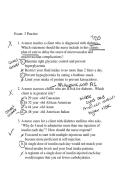
Exam 3 Practice
1. A nurse teaches a client who is diagnosed with diabetes.
Which statement should the nurse include in this clients
plan of care to delay the onset of microvascular and
macrovascular complications?
a. Maintain tight glycemic control and prevent
hyperglycemia
b. Restrict your fluid intake to no more than 2 liters a day.
c. Prevent hypoglycemia by eating a bedtime snack.
d. Limit your intake of protein to prevent ketoacidosis.
2. A nurse assesses clients who are at risk for diabetes. Which
client is at greatest risk?
a. A 29 year -old Caucasian
b. A 32 year -old African American
c. A 44 year -old Asian
d. A 48 year -old American Indian
3. A nurse cares for a client with diabetes mellitus who asks,
“Why do I need to administer more than one injection of
insulin each day”? How should the nurse respond?
a. You need to start with multiple injections until you
become more proficient at self-injection.
b. A single dose of insulin each day would not match your
blood insulin levels and your food intake patterns.
c. A regimen of a single dose of insulin injected each day
would require that you eat fewer carbohydrates.
, d. A single dose of insulin would be too large to be
absorbed, predictably putting you at risk for insulin
shock.
4. After teaching a client who has diabetes mellitus and
retinopathy, nephropathy, and peripheral neuropathy, the
nurse assesses the clients understanding. Which statement
made by the client indicates a correct understanding of the
teaching?
a. I have so many complications, exercising is not
recommended.
b. I will exercise more frequently because I have so many
complications.
c. I used to run for exercise, I will start training for a
marathon.
d. I should look into swimming or water aerobics to get my
exercise.
5. A nurse teaches a client with Type 1 diabetes. Which
statement should the nurse include in this clients teaching
to decrease the clients insulin needs?
a. Limit your fluid intake to 2 liters a day
b. Animal organ meat is high in insulin
c. Limit your carbohydrate intake to 80 grams a day
d. Walk at a moderate pace for 1 mile daily
6. A preoperative nurse assesses a client who has type 1
diabetes prior to a surgical procedure. The clients blood
glucose level is 160 mg/dL. Which action should the nurse
take?
a. Document the findings in the chart.
b. Administer a bolus of regular insulin IV.
c. Call the surgeon to cancel the procedure.
, d. Draw blood gasses to assess the metabolic state.
7. A nurse assesses a client with diabetes mellitus. Which
clinical manifestation should alert the nurse to decreased
kidney function in the client?
a. Urine specific gravity of 1.033
b. Presence of protein in the urine.
c. Elevated capillary blood glucose level.
d. Presence of ketone bodies in the urine.
8. A nurse teaches a client with diabetes about sick day
management. What statement should the nurse include in
this clients teaching?
a. When ill, avoid eating or drinking to reduce vomiting
and diarrhea
b. Monitor your blood glucose levels at least every 4 hours
while sick
c. If vomiting, do not use insulin or take your oral
antidiabetic agent
d. Try to continue your prescribed exercise regimen even if
you are sick
9. After teaching a client with type 2 diabetes, the nurse
assesses the clients understanding. Which statement made
by the client indicates a need for further additional
teaching?
a. I need to have an annual appointment even if my glucose
levels are in good control.
b. Since my diabetes is controlled with diet and exercise, I
must be seen only if I am sick.
c. I can still develop complications even though I do not
have to take insulin at this time.
d. If I have surgery or get very ill, I may have to receive
insulin injections for a short time.
1. A nurse teaches a client who is diagnosed with diabetes.
Which statement should the nurse include in this clients
plan of care to delay the onset of microvascular and
macrovascular complications?
a. Maintain tight glycemic control and prevent
hyperglycemia
b. Restrict your fluid intake to no more than 2 liters a day.
c. Prevent hypoglycemia by eating a bedtime snack.
d. Limit your intake of protein to prevent ketoacidosis.
2. A nurse assesses clients who are at risk for diabetes. Which
client is at greatest risk?
a. A 29 year -old Caucasian
b. A 32 year -old African American
c. A 44 year -old Asian
d. A 48 year -old American Indian
3. A nurse cares for a client with diabetes mellitus who asks,
“Why do I need to administer more than one injection of
insulin each day”? How should the nurse respond?
a. You need to start with multiple injections until you
become more proficient at self-injection.
b. A single dose of insulin each day would not match your
blood insulin levels and your food intake patterns.
c. A regimen of a single dose of insulin injected each day
would require that you eat fewer carbohydrates.
, d. A single dose of insulin would be too large to be
absorbed, predictably putting you at risk for insulin
shock.
4. After teaching a client who has diabetes mellitus and
retinopathy, nephropathy, and peripheral neuropathy, the
nurse assesses the clients understanding. Which statement
made by the client indicates a correct understanding of the
teaching?
a. I have so many complications, exercising is not
recommended.
b. I will exercise more frequently because I have so many
complications.
c. I used to run for exercise, I will start training for a
marathon.
d. I should look into swimming or water aerobics to get my
exercise.
5. A nurse teaches a client with Type 1 diabetes. Which
statement should the nurse include in this clients teaching
to decrease the clients insulin needs?
a. Limit your fluid intake to 2 liters a day
b. Animal organ meat is high in insulin
c. Limit your carbohydrate intake to 80 grams a day
d. Walk at a moderate pace for 1 mile daily
6. A preoperative nurse assesses a client who has type 1
diabetes prior to a surgical procedure. The clients blood
glucose level is 160 mg/dL. Which action should the nurse
take?
a. Document the findings in the chart.
b. Administer a bolus of regular insulin IV.
c. Call the surgeon to cancel the procedure.
, d. Draw blood gasses to assess the metabolic state.
7. A nurse assesses a client with diabetes mellitus. Which
clinical manifestation should alert the nurse to decreased
kidney function in the client?
a. Urine specific gravity of 1.033
b. Presence of protein in the urine.
c. Elevated capillary blood glucose level.
d. Presence of ketone bodies in the urine.
8. A nurse teaches a client with diabetes about sick day
management. What statement should the nurse include in
this clients teaching?
a. When ill, avoid eating or drinking to reduce vomiting
and diarrhea
b. Monitor your blood glucose levels at least every 4 hours
while sick
c. If vomiting, do not use insulin or take your oral
antidiabetic agent
d. Try to continue your prescribed exercise regimen even if
you are sick
9. After teaching a client with type 2 diabetes, the nurse
assesses the clients understanding. Which statement made
by the client indicates a need for further additional
teaching?
a. I need to have an annual appointment even if my glucose
levels are in good control.
b. Since my diabetes is controlled with diet and exercise, I
must be seen only if I am sick.
c. I can still develop complications even though I do not
have to take insulin at this time.
d. If I have surgery or get very ill, I may have to receive
insulin injections for a short time.