
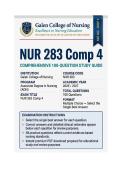
,NUR 283 Comp 4 Exam | Transition to RN Practice
(2026/2027) PDF | Nursing | Galen
1. A client who had an ERCP 30 minutes ago reports difficulty swallowing. Which
action should the nurse take first?
A) Assess airway and swallowing function immediately
B) Offer oral fluids
C) Document the finding
D) Notify the family
Correct Answer: A) Assess airway and swallowing function immediately
Rationale: Airway compromise is the priority after ERCP because the gag reflex
may be absent, increasing aspiration risk. Immediate assessment of airway and
swallowing is essential. Offering fluids or documenting delays safety.
2. The nurse receives a hand-off report on a pediatric unit. Which client should
be seen first?
A) A toddler with bronchiolitis on room air and mild wheezing
B) An infant with pertussis receiving oxygen via nasal cannula
C) A preschooler with otitis media awaiting discharge
D) A school-age child with a simple fracture in a cast
Correct Answer: B) An infant with pertussis receiving oxygen via nasal cannula
,Rationale: Infants with pertussis are at high risk for apnea and severe
respiratory compromise. Any client on supplemental oxygen with a respiratory
diagnosis is a priority over stable conditions.
3. The charge nurse is making assignments on a medical-surgical unit. Which
client should be assigned to the most experienced RN?
A) A client with a urinary tract infection on oral antibiotics
B) A client who is 2 days post-op and ambulating independently
C) A client with a newly placed tracheostomy
D) A client requiring discharge teaching
Correct Answer: C) A client with a newly placed tracheostomy
Rationale: A newly placed tracheostomy requires complex airway management
and assessment skills. The most experienced nurse should care for this client.
The other clients have stable, predictable conditions.
4. A client has a do-not-resuscitate order. Which action is most appropriate?
A) Perform CPR if the client's heart stops
B) Ask the family for permission to perform CPR
C) Call a code blue if the client stops breathing
D) Respect the do-not-resuscitate order and not initiate CPR
Correct Answer: D) Respect the do-not-resuscitate order and not initiate CPR
, Rationale: A do-not-resuscitate order means CPR should not be initiated. The
nurse must honor this order and focus on comfort measures.
5. A graduate RN asks about the difference between NCLEX and nursing
residency. Which response by the preceptor is most accurate?
A) NCLEX only tests minimum competency; residency builds clinical reasoning
and leadership skills for safe, autonomous RN practice.
B) NCLEX tests everything needed; residency is optional.
C) NCLEX is for practical nurses; residency is for registered nurses.
D) NCLEX is a written test; residency is a clinical test.
Correct Answer: A) NCLEX only tests minimum competency; residency builds
clinical reasoning and leadership skills for safe, autonomous RN practice.
Rationale: The NCLEX tests minimum entry-level competency. Residency
programs develop the clinical reasoning, leadership, and autonomous skills
required for safe independent RN practice.
6. A nurse is delegating a task to unlicensed assistive personnel. Which task can
the RN safely delegate?
A) Performing an initial assessment on a new admission
B) Ambulating a stable client
C) Developing a plan of care
D) Evaluating the effectiveness of pain medication
Correct Answer: B) Ambulating a stable client
(2026/2027) PDF | Nursing | Galen
1. A client who had an ERCP 30 minutes ago reports difficulty swallowing. Which
action should the nurse take first?
A) Assess airway and swallowing function immediately
B) Offer oral fluids
C) Document the finding
D) Notify the family
Correct Answer: A) Assess airway and swallowing function immediately
Rationale: Airway compromise is the priority after ERCP because the gag reflex
may be absent, increasing aspiration risk. Immediate assessment of airway and
swallowing is essential. Offering fluids or documenting delays safety.
2. The nurse receives a hand-off report on a pediatric unit. Which client should
be seen first?
A) A toddler with bronchiolitis on room air and mild wheezing
B) An infant with pertussis receiving oxygen via nasal cannula
C) A preschooler with otitis media awaiting discharge
D) A school-age child with a simple fracture in a cast
Correct Answer: B) An infant with pertussis receiving oxygen via nasal cannula
,Rationale: Infants with pertussis are at high risk for apnea and severe
respiratory compromise. Any client on supplemental oxygen with a respiratory
diagnosis is a priority over stable conditions.
3. The charge nurse is making assignments on a medical-surgical unit. Which
client should be assigned to the most experienced RN?
A) A client with a urinary tract infection on oral antibiotics
B) A client who is 2 days post-op and ambulating independently
C) A client with a newly placed tracheostomy
D) A client requiring discharge teaching
Correct Answer: C) A client with a newly placed tracheostomy
Rationale: A newly placed tracheostomy requires complex airway management
and assessment skills. The most experienced nurse should care for this client.
The other clients have stable, predictable conditions.
4. A client has a do-not-resuscitate order. Which action is most appropriate?
A) Perform CPR if the client's heart stops
B) Ask the family for permission to perform CPR
C) Call a code blue if the client stops breathing
D) Respect the do-not-resuscitate order and not initiate CPR
Correct Answer: D) Respect the do-not-resuscitate order and not initiate CPR
, Rationale: A do-not-resuscitate order means CPR should not be initiated. The
nurse must honor this order and focus on comfort measures.
5. A graduate RN asks about the difference between NCLEX and nursing
residency. Which response by the preceptor is most accurate?
A) NCLEX only tests minimum competency; residency builds clinical reasoning
and leadership skills for safe, autonomous RN practice.
B) NCLEX tests everything needed; residency is optional.
C) NCLEX is for practical nurses; residency is for registered nurses.
D) NCLEX is a written test; residency is a clinical test.
Correct Answer: A) NCLEX only tests minimum competency; residency builds
clinical reasoning and leadership skills for safe, autonomous RN practice.
Rationale: The NCLEX tests minimum entry-level competency. Residency
programs develop the clinical reasoning, leadership, and autonomous skills
required for safe independent RN practice.
6. A nurse is delegating a task to unlicensed assistive personnel. Which task can
the RN safely delegate?
A) Performing an initial assessment on a new admission
B) Ambulating a stable client
C) Developing a plan of care
D) Evaluating the effectiveness of pain medication
Correct Answer: B) Ambulating a stable client


