
RDHAP Law and Ethics Exam Prep - 2026/2027 Update Page 1
RDHAP Law and Ethics Exam Prep
CALIFORNIA REGISTERED DENTAL HYGIENIST IN ALTERNATIVE PRACTICE
LATEST UPDATE - 100% VERIFIED ANSWERS
Aligned with current California BPC, CCR, and Dental Hygiene Board Regulations
50 Questions with Verified Answers and Comprehensive Law & Ethics Rationales
60-Minute Time Limit - Mirroring Actual Examination Format
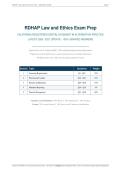
Section Topic Questions Weight
1 Licensing Requirements Q1 - Q15 30%
2 Professional Conduct Q16 - Q23 16%
3 Patient Confidentiality Q24 - Q28 10%
4 Mandated Reporting Q29 - Q30 4%
5 Practice Management Q31 - Q50 40%
Cognitive Level Distribution: 30% Recall | 50% Application | 20% Analysis
Format: 70% scenario-based | 30% direct recall / statutory identification
California RDHAP Law and Ethics Examination - 60 Minute Time
Aligned
Limit with 2026/2027 BPC, CCR, and Dental Hygiene Board Regulations
,RDHAP Law and Ethics Exam Prep - 2026/2027 Update Page 2
SECTION 1: Licensing Requirements
License Maintenance, Renewal, Restoration, Continuing Education, Citations, and Disciplinary Actions.
Q1: A Registered Dental Hygienist in Alternative Practice (RDHAP) moves to a new residence. According
to California Business and Professions Code, within how many days must the RDHAP notify the Dental
Hygiene Board of California (DHBC) of the address change?
A. 10 days
B. 30 days [CORRECT]
C. 60 days
D. 90 days
Correct Answer: B
Rationale: Per BPC 17520 and DHBC regulations, an RDHAP must notify the Board in writing within 30 days of any
address change. Failure to do so may result in citations and fines, and important licensing correspondence (including
renewal notices) may be missed, which does not excuse the licensee from renewal obligations. Option A is too short;
Options C and D exceed the statutory window and could lead to disciplinary action. Licensees should update addresses
promptly via the DHBC online portal to maintain compliance and ensure receipt of all Board communications.
Q2: An RDHAP is renewing their license for the first time. According to CCR Title 16, Section 1017, how
many continuing education units must be completed during the two-year renewal period, and which
mandatory subjects are required?
A. 15 units total, including 2 units in infection control and 2 units in California law
B. 25 units total, including 2 units in infection control, 2 units in California Dental Practice Act, and 2 units in child
abuse recognition and reporting
C. 25 units total for first renewal, including 2 units each in infection control, California Dental Practice Act, and
child abuse/neglect reporting; subsequent renewals require 25 units with mandatory subject minimums
[CORRECT]
D. 50 units total, with no specific subject requirements
Correct Answer: C
Rationale: CCR 1017 requires 25 CE units per renewal period. For the first renewal, RDHAPs must complete 2 units
each in infection control, California Dental Practice Act, and child abuse/neglect reporting; for subsequent renewals, the
same subject minimums apply along with 25 total units. Option A undercounts the required units. Option B incorrectly
omits the mandatory child abuse reporting course. Option D overstates units and omits mandatory subjects. Licensees
should retain CE certificates for at least 5 years for audit purposes.
California RDHAP Law and Ethics Examination - 60 Minute Time
Aligned
Limit with 2026/2027 BPC, CCR, and Dental Hygiene Board Regulations
, RDHAP Law and Ethics Exam Prep - 2026/2027 Update Page 3
Q3: An RDHAP's license expired six months ago. They wish to restore the license to active status. Which
process must they follow per BPC 1911 and DHBC regulations?
A. Simply pay the renewal fee; the license will be automatically restored
B. Submit a restoration application, pay all past-due renewal fees plus a restoration fee, complete continuing
education requirements, and confirm no disqualifying disciplinary history [CORRECT]
C. Apply as a new applicant and retake the clinical board examination
D. Wait one full year before applying for restoration
Correct Answer: B
Rationale: Per BPC 1911, restoration of an expired RDHAP license requires submission of a restoration application,
payment of all delinquent fees, completion of required CE, and verification that the applicant has not engaged in
unlicensed practice during the lapse. Option A is incorrect; restoration is not automatic. Option C is generally not
required unless the lapse exceeds the statutory grace period (typically 5 years). Option D is incorrect; no mandatory
waiting period exists. Practicing with an expired license constitutes unlicensed activity under BPC 1950.5 and may result
in disciplinary action.
Q4: An RDHAP receives a citation from the DHBC for a minor violation. The citation includes a $500
administrative fine. Which statement about the citation process is CORRECT under BPC 125.9?
A. The RDHAP must immediately surrender their license while the citation is pending
B. A citation is an administrative action that may be issued for minor violations; the RDHAP may pay the fine or
request an informal hearing to contest the citation [CORRECT]
C. Paying the fine constitutes an admission of unprofessional conduct and triggers automatic license revocation
D. Citations may only be issued after a formal disciplinary hearing
Correct Answer: B
Rationale: BPC 125.9 authorizes the DHBC to issue citations and administrative fines for minor violations without
formal disciplinary proceedings. The cited licensee may pay the fine (without admission of guilt) or request an informal
hearing to contest. Option A is incorrect; citations do not require license surrender. Option C mischaracterizes the
effect—paying the fine resolves the citation but does not constitute discipline or trigger revocation. Option D is incorrect;
citations may be issued without a formal hearing, which is the efficiency purpose of the citation system. Multiple
citations for the same violation may escalate to formal discipline.
Q5: The DHBC places an RDHAP on probation for unprofessional conduct. Which of the following is NOT
a typical condition of probation under BPC 1965?
A. Submission to random drug and alcohol testing
B. Completion of additional continuing education hours
C. Suspension of all licensure privileges for the entire probation period with no practice permitted [CORRECT]
D. Quarterly reports from a practice monitor or supervisor
Correct Answer: C
Rationale: Probation under BPC 1965 typically includes conditions such as additional CE, practice monitoring,
supervision requirements, psychological evaluation, and drug testing. Probation may include a brief suspension period at
the start (e.g., 30 days) but generally permits supervised practice with conditions for the remainder; Option C incorrectly
assumes the entire probation period involves full suspension, which would effectively be revocation. Options A, B, and D
are all common probation conditions. Violation of probation terms may result in further discipline, including revocation.
Licensees should consult a license defense attorney before signing stipulated probation agreements.
California RDHAP Law and Ethics Examination - 60 Minute Time
Aligned
Limit with 2026/2027 BPC, CCR, and Dental Hygiene Board Regulations
RDHAP Law and Ethics Exam Prep
CALIFORNIA REGISTERED DENTAL HYGIENIST IN ALTERNATIVE PRACTICE
LATEST UPDATE - 100% VERIFIED ANSWERS
Aligned with current California BPC, CCR, and Dental Hygiene Board Regulations
50 Questions with Verified Answers and Comprehensive Law & Ethics Rationales
60-Minute Time Limit - Mirroring Actual Examination Format
Section Topic Questions Weight
1 Licensing Requirements Q1 - Q15 30%
2 Professional Conduct Q16 - Q23 16%
3 Patient Confidentiality Q24 - Q28 10%
4 Mandated Reporting Q29 - Q30 4%
5 Practice Management Q31 - Q50 40%
Cognitive Level Distribution: 30% Recall | 50% Application | 20% Analysis
Format: 70% scenario-based | 30% direct recall / statutory identification
California RDHAP Law and Ethics Examination - 60 Minute Time
Aligned
Limit with 2026/2027 BPC, CCR, and Dental Hygiene Board Regulations
,RDHAP Law and Ethics Exam Prep - 2026/2027 Update Page 2
SECTION 1: Licensing Requirements
License Maintenance, Renewal, Restoration, Continuing Education, Citations, and Disciplinary Actions.
Q1: A Registered Dental Hygienist in Alternative Practice (RDHAP) moves to a new residence. According
to California Business and Professions Code, within how many days must the RDHAP notify the Dental
Hygiene Board of California (DHBC) of the address change?
A. 10 days
B. 30 days [CORRECT]
C. 60 days
D. 90 days
Correct Answer: B
Rationale: Per BPC 17520 and DHBC regulations, an RDHAP must notify the Board in writing within 30 days of any
address change. Failure to do so may result in citations and fines, and important licensing correspondence (including
renewal notices) may be missed, which does not excuse the licensee from renewal obligations. Option A is too short;
Options C and D exceed the statutory window and could lead to disciplinary action. Licensees should update addresses
promptly via the DHBC online portal to maintain compliance and ensure receipt of all Board communications.
Q2: An RDHAP is renewing their license for the first time. According to CCR Title 16, Section 1017, how
many continuing education units must be completed during the two-year renewal period, and which
mandatory subjects are required?
A. 15 units total, including 2 units in infection control and 2 units in California law
B. 25 units total, including 2 units in infection control, 2 units in California Dental Practice Act, and 2 units in child
abuse recognition and reporting
C. 25 units total for first renewal, including 2 units each in infection control, California Dental Practice Act, and
child abuse/neglect reporting; subsequent renewals require 25 units with mandatory subject minimums
[CORRECT]
D. 50 units total, with no specific subject requirements
Correct Answer: C
Rationale: CCR 1017 requires 25 CE units per renewal period. For the first renewal, RDHAPs must complete 2 units
each in infection control, California Dental Practice Act, and child abuse/neglect reporting; for subsequent renewals, the
same subject minimums apply along with 25 total units. Option A undercounts the required units. Option B incorrectly
omits the mandatory child abuse reporting course. Option D overstates units and omits mandatory subjects. Licensees
should retain CE certificates for at least 5 years for audit purposes.
California RDHAP Law and Ethics Examination - 60 Minute Time
Aligned
Limit with 2026/2027 BPC, CCR, and Dental Hygiene Board Regulations
, RDHAP Law and Ethics Exam Prep - 2026/2027 Update Page 3
Q3: An RDHAP's license expired six months ago. They wish to restore the license to active status. Which
process must they follow per BPC 1911 and DHBC regulations?
A. Simply pay the renewal fee; the license will be automatically restored
B. Submit a restoration application, pay all past-due renewal fees plus a restoration fee, complete continuing
education requirements, and confirm no disqualifying disciplinary history [CORRECT]
C. Apply as a new applicant and retake the clinical board examination
D. Wait one full year before applying for restoration
Correct Answer: B
Rationale: Per BPC 1911, restoration of an expired RDHAP license requires submission of a restoration application,
payment of all delinquent fees, completion of required CE, and verification that the applicant has not engaged in
unlicensed practice during the lapse. Option A is incorrect; restoration is not automatic. Option C is generally not
required unless the lapse exceeds the statutory grace period (typically 5 years). Option D is incorrect; no mandatory
waiting period exists. Practicing with an expired license constitutes unlicensed activity under BPC 1950.5 and may result
in disciplinary action.
Q4: An RDHAP receives a citation from the DHBC for a minor violation. The citation includes a $500
administrative fine. Which statement about the citation process is CORRECT under BPC 125.9?
A. The RDHAP must immediately surrender their license while the citation is pending
B. A citation is an administrative action that may be issued for minor violations; the RDHAP may pay the fine or
request an informal hearing to contest the citation [CORRECT]
C. Paying the fine constitutes an admission of unprofessional conduct and triggers automatic license revocation
D. Citations may only be issued after a formal disciplinary hearing
Correct Answer: B
Rationale: BPC 125.9 authorizes the DHBC to issue citations and administrative fines for minor violations without
formal disciplinary proceedings. The cited licensee may pay the fine (without admission of guilt) or request an informal
hearing to contest. Option A is incorrect; citations do not require license surrender. Option C mischaracterizes the
effect—paying the fine resolves the citation but does not constitute discipline or trigger revocation. Option D is incorrect;
citations may be issued without a formal hearing, which is the efficiency purpose of the citation system. Multiple
citations for the same violation may escalate to formal discipline.
Q5: The DHBC places an RDHAP on probation for unprofessional conduct. Which of the following is NOT
a typical condition of probation under BPC 1965?
A. Submission to random drug and alcohol testing
B. Completion of additional continuing education hours
C. Suspension of all licensure privileges for the entire probation period with no practice permitted [CORRECT]
D. Quarterly reports from a practice monitor or supervisor
Correct Answer: C
Rationale: Probation under BPC 1965 typically includes conditions such as additional CE, practice monitoring,
supervision requirements, psychological evaluation, and drug testing. Probation may include a brief suspension period at
the start (e.g., 30 days) but generally permits supervised practice with conditions for the remainder; Option C incorrectly
assumes the entire probation period involves full suspension, which would effectively be revocation. Options A, B, and D
are all common probation conditions. Violation of probation terms may result in further discipline, including revocation.
Licensees should consult a license defense attorney before signing stipulated probation agreements.
California RDHAP Law and Ethics Examination - 60 Minute Time
Aligned
Limit with 2026/2027 BPC, CCR, and Dental Hygiene Board Regulations


