

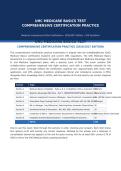
UHC MEDICARE BASICS TEST
COMPREHENSIVE CERTIFICATION PRACTICE
Medicare Compliance & Plan Certification • 2026/2027 Edition • 200 Questions
UHC MEDICARE BASICS TEST
COMPREHENSIVE CERTIFICATION PRACTICE (2026/2027 EDITION)
This comprehensive certification practice examination is aligned with the UnitedHealthcare (UHC)
Medicare Basics certification blueprint and current CMS regulations. The UHC Medicare Basics
Assessment is a required certification for agents selling UnitedHealthcare Medicare Advantage, Part
D, and Medicare Supplement plans, with a passing score of 85%. This exam contains 200
multiple-choice questions organized into eight sections, each with a complete rationale for the
correct answer. Coverage reflects the certification cognitive mix: approximately 30% recall, 50%
application, and 20% analysis. Questions emphasize clinical and compliance scenarios (≈75%)
alongside direct knowledge items (≈25%), with four options (A–D) and exactly one correct response
per item.
Section Topic Questions
Section 1 Medicare Basics & Eligibility – Parts A, B, C, D, Eligibility Criteria, Automatic Enrollment
30
Section 2 Medicare Advantage (MA) Plans – Part C, HMO/PPO/POS/PFFS/SNPs, Network Characteristics,
35 MOOP
Section 3 Medicare Supplement Insurance (Medigap) – Open Enrollment, Guaranteed Issue,
25 MACRA Impact, Underwritin
Section 4 Prescription Drug Coverage (Part D) – Formulary, UM Rules, LEP, LIS, IRA 202530
Changes
Section 5 MA vs. Medigap – Key Differences, Switching Rules, Automatic Disenrollment 20
Section 6 Enrollment Periods & Procedures – IEP, AEP, SEPs, Valid Election Periods 20
Section 7 Compliance & Ethics – Agent Conduct, Educational vs. Marketing Events, Food/Giveaway
20 Rules, Lead Cards
Section 8 Integrated Scenario-Based Questions – Complex Medicare Scenarios 20
TOTAL 200
How to use this exam: Work through the sections in order, marking your answers. Each item shows
four options (A–D) with exactly one correct response, followed by the answer and a rationale. A
consolidated answer key appears at the end for quick scoring. Aim for at least 85% correct (170 of
200) to mirror the UHC Medicare Basics passing standard.
,UHC MEDICARE BASICS TEST Comprehensive Certification Practice (2026/2027)
Section 1: Medicare Basics & Eligibility – Parts A, B, C, D, Eligibility Criteria,
Automatic Enrollment
Q1: Which federal agency administers the Medicare program?
A. The Social Security Administration
B. The Centers for Medicare & Medicaid Services (CMS) [CORRECT]
C. The Department of Veterans Affairs
D. The Federal Trade Commission
Correct Answer: B
Rationale: CMS administers Medicare. The Social Security Administration handles enrollment, not program
administration.
Q2: Medicare Part A (Hospital Insurance) covers which of the following?
A. Inpatient hospital stays, skilled nursing facility care, hospice, and some home health care [CORRECT]
B. Routine outpatient doctor visits only
C. Self-administered prescription drugs
D. Routine dental and vision services
Correct Answer: A
Rationale: Part A covers inpatient hospital, skilled nursing facility, hospice, and some home health services.
Q3: Medicare Part A is funded primarily through:
A. Beneficiary monthly premiums only
B. Payroll taxes [CORRECT]
C. State sales taxes
D. Private insurance company premiums
Correct Answer: B
Rationale: Part A is funded primarily through payroll taxes paid by workers and employers.
Q4: Medicare Part B (Medical Insurance) covers:
A. Outpatient medical services, doctor visits, preventive care, durable medical equipment, and some
home health services [CORRECT]
B. Inpatient hospital stays only
C. Hospice care only
D. Custodial long-term care
Correct Answer: A
Rationale: Part B covers outpatient and physician services, preventive care, durable medical equipment, and
some home health.
Q5: Medicare Part B is funded through:
A. Beneficiary monthly premiums and general U.S. Treasury revenues [CORRECT]
B. Payroll taxes only
C. Private donations
D. State Medicaid funds
Correct Answer: A
Rationale: Part B is funded by beneficiary premiums combined with general U.S. Treasury revenues.
Page 2 of 38
,UHC MEDICARE BASICS TEST Comprehensive Certification Practice (2026/2027)
Q6: The combination of Medicare Part A and Part B is known as:
A. Original Medicare [CORRECT]
B. Medicare Advantage
C. Medigap
D. Medicaid
Correct Answer: A
Rationale: Original Medicare consists of Part A (hospital) and Part B (medical) together.
Q7: Which consumer is generally eligible for Medicare based on age?
A. Anyone age 65 or older [CORRECT]
B. Anyone age 50 or older
C. Anyone age 62 or older
D. Anyone age 70 or older
Correct Answer: A
Rationale: Age-based Medicare eligibility begins at age 65.
Q8: A consumer under age 65 may qualify for Medicare if they have received Social Security disability
benefits for at least:
A. 24 months [CORRECT]
B. 6 months
C. 12 months
D. 60 months
Correct Answer: A
Rationale: After 24 months of Social Security disability benefits, a consumer becomes eligible for Medicare
regardless of age.
Q9: Which condition qualifies a consumer of ANY age for Medicare?
A. End-stage renal disease (ESRD) or amyotrophic lateral sclerosis (ALS) [CORRECT]
B. Asthma
C. Hypertension
D. Type 2 diabetes
Correct Answer: A
Rationale: ESRD and ALS confer Medicare eligibility at any age.
Q10: For consumers already receiving Social Security benefits, enrollment in Medicare Parts A and B is
generally:
A. Automatic [CORRECT]
B. Never allowed
C. Available only after a medical exam
D. Only possible through a private insurer
Correct Answer: A
Rationale: Social Security beneficiaries are generally auto-enrolled in Parts A and B unless they choose to
delay.
Q11: Which service is NOT covered by Medicare Part A?
A. Routine physical exams [CORRECT]
B. Inpatient hospital stays
C. Hospice care
D. Skilled nursing facility care
Correct Answer: A
Rationale: Part A does not cover routine physical exams; it covers inpatient, skilled nursing, hospice, and some
home health.
Page 3 of 38
, UHC MEDICARE BASICS TEST Comprehensive Certification Practice (2026/2027)
Q12: Milton is turning 65 and already receives Social Security retirement benefits. What should the
agent explain about his Medicare enrollment?
A. He will generally be automatically enrolled in Medicare Parts A and B unless he chooses to delay
[CORRECT]
B. He must pass a medical examination first
C. He cannot enroll until age 67
D. He is automatically enrolled in Part D only
Correct Answer: A
Rationale: Receiving Social Security triggers automatic Part A and Part B enrollment unless the beneficiary opts
out.
Q13: A 58-year-old consumer has been diagnosed with ALS. The agent should explain that this
consumer:
A. Is eligible for Medicare at any age [CORRECT]
B. Must wait until age 65
C. Must wait 24 months after diagnosis
D. Is never eligible for Medicare
Correct Answer: A
Rationale: ALS confers immediate Medicare eligibility at any age.
Q14: A 55-year-old consumer has received Social Security disability benefits for 30 months. Is this
consumer eligible for Medicare?
A. Yes, because eligibility begins after 24 months of disability benefits [CORRECT]
B. No, they must be 65
C. Only after 5 years of benefits
D. Only for Part D
Correct Answer: A
Rationale: Medicare eligibility begins after 24 months of Social Security disability benefits, which has been
exceeded.
Q15: A 45-year-old consumer has end-stage renal disease and requires dialysis. The agent should
explain that this consumer:
A. Is eligible for Medicare at any age due to ESRD [CORRECT]
B. Must wait until age 65
C. Cannot receive Medicare
D. Is eligible only for Part D
Correct Answer: A
Rationale: ESRD confers Medicare eligibility at any age for consumers requiring dialysis or transplant.
Q16: Most consumers receive Medicare Part A premium-free if:
A. They or their spouse paid Medicare taxes for at least 40 quarters (10 years) [CORRECT]
B. They hold any job
C. They are over age 50
D. They enroll in Part D
Correct Answer: A
Rationale: Forty quarters of Medicare-covered employment qualify the beneficiary for premium-free Part A.
Page 4 of 38
COMPREHENSIVE CERTIFICATION PRACTICE
Medicare Compliance & Plan Certification • 2026/2027 Edition • 200 Questions
UHC MEDICARE BASICS TEST
COMPREHENSIVE CERTIFICATION PRACTICE (2026/2027 EDITION)
This comprehensive certification practice examination is aligned with the UnitedHealthcare (UHC)
Medicare Basics certification blueprint and current CMS regulations. The UHC Medicare Basics
Assessment is a required certification for agents selling UnitedHealthcare Medicare Advantage, Part
D, and Medicare Supplement plans, with a passing score of 85%. This exam contains 200
multiple-choice questions organized into eight sections, each with a complete rationale for the
correct answer. Coverage reflects the certification cognitive mix: approximately 30% recall, 50%
application, and 20% analysis. Questions emphasize clinical and compliance scenarios (≈75%)
alongside direct knowledge items (≈25%), with four options (A–D) and exactly one correct response
per item.
Section Topic Questions
Section 1 Medicare Basics & Eligibility – Parts A, B, C, D, Eligibility Criteria, Automatic Enrollment
30
Section 2 Medicare Advantage (MA) Plans – Part C, HMO/PPO/POS/PFFS/SNPs, Network Characteristics,
35 MOOP
Section 3 Medicare Supplement Insurance (Medigap) – Open Enrollment, Guaranteed Issue,
25 MACRA Impact, Underwritin
Section 4 Prescription Drug Coverage (Part D) – Formulary, UM Rules, LEP, LIS, IRA 202530
Changes
Section 5 MA vs. Medigap – Key Differences, Switching Rules, Automatic Disenrollment 20
Section 6 Enrollment Periods & Procedures – IEP, AEP, SEPs, Valid Election Periods 20
Section 7 Compliance & Ethics – Agent Conduct, Educational vs. Marketing Events, Food/Giveaway
20 Rules, Lead Cards
Section 8 Integrated Scenario-Based Questions – Complex Medicare Scenarios 20
TOTAL 200
How to use this exam: Work through the sections in order, marking your answers. Each item shows
four options (A–D) with exactly one correct response, followed by the answer and a rationale. A
consolidated answer key appears at the end for quick scoring. Aim for at least 85% correct (170 of
200) to mirror the UHC Medicare Basics passing standard.
,UHC MEDICARE BASICS TEST Comprehensive Certification Practice (2026/2027)
Section 1: Medicare Basics & Eligibility – Parts A, B, C, D, Eligibility Criteria,
Automatic Enrollment
Q1: Which federal agency administers the Medicare program?
A. The Social Security Administration
B. The Centers for Medicare & Medicaid Services (CMS) [CORRECT]
C. The Department of Veterans Affairs
D. The Federal Trade Commission
Correct Answer: B
Rationale: CMS administers Medicare. The Social Security Administration handles enrollment, not program
administration.
Q2: Medicare Part A (Hospital Insurance) covers which of the following?
A. Inpatient hospital stays, skilled nursing facility care, hospice, and some home health care [CORRECT]
B. Routine outpatient doctor visits only
C. Self-administered prescription drugs
D. Routine dental and vision services
Correct Answer: A
Rationale: Part A covers inpatient hospital, skilled nursing facility, hospice, and some home health services.
Q3: Medicare Part A is funded primarily through:
A. Beneficiary monthly premiums only
B. Payroll taxes [CORRECT]
C. State sales taxes
D. Private insurance company premiums
Correct Answer: B
Rationale: Part A is funded primarily through payroll taxes paid by workers and employers.
Q4: Medicare Part B (Medical Insurance) covers:
A. Outpatient medical services, doctor visits, preventive care, durable medical equipment, and some
home health services [CORRECT]
B. Inpatient hospital stays only
C. Hospice care only
D. Custodial long-term care
Correct Answer: A
Rationale: Part B covers outpatient and physician services, preventive care, durable medical equipment, and
some home health.
Q5: Medicare Part B is funded through:
A. Beneficiary monthly premiums and general U.S. Treasury revenues [CORRECT]
B. Payroll taxes only
C. Private donations
D. State Medicaid funds
Correct Answer: A
Rationale: Part B is funded by beneficiary premiums combined with general U.S. Treasury revenues.
Page 2 of 38
,UHC MEDICARE BASICS TEST Comprehensive Certification Practice (2026/2027)
Q6: The combination of Medicare Part A and Part B is known as:
A. Original Medicare [CORRECT]
B. Medicare Advantage
C. Medigap
D. Medicaid
Correct Answer: A
Rationale: Original Medicare consists of Part A (hospital) and Part B (medical) together.
Q7: Which consumer is generally eligible for Medicare based on age?
A. Anyone age 65 or older [CORRECT]
B. Anyone age 50 or older
C. Anyone age 62 or older
D. Anyone age 70 or older
Correct Answer: A
Rationale: Age-based Medicare eligibility begins at age 65.
Q8: A consumer under age 65 may qualify for Medicare if they have received Social Security disability
benefits for at least:
A. 24 months [CORRECT]
B. 6 months
C. 12 months
D. 60 months
Correct Answer: A
Rationale: After 24 months of Social Security disability benefits, a consumer becomes eligible for Medicare
regardless of age.
Q9: Which condition qualifies a consumer of ANY age for Medicare?
A. End-stage renal disease (ESRD) or amyotrophic lateral sclerosis (ALS) [CORRECT]
B. Asthma
C. Hypertension
D. Type 2 diabetes
Correct Answer: A
Rationale: ESRD and ALS confer Medicare eligibility at any age.
Q10: For consumers already receiving Social Security benefits, enrollment in Medicare Parts A and B is
generally:
A. Automatic [CORRECT]
B. Never allowed
C. Available only after a medical exam
D. Only possible through a private insurer
Correct Answer: A
Rationale: Social Security beneficiaries are generally auto-enrolled in Parts A and B unless they choose to
delay.
Q11: Which service is NOT covered by Medicare Part A?
A. Routine physical exams [CORRECT]
B. Inpatient hospital stays
C. Hospice care
D. Skilled nursing facility care
Correct Answer: A
Rationale: Part A does not cover routine physical exams; it covers inpatient, skilled nursing, hospice, and some
home health.
Page 3 of 38
, UHC MEDICARE BASICS TEST Comprehensive Certification Practice (2026/2027)
Q12: Milton is turning 65 and already receives Social Security retirement benefits. What should the
agent explain about his Medicare enrollment?
A. He will generally be automatically enrolled in Medicare Parts A and B unless he chooses to delay
[CORRECT]
B. He must pass a medical examination first
C. He cannot enroll until age 67
D. He is automatically enrolled in Part D only
Correct Answer: A
Rationale: Receiving Social Security triggers automatic Part A and Part B enrollment unless the beneficiary opts
out.
Q13: A 58-year-old consumer has been diagnosed with ALS. The agent should explain that this
consumer:
A. Is eligible for Medicare at any age [CORRECT]
B. Must wait until age 65
C. Must wait 24 months after diagnosis
D. Is never eligible for Medicare
Correct Answer: A
Rationale: ALS confers immediate Medicare eligibility at any age.
Q14: A 55-year-old consumer has received Social Security disability benefits for 30 months. Is this
consumer eligible for Medicare?
A. Yes, because eligibility begins after 24 months of disability benefits [CORRECT]
B. No, they must be 65
C. Only after 5 years of benefits
D. Only for Part D
Correct Answer: A
Rationale: Medicare eligibility begins after 24 months of Social Security disability benefits, which has been
exceeded.
Q15: A 45-year-old consumer has end-stage renal disease and requires dialysis. The agent should
explain that this consumer:
A. Is eligible for Medicare at any age due to ESRD [CORRECT]
B. Must wait until age 65
C. Cannot receive Medicare
D. Is eligible only for Part D
Correct Answer: A
Rationale: ESRD confers Medicare eligibility at any age for consumers requiring dialysis or transplant.
Q16: Most consumers receive Medicare Part A premium-free if:
A. They or their spouse paid Medicare taxes for at least 40 quarters (10 years) [CORRECT]
B. They hold any job
C. They are over age 50
D. They enroll in Part D
Correct Answer: A
Rationale: Forty quarters of Medicare-covered employment qualify the beneficiary for premium-free Part A.
Page 4 of 38


