

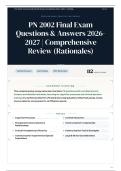
PN 2002 FINAL EXAM QUESTIONS & ANSWERS 2026-2027 | COMPR… EXAM
P R O F E S S I O N A L P R A C T I C E M AT E R I A L S
PN 2002 Final Exam
Questions & Answers 2026-
2027 | Comprehensive
Review (Rationales)
Verified Answers Exam Ready With Rationales 112 QUESTIONS
DOCUMENT OVERVIEW
This comprehensive review document contains 112 questions with provided correct
answers and detailed rationales, focusing on cognitive processes and clinical decision-
making. It is perfectly suited for LPN students and graduates to effectively study, review
course material, and prepare for certification exams.
TOPICS
• Cognitive Processes • Conflict Resolution
• Therapeutic Communication & • Communication Fundamentals
Relationships
• Cultural Competency & Diversity • Communication Tools & Strategies
• Communication Impairments & Special • Legal & Ethical Considerations
Populations
Page 1
, E XA M Q U EST I O N S
Q1 QUESTION 1 OF 112
Perception
CORRECT ANSWER
a cognitive process by which a person transforms external sensory data into personalized
images of reality
RATIONALE
Perception is the cognitive process by which the brain interprets sensory information from the
environment. This interpretation is not a passive reception of data but an active construction of
reality, influenced by an individual's past experiences, beliefs, and expectations.
Q2 QUESTION 2 OF 112
Problem solving
CORRECT ANSWER
a comprehensive, sequential, cognitive process used to solve a problem by reducing the
difference between current and desired condit
RATIONALE
Problem-solving is a cognitive process that involves a series of steps to address a challenge. It is
characterized by its systematic nature, moving from identifying the current situation to defining
the desired outcome.
Q3 QUESTION 3 OF 112
Problem solving process- scientific method
Page 2
, CORRECT ANSWER
· Define the problem
· Gather data
· Analyze data
· Develop solutions
· Implement solutions
· Evaluate solutions
RATIONALE
The scientific method is a systematic approach to problem-solving that begins with clearly
defining the issue at hand. This is followed by the crucial step of gathering relevant data to
understand the situation fully.
Q4 QUESTION 4 OF 112
Decision-making
CORRECT ANSWER
is a process that chooses a preferred option or course of actions from among a set of
alternatives based on given criteria or strategies.
RATIONALE
Decision-making involves evaluating various options against established criteria to select the most
suitable one. This selection process aims to achieve a specific outcome or goal.
Q5 QUESTION 5 OF 112
Decision Making Process
CORRECT ANSWER
· Define problem
· Set goals/ identify evaluation criteria
· Identify alternatives for each outcome.
· Evaluate alternatives for each outcome
Choose the preferred alternative
Page 3
, RATIONALE
The decision-making process is a structured approach to problem-solving that begins with clearly
defining the problem. It then involves establishing specific goals or criteria against which potential
solutions will be measured.
Q6 QUESTION 6 OF 112
Critical Thinking
CORRECT ANSWER
analytical process in which you purposefully use specific thinking skills to make clinical
decisions.
RATIONALE
Critical thinking is a deliberate and systematic approach to decision-making. It involves the
conscious application of specific cognitive skills to analyze information and arrive at a reasoned
conclusion.
Q7 QUESTION 7 OF 112
Selective attention
CORRECT ANSWER
is the process of focusing on a particular object in the environment for a certain period.
RATIONALE
Selective attention is the cognitive process by which an individual focuses on specific stimuli or
information while ignoring other competing stimuli. This allows for efficient processing of relevant
environmental cues.
Q8 QUESTION 8 OF 112
Mutuality
Page 4
P R O F E S S I O N A L P R A C T I C E M AT E R I A L S
PN 2002 Final Exam
Questions & Answers 2026-
2027 | Comprehensive
Review (Rationales)
Verified Answers Exam Ready With Rationales 112 QUESTIONS
DOCUMENT OVERVIEW
This comprehensive review document contains 112 questions with provided correct
answers and detailed rationales, focusing on cognitive processes and clinical decision-
making. It is perfectly suited for LPN students and graduates to effectively study, review
course material, and prepare for certification exams.
TOPICS
• Cognitive Processes • Conflict Resolution
• Therapeutic Communication & • Communication Fundamentals
Relationships
• Cultural Competency & Diversity • Communication Tools & Strategies
• Communication Impairments & Special • Legal & Ethical Considerations
Populations
Page 1
, E XA M Q U EST I O N S
Q1 QUESTION 1 OF 112
Perception
CORRECT ANSWER
a cognitive process by which a person transforms external sensory data into personalized
images of reality
RATIONALE
Perception is the cognitive process by which the brain interprets sensory information from the
environment. This interpretation is not a passive reception of data but an active construction of
reality, influenced by an individual's past experiences, beliefs, and expectations.
Q2 QUESTION 2 OF 112
Problem solving
CORRECT ANSWER
a comprehensive, sequential, cognitive process used to solve a problem by reducing the
difference between current and desired condit
RATIONALE
Problem-solving is a cognitive process that involves a series of steps to address a challenge. It is
characterized by its systematic nature, moving from identifying the current situation to defining
the desired outcome.
Q3 QUESTION 3 OF 112
Problem solving process- scientific method
Page 2
, CORRECT ANSWER
· Define the problem
· Gather data
· Analyze data
· Develop solutions
· Implement solutions
· Evaluate solutions
RATIONALE
The scientific method is a systematic approach to problem-solving that begins with clearly
defining the issue at hand. This is followed by the crucial step of gathering relevant data to
understand the situation fully.
Q4 QUESTION 4 OF 112
Decision-making
CORRECT ANSWER
is a process that chooses a preferred option or course of actions from among a set of
alternatives based on given criteria or strategies.
RATIONALE
Decision-making involves evaluating various options against established criteria to select the most
suitable one. This selection process aims to achieve a specific outcome or goal.
Q5 QUESTION 5 OF 112
Decision Making Process
CORRECT ANSWER
· Define problem
· Set goals/ identify evaluation criteria
· Identify alternatives for each outcome.
· Evaluate alternatives for each outcome
Choose the preferred alternative
Page 3
, RATIONALE
The decision-making process is a structured approach to problem-solving that begins with clearly
defining the problem. It then involves establishing specific goals or criteria against which potential
solutions will be measured.
Q6 QUESTION 6 OF 112
Critical Thinking
CORRECT ANSWER
analytical process in which you purposefully use specific thinking skills to make clinical
decisions.
RATIONALE
Critical thinking is a deliberate and systematic approach to decision-making. It involves the
conscious application of specific cognitive skills to analyze information and arrive at a reasoned
conclusion.
Q7 QUESTION 7 OF 112
Selective attention
CORRECT ANSWER
is the process of focusing on a particular object in the environment for a certain period.
RATIONALE
Selective attention is the cognitive process by which an individual focuses on specific stimuli or
information while ignoring other competing stimuli. This allows for efficient processing of relevant
environmental cues.
Q8 QUESTION 8 OF 112
Mutuality
Page 4


