

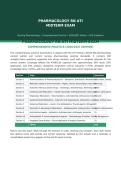
PHARMACOLOGY RN ATI
MIDTERM EXAM
Nursing Pharmacology • Comprehensive Practice • 2026/2027 Edition • 200 Questions
PHARMACOLOGY RN ATI MIDTERM EXAM
COMPREHENSIVE PRACTICE (2026/2027 EDITION)
This comprehensive practice examination is aligned with the ATI Testing / NCLEX-RN pharmacology
content outline and current nursing pharmacology practice standards. It contains 200
multiple-choice questions organized into eleven sections, each with a complete rationale for the
correct answer. Coverage reflects the ATI/NCLEX cognitive mix: approximately 30% recall, 50%
application, and 20% analysis. Questions emphasize clinical scenarios (≈75%) alongside direct
knowledge items (≈25%), with four options (A–D) and exactly one correct response per item.
Section Topic Questions
Section 1 Pharmacokinetics & Pharmacodynamics – Absorption, Distribution, Metabolism,
30Excretion, Dosing
Section 2 Medication Safety & Error Prevention – Rights, Checks, Reconciliation, High-Alert
20 Drugs
Section 3 Autonomic Nervous System Drugs – Cholinergic, Anticholinergic, Adrenergic Agents
20
Section 4 Cardiovascular Medications – Cardiac Glycosides, Antihypertensives, Anticoagulants,
25 Lipid Agents
Section 5 Respiratory Medications – Bronchodilators, Corticosteroids, Antitussives, Expectorants
15
Section 6 Gastrointestinal Medications – Antacids, Acid Suppressants, Antiemetics, Laxatives,
15 Antidiarrheals
Section 7 Endocrine Medications – Insulin, Oral Antidiabetics, Thyroid Agents, OB Agents20
Section 8 Psychiatric & Neurological Medications – Antidepressants, Antipsychotics, Anxiolytics,
15 Antiepileptics
Section 9 Anti-Infective Agents – Antibiotics, Antituberculars, Antifungals, Antivirals 15
Section 10 Antineoplastic & Immunosuppressive Agents – Chemotherapy Principles, Toxicity
10 Management
Section 11 Integrated Case Studies – Clinical Application & Analysis Scenarios 15
TOTAL 200
How to use this exam: Work through the sections in order, marking your answers. Each item shows
four options (A–D) with exactly one correct response, followed by the answer and a rationale. A
consolidated answer key appears at the end for quick scoring.
,PHARMACOLOGY RN ATI MIDTERM Comprehensive Practice (2026/2027)
Section 1: Pharmacokinetics & Pharmacodynamics – Absorption, Distribution,
Metabolism, Excretion, Dosing
Q1: Absorption is best defined as:
A. the movement of a drug from its site of administration into the bloodstream [CORRECT]
B. the transport of a drug to target tissues
C. the chemical alteration of a drug by the liver
D. the removal of a drug from the body
Correct Answer: A
Rationale: Absorption is movement of the drug from the administration site into systemic circulation.
Q2: Distribution is best defined as:
A. transport of the drug via the bloodstream to target tissues [CORRECT]
B. movement into the bloodstream
C. chemical alteration by the liver
D. excretion by the kidneys
Correct Answer: A
Rationale: Distribution carries the absorbed drug through the bloodstream to its sites of action.
Q3: Metabolism (biotransformation) is best defined as:
A. the chemical alteration of a drug, primarily by the liver [CORRECT]
B. movement of the drug into the bloodstream
C. transport to tissues
D. removal of metabolites
Correct Answer: A
Rationale: Metabolism chemically alters drugs (biotransformation), mainly in the liver, to facilitate elimination.
Q4: Excretion (elimination) is best defined as:
A. removal of the drug or its metabolites from the body [CORRECT]
B. chemical alteration in the liver
C. movement into the bloodstream
D. binding to plasma proteins
Correct Answer: A
Rationale: Elimination removes the drug and its metabolites, primarily via the kidneys, liver/bile, and lungs.
Q5: The first-pass effect refers to:
A. a reduction in oral drug concentration as it passes through the gut wall and liver before reaching
systemic circulation [CORRECT]
B. the initial dose of a drug
C. rapid excretion by the kidney
D. drug binding to plasma proteins
Correct Answer: A
Rationale: First-pass metabolism reduces oral bioavailability because the drug traverses the GI tract and liver
before reaching circulation.
Q6: Which route of administration is MOST affected by the first-pass effect?
A. oral [CORRECT]
B. intravenous
C. sublingual
D. intramuscular
Correct Answer: A
Rationale: Oral drugs pass through the liver first; IV and other parenteral routes bypass first-pass metabolism.
Page 2 of 37
,PHARMACOLOGY RN ATI MIDTERM Comprehensive Practice (2026/2027)
Q7: Bioavailability is defined as:
A. the percentage of an administered drug that reaches systemic circulation unchanged [CORRECT]
B. the time for drug concentration to halve
C. the ratio of toxic to therapeutic dose
D. the rate of renal excretion
Correct Answer: A
Rationale: Bioavailability is the fraction of the dose reaching systemic circulation in active form.
Q8: A drug given intravenously has a bioavailability of:
A. 100% [CORRECT]
B. 50%
C. 75%
D. 0%
Correct Answer: A
Rationale: IV administration delivers the entire dose directly into circulation, so bioavailability is 100%.
Q9: Half-life is the time required for:
A. the plasma drug concentration to decrease by 50% [CORRECT]
B. the drug to be fully eliminated
C. the drug to reach peak effect
D. absorption to complete
Correct Answer: A
Rationale: Half-life is the time for drug concentration to fall by half; about 4-5 half-lives are needed for
elimination.
Q10: A drug's therapeutic index is the ratio between:
A. the toxic dose and the therapeutic dose [CORRECT]
B. the loading dose and maintenance dose
C. the peak and trough levels
D. the oral and IV doses
Correct Answer: A
Rationale: The therapeutic index compares toxic to therapeutic doses; a narrow index means less safety
margin.
Q11: A drug with a narrow therapeutic index:
A. requires close monitoring because the safe range is small [CORRECT]
B. is always safe
C. needs no monitoring
D. has no adverse effects
Correct Answer: A
Rationale: Narrow therapeutic index drugs (e.g., digoxin, warfarin, phenytoin) need careful monitoring to avoid
toxicity.
Q12: An agonist is a drug that:
A. activates a receptor to produce a response [CORRECT]
B. blocks a receptor
C. has no receptor interaction
D. only binds plasma proteins
Correct Answer: A
Rationale: Agonists bind and activate receptors, mimicking endogenous ligands.
Page 3 of 37
, PHARMACOLOGY RN ATI MIDTERM Comprehensive Practice (2026/2027)
Q13: An antagonist is a drug that:
A. binds a receptor and blocks its activation [CORRECT]
B. activates a receptor
C. enhances endogenous ligands
D. has no receptor affinity
Correct Answer: A
Rationale: Antagonists occupy receptors without activating them, preventing agonist action.
Q14: A drug's potency refers to:
A. the amount of drug needed to produce a given effect [CORRECT]
B. the maximum effect achievable
C. the duration of action
D. the elimination rate
Correct Answer: A
Rationale: Potency is the dose required for a given effect; a more potent drug works at a lower dose.
Q15: A drug's efficacy refers to:
A. the maximum response a drug can produce [CORRECT]
B. the dose required
C. the time to onset
D. the side effect profile
Correct Answer: A
Rationale: Efficacy is the ceiling (maximal) effect; potency and efficacy are distinct concepts.
Q16: The 'onset of action' of a drug is:
A. the time it takes to reach the minimum effective concentration [CORRECT]
B. the time to peak effect
C. the duration of action
D. the half-life
Correct Answer: A
Rationale: Onset is the time to reach the minimum effective concentration and begin producing a response.
Q17: The 'peak' of a drug refers to:
A. the highest plasma concentration after administration [CORRECT]
B. the lowest concentration
C. the onset of action
D. the duration
Correct Answer: A
Rationale: Peak is the maximum plasma concentration; trough is the lowest, just before the next dose.
Q18: The 'trough' level is drawn:
A. just before the next dose (lowest concentration) [CORRECT]
B. 30-60 minutes after a dose
C. immediately after a dose
D. at any time
Correct Answer: A
Rationale: Trough levels are drawn just before the next dose to ensure the drug is not accumulating to toxicity.
Page 4 of 37
MIDTERM EXAM
Nursing Pharmacology • Comprehensive Practice • 2026/2027 Edition • 200 Questions
PHARMACOLOGY RN ATI MIDTERM EXAM
COMPREHENSIVE PRACTICE (2026/2027 EDITION)
This comprehensive practice examination is aligned with the ATI Testing / NCLEX-RN pharmacology
content outline and current nursing pharmacology practice standards. It contains 200
multiple-choice questions organized into eleven sections, each with a complete rationale for the
correct answer. Coverage reflects the ATI/NCLEX cognitive mix: approximately 30% recall, 50%
application, and 20% analysis. Questions emphasize clinical scenarios (≈75%) alongside direct
knowledge items (≈25%), with four options (A–D) and exactly one correct response per item.
Section Topic Questions
Section 1 Pharmacokinetics & Pharmacodynamics – Absorption, Distribution, Metabolism,
30Excretion, Dosing
Section 2 Medication Safety & Error Prevention – Rights, Checks, Reconciliation, High-Alert
20 Drugs
Section 3 Autonomic Nervous System Drugs – Cholinergic, Anticholinergic, Adrenergic Agents
20
Section 4 Cardiovascular Medications – Cardiac Glycosides, Antihypertensives, Anticoagulants,
25 Lipid Agents
Section 5 Respiratory Medications – Bronchodilators, Corticosteroids, Antitussives, Expectorants
15
Section 6 Gastrointestinal Medications – Antacids, Acid Suppressants, Antiemetics, Laxatives,
15 Antidiarrheals
Section 7 Endocrine Medications – Insulin, Oral Antidiabetics, Thyroid Agents, OB Agents20
Section 8 Psychiatric & Neurological Medications – Antidepressants, Antipsychotics, Anxiolytics,
15 Antiepileptics
Section 9 Anti-Infective Agents – Antibiotics, Antituberculars, Antifungals, Antivirals 15
Section 10 Antineoplastic & Immunosuppressive Agents – Chemotherapy Principles, Toxicity
10 Management
Section 11 Integrated Case Studies – Clinical Application & Analysis Scenarios 15
TOTAL 200
How to use this exam: Work through the sections in order, marking your answers. Each item shows
four options (A–D) with exactly one correct response, followed by the answer and a rationale. A
consolidated answer key appears at the end for quick scoring.
,PHARMACOLOGY RN ATI MIDTERM Comprehensive Practice (2026/2027)
Section 1: Pharmacokinetics & Pharmacodynamics – Absorption, Distribution,
Metabolism, Excretion, Dosing
Q1: Absorption is best defined as:
A. the movement of a drug from its site of administration into the bloodstream [CORRECT]
B. the transport of a drug to target tissues
C. the chemical alteration of a drug by the liver
D. the removal of a drug from the body
Correct Answer: A
Rationale: Absorption is movement of the drug from the administration site into systemic circulation.
Q2: Distribution is best defined as:
A. transport of the drug via the bloodstream to target tissues [CORRECT]
B. movement into the bloodstream
C. chemical alteration by the liver
D. excretion by the kidneys
Correct Answer: A
Rationale: Distribution carries the absorbed drug through the bloodstream to its sites of action.
Q3: Metabolism (biotransformation) is best defined as:
A. the chemical alteration of a drug, primarily by the liver [CORRECT]
B. movement of the drug into the bloodstream
C. transport to tissues
D. removal of metabolites
Correct Answer: A
Rationale: Metabolism chemically alters drugs (biotransformation), mainly in the liver, to facilitate elimination.
Q4: Excretion (elimination) is best defined as:
A. removal of the drug or its metabolites from the body [CORRECT]
B. chemical alteration in the liver
C. movement into the bloodstream
D. binding to plasma proteins
Correct Answer: A
Rationale: Elimination removes the drug and its metabolites, primarily via the kidneys, liver/bile, and lungs.
Q5: The first-pass effect refers to:
A. a reduction in oral drug concentration as it passes through the gut wall and liver before reaching
systemic circulation [CORRECT]
B. the initial dose of a drug
C. rapid excretion by the kidney
D. drug binding to plasma proteins
Correct Answer: A
Rationale: First-pass metabolism reduces oral bioavailability because the drug traverses the GI tract and liver
before reaching circulation.
Q6: Which route of administration is MOST affected by the first-pass effect?
A. oral [CORRECT]
B. intravenous
C. sublingual
D. intramuscular
Correct Answer: A
Rationale: Oral drugs pass through the liver first; IV and other parenteral routes bypass first-pass metabolism.
Page 2 of 37
,PHARMACOLOGY RN ATI MIDTERM Comprehensive Practice (2026/2027)
Q7: Bioavailability is defined as:
A. the percentage of an administered drug that reaches systemic circulation unchanged [CORRECT]
B. the time for drug concentration to halve
C. the ratio of toxic to therapeutic dose
D. the rate of renal excretion
Correct Answer: A
Rationale: Bioavailability is the fraction of the dose reaching systemic circulation in active form.
Q8: A drug given intravenously has a bioavailability of:
A. 100% [CORRECT]
B. 50%
C. 75%
D. 0%
Correct Answer: A
Rationale: IV administration delivers the entire dose directly into circulation, so bioavailability is 100%.
Q9: Half-life is the time required for:
A. the plasma drug concentration to decrease by 50% [CORRECT]
B. the drug to be fully eliminated
C. the drug to reach peak effect
D. absorption to complete
Correct Answer: A
Rationale: Half-life is the time for drug concentration to fall by half; about 4-5 half-lives are needed for
elimination.
Q10: A drug's therapeutic index is the ratio between:
A. the toxic dose and the therapeutic dose [CORRECT]
B. the loading dose and maintenance dose
C. the peak and trough levels
D. the oral and IV doses
Correct Answer: A
Rationale: The therapeutic index compares toxic to therapeutic doses; a narrow index means less safety
margin.
Q11: A drug with a narrow therapeutic index:
A. requires close monitoring because the safe range is small [CORRECT]
B. is always safe
C. needs no monitoring
D. has no adverse effects
Correct Answer: A
Rationale: Narrow therapeutic index drugs (e.g., digoxin, warfarin, phenytoin) need careful monitoring to avoid
toxicity.
Q12: An agonist is a drug that:
A. activates a receptor to produce a response [CORRECT]
B. blocks a receptor
C. has no receptor interaction
D. only binds plasma proteins
Correct Answer: A
Rationale: Agonists bind and activate receptors, mimicking endogenous ligands.
Page 3 of 37
, PHARMACOLOGY RN ATI MIDTERM Comprehensive Practice (2026/2027)
Q13: An antagonist is a drug that:
A. binds a receptor and blocks its activation [CORRECT]
B. activates a receptor
C. enhances endogenous ligands
D. has no receptor affinity
Correct Answer: A
Rationale: Antagonists occupy receptors without activating them, preventing agonist action.
Q14: A drug's potency refers to:
A. the amount of drug needed to produce a given effect [CORRECT]
B. the maximum effect achievable
C. the duration of action
D. the elimination rate
Correct Answer: A
Rationale: Potency is the dose required for a given effect; a more potent drug works at a lower dose.
Q15: A drug's efficacy refers to:
A. the maximum response a drug can produce [CORRECT]
B. the dose required
C. the time to onset
D. the side effect profile
Correct Answer: A
Rationale: Efficacy is the ceiling (maximal) effect; potency and efficacy are distinct concepts.
Q16: The 'onset of action' of a drug is:
A. the time it takes to reach the minimum effective concentration [CORRECT]
B. the time to peak effect
C. the duration of action
D. the half-life
Correct Answer: A
Rationale: Onset is the time to reach the minimum effective concentration and begin producing a response.
Q17: The 'peak' of a drug refers to:
A. the highest plasma concentration after administration [CORRECT]
B. the lowest concentration
C. the onset of action
D. the duration
Correct Answer: A
Rationale: Peak is the maximum plasma concentration; trough is the lowest, just before the next dose.
Q18: The 'trough' level is drawn:
A. just before the next dose (lowest concentration) [CORRECT]
B. 30-60 minutes after a dose
C. immediately after a dose
D. at any time
Correct Answer: A
Rationale: Trough levels are drawn just before the next dose to ensure the drug is not accumulating to toxicity.
Page 4 of 37


