
titlist "
little d- Iris ribosomes starch
mid granule
↳
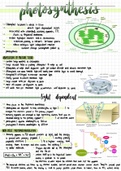
Chloroplast biconvex 's about 3- 10mm
circular
DNA
↳
thylakoid membrane : where light dependent
-
occurs
. ☒
•
associated with chlorophyll , accessory pigments ,
ETC
↳
grana :
stacks of thylakoid membranes
☐
•
enclose hydrogen reservoir used in che miosmosis
; .
lamella extensions
forming a network between grand
↳ :
lipid
↳ stroma rubisco catalyses light independent reaction
: globule
starch granule insoluble storage carbohydrate product of
↳ :
photosynthesis
ADAPTATION OF PALISADE TISSUE
↳
contain large numbers of chloroplasts
↳
large vacuole helps
pushing chloroplast to edge of cell
in
chloroplasts at edge short diffusion path for carbon dioxide and absorb maximum light
↳
↳
chloroplasts can move towards light and away from intense light to avoid damage
↳
elongated & arranged to intercept maximum light
↳
closely packed to absorb maximum light
↳
large surface area for diffusion of gases
↳
moist cell surfaces for diffusion of gases
↳ cell walls thin for maximum light penetration and diffusion of gases
↳
takes
place in the thylakoid membranes
photosystems required wavelengths light (photons )
↳
are to trap of to
the electron found the
energize primary pigment in
arranged light harvesting clusters that pass on
↳
accessory pigments are in
absorbed energy to the primary pigment (chlorophyll a) at reaction centre
photosystem 1 absorbs wavelengths of 700mm
↳
↳
photosystem 11 absorbs wavelengths of 680mm
NON CYCLIC PHOTO PHOSPHORYLATION
-
↳
Accessory pigments PSII absorb photons of light and the energy
in ,
is passed onto primary pigment ( chlorophyll a) exciting primary
pigments electrons ( photo activation ) to a higher energy level
causing them to escape and also causes the splitting ( photolysis )
of water molecules Oxygen diffuses out of the chloroplast
°
and into the air
protons build up in the thylakoid lumen
+
UH
°
2h20 → 02 Ye
-
t +
causing a gradient to be formed
0
the electrons in water replace the electrons that have left the pigment
↳
The energized electrons are taken up by electron acceptor and ,
are
passed down electron carrier chain . They're passed from
PSII to carrier proteins where the energy is used to PSI
,
pump protons from stroma to lumen ; then to ,
where more
little d- Iris ribosomes starch
mid granule
↳
Chloroplast biconvex 's about 3- 10mm
circular
DNA
↳
thylakoid membrane : where light dependent
-
occurs
. ☒
•
associated with chlorophyll , accessory pigments ,
ETC
↳
grana :
stacks of thylakoid membranes
☐
•
enclose hydrogen reservoir used in che miosmosis
; .
lamella extensions
forming a network between grand
↳ :
lipid
↳ stroma rubisco catalyses light independent reaction
: globule
starch granule insoluble storage carbohydrate product of
↳ :
photosynthesis
ADAPTATION OF PALISADE TISSUE
↳
contain large numbers of chloroplasts
↳
large vacuole helps
pushing chloroplast to edge of cell
in
chloroplasts at edge short diffusion path for carbon dioxide and absorb maximum light
↳
↳
chloroplasts can move towards light and away from intense light to avoid damage
↳
elongated & arranged to intercept maximum light
↳
closely packed to absorb maximum light
↳
large surface area for diffusion of gases
↳
moist cell surfaces for diffusion of gases
↳ cell walls thin for maximum light penetration and diffusion of gases
↳
takes
place in the thylakoid membranes
photosystems required wavelengths light (photons )
↳
are to trap of to
the electron found the
energize primary pigment in
arranged light harvesting clusters that pass on
↳
accessory pigments are in
absorbed energy to the primary pigment (chlorophyll a) at reaction centre
photosystem 1 absorbs wavelengths of 700mm
↳
↳
photosystem 11 absorbs wavelengths of 680mm
NON CYCLIC PHOTO PHOSPHORYLATION
-
↳
Accessory pigments PSII absorb photons of light and the energy
in ,
is passed onto primary pigment ( chlorophyll a) exciting primary
pigments electrons ( photo activation ) to a higher energy level
causing them to escape and also causes the splitting ( photolysis )
of water molecules Oxygen diffuses out of the chloroplast
°
and into the air
protons build up in the thylakoid lumen
+
UH
°
2h20 → 02 Ye
-
t +
causing a gradient to be formed
0
the electrons in water replace the electrons that have left the pigment
↳
The energized electrons are taken up by electron acceptor and ,
are
passed down electron carrier chain . They're passed from
PSII to carrier proteins where the energy is used to PSI
,
pump protons from stroma to lumen ; then to ,
where more


