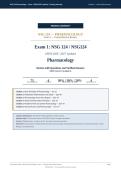
NSG 124 Pharmacology — Exam 1 (2026/2027 Update) | Herzing University Graded A- | 100% Verified Answers
HERZING UNIVERSITY
NSG 124 — PHARMACOLOGY
Exam 1 — Comprehensive Review
Exam 1: NSG 124 / NSG124
(NEW Update)
Pharmacology
Review with Questions and Verified Answers
100% Correct • Graded A-
75
Total Questions
6
Sections
30% / 50% / 20%
Recall / App / Analysis
4
Options per Q
Section 1. Basic Principles of Pharmacology — Q1-25
Section 2. Medication Administration and Safety — Q26-40
Section 3. Pharmacology Across the Lifespan — Q41-50
Section 4. Herbal and Alternative Therapies — Q51-55
Section 5. Peripheral Nervous System Pharmacology — Q56-70
Section 6. Nursing Process and Pharmacology — Q71-75
Cognitive Distribution: 30% Recall • 50% Application • 20% Analysis
Question Style: 75% scenario-based • 25% direct recall / dosage calculations
Format: Multiple-choice, 4 options (A–D), one best answer per question.
Rationales: Each question includes NSG124-specific pharmacology reasoning (pharmacokinetics, pharmacodynamics, safety,
lifespan, nursing process).
Herzing University | NSG124 Pharmacology | Exam 1 — Review with Verified Answers Page 1
CONFIDENTIAL — For Herzing NSG124 Review Use Only
,NSG 124 Pharmacology — Exam 1 (2026/2027 Update) | Herzing University Graded A- | 100% Verified Answers
Exam Directions & Blueprint
This comprehensive examination is aligned with the 2026–2027 Herzing University NSG124 Pharmacology
curriculum and Exam 1 blueprint. It is structured into six (6) sections containing a total of 75 multiple-choice
questions designed to assess foundational pharmacology principles, medication safety, lifespan considerations,
peripheral nervous system (PNS) pharmacology, and integration of the nursing process with pharmacotherapeutics.
Each question has been written and verified to a "100% Correct, Grade A-" standard with NSG124-specific
pharmacology rationales.
Questions are distributed across six content areas to mirror the Herzing exam blueprint: Section 1 (Q1–25) Basic
Principles of Pharmacology; Section 2 (Q26–40) Medication Administration and Safety; Section 3 (Q41–50)
Pharmacology Across the Lifespan; Section 4 (Q51–55) Herbal and Alternative Therapies; Section 5 (Q56–70)
Peripheral Nervous System Pharmacology; and Section 6 (Q71–75) Nursing Process and Pharmacology.
Approximately 75% of items are scenario-based, reflecting clinical reasoning, while 25% are direct-recall or
dosage-calculation items.
Updates reflected in this 2026/2027 version include the FDA Pregnancy and Lactation Labeling Rule (PLLR,
replacing the former A/B/C/D/X categories), the 2023 AGS Beers Criteria for potentially inappropriate medications in
older adults, current ISMP high-alert medication lists, and contemporary PNS pharmacology (including sugammadex
reversal of rocuronium/vecuronium). Distractors are constructed around common NSG124 Exam 1 pitfalls:
pharmacokinetic phase confusion, absorption-factor misidentification, dose-calculation errors, route selection
mistakes, pediatric/geriatric dosing errors, drug-category confusion, cholinergic vs. adrenergic effect misattribution,
pregnancy category misunderstanding, herbal-interaction oversight, and nursing process misapplication.
How to Use This Review:
• Read each question stem completely before reviewing options; identify key terms such as "FIRST," "BEST," "MOST
important," or "PRIORITY."
• Eliminate clearly incorrect distractors first; the correct option will reflect current pharmacology evidence (2026/2027
references).
• For dosage calculations, perform the math independently before checking the answer to build exam-day fluency.
• Review each rationale thoroughly—the explanation identifies the underlying pharmacokinetic, pharmacodynamic,
lifespan, safety, or nursing-process principle.
• Note questions that align with Herzing NSG124 course objectives and exam blueprints for focused remediation.
Section 1: Basic Principles of Pharmacology
(Drug Nomenclature, Pharmacokinetics, Pharmacodynamics, & Drug Interactions)
Q1: A pharmacist receives a prescription for “acetaminophen 325 mg PO every 6 hours PRN for pain.” The
patient asks the nurse why the medication bottle says “Tylenol” when the prescription did not say that. Which
response by the nurse best explains drug nomenclature?
A. \“Acetaminophen\” is the chemical name and \“Tylenol\” is the generic name assigned by the manufacturer.
B. \“Acetaminophen\” is the trade name and \“Tylenol\” is the chemical formula for the compound.
Herzing University | NSG124 Pharmacology | Exam 1 — Review with Verified Answers Page 2
CONFIDENTIAL — For Herzing NSG124 Review Use Only
, NSG 124 Pharmacology — Exam 1 (2026/2027 Update) | Herzing University Graded A- | 100% Verified Answers
C. \“Acetaminophen\” is the generic name and \“Tylenol\” is the trade/brand name assigned by the
pharmaceutical company. [CORRECT]
D. Both names refer to the chemical structure; the pharmacist chose Tylenol based on cost.
Correct Answer: C — \“Acetaminophen\” is the generic name and \“Tylenol\” is the trade/brand name assigned ...
Rationale: Drug nomenclature follows three levels: chemical (exact molecular structure), generic (official nonproprietary
name assigned by USAN, e.g., acetaminophen), and trade/brand name (proprietary, capitalized, assigned by the
manufacturer, e.g., Tylenol). Option A reverses generic/trade; option B reverses the categories; option D is incorrect
because trade names are marketing choices, not chemistry. Nurses must know generic names because they remain
consistent across manufacturers and formularies, while multiple trade names may exist for the same drug.
Q2: A new drug is undergoing Phase III clinical trials. The nurse understands that during this phase, the drug
is being evaluated primarily for:
A. Safety and dosage range in healthy volunteers (20-80 subjects).
B. Effectiveness in patients with the target disease (100-300 subjects).
C. Efficacy and adverse effects in a large, diverse patient population (1,000-3,000 subjects). [CORRECT]
D. Long-term safety and rare adverse effects after market approval.
Correct Answer: C — Efficacy and adverse effects in a large, diverse patient population (1,000-3,000 subjec...
Rationale: Phase III trials enroll 1,000-3,000 patients with the target disease to confirm efficacy, monitor side effects,
compare with standard treatments, and collect data for FDA NDA submission. Phase I (option A) tests safety in healthy
volunteers. Phase II (option B) tests effectiveness in 100-300 patients with the disease. Phase IV (option D) is
post-marketing surveillance after FDA approval. Understanding clinical trial phases helps nurses interpret emerging drug
data and patient education about investigational drugs.
Q3: A patient asks why generic drugs are less expensive than brand-name drugs. The nurse's best response,
based on the FDA drug approval process, is:
A. Generic drugs contain lower-quality ingredients and are not regulated by the FDA.
B. Generic drugs have the same active ingredient, strength, route, and bioequivalence as brand-name drugs
but cost less because manufacturers skip the expensive research and clinical trials. [CORRECT]
C. Generic drugs work differently in the body and require higher doses to be effective.
D. Generic drugs are only approved for over-the-counter use, not prescription medications.
Correct Answer: B — Generic drugs have the same active ingredient, strength, route, and bioequivalence as b...
Rationale: The FDA requires generic drugs to demonstrate bioequivalence (same rate and extent of absorption, 80-125%
of brand-name) before approval. Generic manufacturers do not repeat preclinical/clinical trials because the brand-name
drug already established safety and efficacy; they only file an Abbreviated New Drug Application (ANDA). Option A is
false because generics are FDA-regulated; option C contradicts bioequivalence requirements; option D is incorrect as many
generics are prescription medications. Cost savings come from skipping research costs, not lower quality.
Q4: A patient receives a medication intravenously. The nurse explains that this route bypasses first-pass
metabolism. Which statement best explains the clinical significance of first-pass effect?
A. First-pass metabolism increases the bioavailability of oral medications by activating prodrugs in the liver.
B. First-pass metabolism reduces the bioavailability of oral medications because the drug is partially
metabolized in the liver before reaching systemic circulation. [CORRECT]
C. First-pass metabolism only occurs with sublingual medications absorbed under the tongue.
Herzing University | NSG124 Pharmacology | Exam 1 — Review with Verified Answers Page 3
CONFIDENTIAL — For Herzing NSG124 Review Use Only
HERZING UNIVERSITY
NSG 124 — PHARMACOLOGY
Exam 1 — Comprehensive Review
Exam 1: NSG 124 / NSG124
(NEW Update)
Pharmacology
Review with Questions and Verified Answers
100% Correct • Graded A-
75
Total Questions
6
Sections
30% / 50% / 20%
Recall / App / Analysis
4
Options per Q
Section 1. Basic Principles of Pharmacology — Q1-25
Section 2. Medication Administration and Safety — Q26-40
Section 3. Pharmacology Across the Lifespan — Q41-50
Section 4. Herbal and Alternative Therapies — Q51-55
Section 5. Peripheral Nervous System Pharmacology — Q56-70
Section 6. Nursing Process and Pharmacology — Q71-75
Cognitive Distribution: 30% Recall • 50% Application • 20% Analysis
Question Style: 75% scenario-based • 25% direct recall / dosage calculations
Format: Multiple-choice, 4 options (A–D), one best answer per question.
Rationales: Each question includes NSG124-specific pharmacology reasoning (pharmacokinetics, pharmacodynamics, safety,
lifespan, nursing process).
Herzing University | NSG124 Pharmacology | Exam 1 — Review with Verified Answers Page 1
CONFIDENTIAL — For Herzing NSG124 Review Use Only
,NSG 124 Pharmacology — Exam 1 (2026/2027 Update) | Herzing University Graded A- | 100% Verified Answers
Exam Directions & Blueprint
This comprehensive examination is aligned with the 2026–2027 Herzing University NSG124 Pharmacology
curriculum and Exam 1 blueprint. It is structured into six (6) sections containing a total of 75 multiple-choice
questions designed to assess foundational pharmacology principles, medication safety, lifespan considerations,
peripheral nervous system (PNS) pharmacology, and integration of the nursing process with pharmacotherapeutics.
Each question has been written and verified to a "100% Correct, Grade A-" standard with NSG124-specific
pharmacology rationales.
Questions are distributed across six content areas to mirror the Herzing exam blueprint: Section 1 (Q1–25) Basic
Principles of Pharmacology; Section 2 (Q26–40) Medication Administration and Safety; Section 3 (Q41–50)
Pharmacology Across the Lifespan; Section 4 (Q51–55) Herbal and Alternative Therapies; Section 5 (Q56–70)
Peripheral Nervous System Pharmacology; and Section 6 (Q71–75) Nursing Process and Pharmacology.
Approximately 75% of items are scenario-based, reflecting clinical reasoning, while 25% are direct-recall or
dosage-calculation items.
Updates reflected in this 2026/2027 version include the FDA Pregnancy and Lactation Labeling Rule (PLLR,
replacing the former A/B/C/D/X categories), the 2023 AGS Beers Criteria for potentially inappropriate medications in
older adults, current ISMP high-alert medication lists, and contemporary PNS pharmacology (including sugammadex
reversal of rocuronium/vecuronium). Distractors are constructed around common NSG124 Exam 1 pitfalls:
pharmacokinetic phase confusion, absorption-factor misidentification, dose-calculation errors, route selection
mistakes, pediatric/geriatric dosing errors, drug-category confusion, cholinergic vs. adrenergic effect misattribution,
pregnancy category misunderstanding, herbal-interaction oversight, and nursing process misapplication.
How to Use This Review:
• Read each question stem completely before reviewing options; identify key terms such as "FIRST," "BEST," "MOST
important," or "PRIORITY."
• Eliminate clearly incorrect distractors first; the correct option will reflect current pharmacology evidence (2026/2027
references).
• For dosage calculations, perform the math independently before checking the answer to build exam-day fluency.
• Review each rationale thoroughly—the explanation identifies the underlying pharmacokinetic, pharmacodynamic,
lifespan, safety, or nursing-process principle.
• Note questions that align with Herzing NSG124 course objectives and exam blueprints for focused remediation.
Section 1: Basic Principles of Pharmacology
(Drug Nomenclature, Pharmacokinetics, Pharmacodynamics, & Drug Interactions)
Q1: A pharmacist receives a prescription for “acetaminophen 325 mg PO every 6 hours PRN for pain.” The
patient asks the nurse why the medication bottle says “Tylenol” when the prescription did not say that. Which
response by the nurse best explains drug nomenclature?
A. \“Acetaminophen\” is the chemical name and \“Tylenol\” is the generic name assigned by the manufacturer.
B. \“Acetaminophen\” is the trade name and \“Tylenol\” is the chemical formula for the compound.
Herzing University | NSG124 Pharmacology | Exam 1 — Review with Verified Answers Page 2
CONFIDENTIAL — For Herzing NSG124 Review Use Only
, NSG 124 Pharmacology — Exam 1 (2026/2027 Update) | Herzing University Graded A- | 100% Verified Answers
C. \“Acetaminophen\” is the generic name and \“Tylenol\” is the trade/brand name assigned by the
pharmaceutical company. [CORRECT]
D. Both names refer to the chemical structure; the pharmacist chose Tylenol based on cost.
Correct Answer: C — \“Acetaminophen\” is the generic name and \“Tylenol\” is the trade/brand name assigned ...
Rationale: Drug nomenclature follows three levels: chemical (exact molecular structure), generic (official nonproprietary
name assigned by USAN, e.g., acetaminophen), and trade/brand name (proprietary, capitalized, assigned by the
manufacturer, e.g., Tylenol). Option A reverses generic/trade; option B reverses the categories; option D is incorrect
because trade names are marketing choices, not chemistry. Nurses must know generic names because they remain
consistent across manufacturers and formularies, while multiple trade names may exist for the same drug.
Q2: A new drug is undergoing Phase III clinical trials. The nurse understands that during this phase, the drug
is being evaluated primarily for:
A. Safety and dosage range in healthy volunteers (20-80 subjects).
B. Effectiveness in patients with the target disease (100-300 subjects).
C. Efficacy and adverse effects in a large, diverse patient population (1,000-3,000 subjects). [CORRECT]
D. Long-term safety and rare adverse effects after market approval.
Correct Answer: C — Efficacy and adverse effects in a large, diverse patient population (1,000-3,000 subjec...
Rationale: Phase III trials enroll 1,000-3,000 patients with the target disease to confirm efficacy, monitor side effects,
compare with standard treatments, and collect data for FDA NDA submission. Phase I (option A) tests safety in healthy
volunteers. Phase II (option B) tests effectiveness in 100-300 patients with the disease. Phase IV (option D) is
post-marketing surveillance after FDA approval. Understanding clinical trial phases helps nurses interpret emerging drug
data and patient education about investigational drugs.
Q3: A patient asks why generic drugs are less expensive than brand-name drugs. The nurse's best response,
based on the FDA drug approval process, is:
A. Generic drugs contain lower-quality ingredients and are not regulated by the FDA.
B. Generic drugs have the same active ingredient, strength, route, and bioequivalence as brand-name drugs
but cost less because manufacturers skip the expensive research and clinical trials. [CORRECT]
C. Generic drugs work differently in the body and require higher doses to be effective.
D. Generic drugs are only approved for over-the-counter use, not prescription medications.
Correct Answer: B — Generic drugs have the same active ingredient, strength, route, and bioequivalence as b...
Rationale: The FDA requires generic drugs to demonstrate bioequivalence (same rate and extent of absorption, 80-125%
of brand-name) before approval. Generic manufacturers do not repeat preclinical/clinical trials because the brand-name
drug already established safety and efficacy; they only file an Abbreviated New Drug Application (ANDA). Option A is
false because generics are FDA-regulated; option C contradicts bioequivalence requirements; option D is incorrect as many
generics are prescription medications. Cost savings come from skipping research costs, not lower quality.
Q4: A patient receives a medication intravenously. The nurse explains that this route bypasses first-pass
metabolism. Which statement best explains the clinical significance of first-pass effect?
A. First-pass metabolism increases the bioavailability of oral medications by activating prodrugs in the liver.
B. First-pass metabolism reduces the bioavailability of oral medications because the drug is partially
metabolized in the liver before reaching systemic circulation. [CORRECT]
C. First-pass metabolism only occurs with sublingual medications absorbed under the tongue.
Herzing University | NSG124 Pharmacology | Exam 1 — Review with Verified Answers Page 3
CONFIDENTIAL — For Herzing NSG124 Review Use Only