

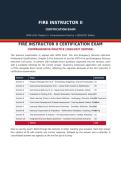
FIRE INSTRUCTOR II
CERTIFICATION EXAM
NFPA 1041 Chapter 5 • Comprehensive Practice • 2026/2027 Edition
FIRE INSTRUCTOR II CERTIFICATION EXAM
COMPREHENSIVE PRACTICE (2026/2027 EDITION)
This practice examination is aligned with NFPA 1041, Fire and Emergency Services Instructor
Professional Qualifications, Chapter 5 (Fire Instructor II) and the IFSTA Fire and Emergency Services
Instructor curriculum. It contains 200 multiple-choice questions organized into ten sections, each
with a complete rationale for the correct answer. Questions emphasize application and analysis
(≈75%) alongside direct recall (≈25%), reflecting the cognitive demands of the Fire Instructor II
certification examination.
Section Topic Questions
Section 1 Program Management (5.2) – Scheduling, Budgeting, Instructor Evaluation 25
Section 2 Instructional Development (5.3) – Lesson Plan Creation & Modification 25
Section 3 Instructional Delivery (5.4) – Supervising Instructors & Students, Safety 25
Section 4 Evaluation & Testing (5.5) – Student Evaluation, Test Development, Analysis25
Section 5 Adult Learning Theory & Instructional Methods – Andragogy, Domains, Bloom's
20 Taxonomy
Section 6 Curriculum Development & Needs Assessment – Training Needs, Master Schedule
15
Section 7 Learning Objectives & Performance Outcomes – Condition, Behavior, Standard
15
Section 8 Instructor Supervision & Evaluation – Performance Feedback, Coaching, Mentoring
15
Section 9 Test Development & Analysis – Formative/Summative, Validity, Reliability 15
Section 10 Integrated Scenario-Based Questions – Complex Instructional Scenarios 20
TOTAL 200
How to use this exam: Work through the sections in order, marking your answers. Each item shows
four options (A–D) with exactly one correct response, followed by the answer and a rationale. A
consolidated answer key appears at the end for quick scoring.
,FIRE INSTRUCTOR II — Certification Exam Comprehensive Practice (2026/2027)
Section 1: Program Management (5.2) – Scheduling, Budgeting, Instructor
Evaluation
Q1: According to NFPA 1041, the FIRST step in establishing a training schedule is to:
A. assign instructors
B. determine the training needs [CORRECT]
C. reserve the facility
D. order materials
Correct Answer: B
Rationale: The first step in establishing a training schedule is to determine needs; instructors, facilities, and
materials follow from the identified needs.
Q2: A master training schedule is best described as a document that:
A. lists only voluntary training
B. consolidates all required training activities into a single, coordinated document [CORRECT]
C. tracks individual overtime only
D. records instructor vacation time
Correct Answer: B
Rationale: The master training schedule consolidates all required training activities into one coordinated
document so the entire program can be managed at once.
Q3: The master training schedule should be built primarily on:
A. instructor preferences
B. regulatory requirements that establish minimum mandatory training [CORRECT]
C. student requests
D. budget surplus
Correct Answer: B
Rationale: The master schedule is built on regulatory requirements that establish the minimum mandatory
training the department must deliver.
Q4: Which duty is a program management responsibility of a Fire Instructor II?
A. delivering one specific lesson only
B. managing instructional resources, staff, facilities, and records and reports [CORRECT]
C. scheduling only personal leave
D. ordering fuel for apparatus
Correct Answer: B
Rationale: Program management (5.2) includes managing instructional resources, staff, facilities, and records
and reports, not just delivering a single lesson.
Q5: When formulating budget needs, an Instructor II must consider:
A. only the previous year's budget
B. training goals, agency budget policy, and current resources [CORRECT]
C. instructor meal preferences
D. marketing costs
Correct Answer: B
Rationale: Budget needs are formulated based on training goals, agency budget policy, and current resources.
Page 2 of 38
,FIRE INSTRUCTOR II — Certification Exam Comprehensive Practice (2026/2027)
Q6: Instructor evaluations conducted by an Instructor II should use:
A. personal opinion only
B. evaluation forms, department policy, and JPRs [CORRECT]
C. student popularity
D. tenure alone
Correct Answer: B
Rationale: Instructors are evaluated using evaluation forms, department policy, and JPRs to ensure objectivity.
Q7: The primary purpose of evaluating instructors is to:
A. rank them for termination
B. identify strengths and weaknesses [CORRECT]
C. satisfy paperwork requirements
D. reduce training time
Correct Answer: B
Rationale: Instructor evaluation identifies areas of strength and weakness to support development.
Q8: A complete instructor evaluation should also:
A. recommend changes in instructional style where needed [CORRECT]
B. ignore weaknesses
C. be kept secret from the instructor
D. focus only on appearance
Correct Answer: A
Rationale: Evaluations recommend changes in instructional style and communication methods where needed.
Q9: An effective instructor evaluation process provides:
A. no feedback to the instructor
B. opportunity for instructor feedback to the evaluator [CORRECT]
C. a one-way critique
D. anonymous public posting
Correct Answer: B
Rationale: The process provides an opportunity for instructor feedback to the evaluator, supporting fairness
and development.
Q10: Instructional sessions should be scheduled according to:
A. the instructor's convenience
B. department scheduling policy and the timeline for delivery [CORRECT]
C. student availability only
D. the weather
Correct Answer: B
Rationale: Sessions are scheduled according to department scheduling policy and the timeline for delivery.
Q11: In NFPA 1041, the abbreviation JPR stands for:
A. Job Performance Requirement [CORRECT]
B. Junior Promotion Request
C. Job Placement Record
D. Judicial Procedure Rule
Correct Answer: A
Rationale: JPR means Job Performance Requirement, the observable and measurable statements that define
competency.
Page 3 of 38
, FIRE INSTRUCTOR II — Certification Exam Comprehensive Practice (2026/2027)
Q12: When resources are limited, which training should receive scheduling priority?
A. elective specialty courses
B. training required by regulatory mandates [CORRECT]
C. social events
D. off-duty hobbies
Correct Answer: B
Rationale: Regulatory-mandated minimum training receives priority because it is legally required.
Q13: Accurate training records and reports are maintained primarily to:
A. document compliance and student progress [CORRECT]
B. decorate the office
C. satisfy instructors' curiosity
D. be destroyed annually
Correct Answer: A
Rationale: Records and reports document compliance and student progress and are a core program
management duty.
Q14: Scenario: You must schedule several mandatory evolutions within a limited timeframe. Your first
action is to:
A. post a sign-up sheet
B. determine the training needs and regulatory requirements [CORRECT]
C. cancel the training
D. pick the longest course
Correct Answer: B
Rationale: Determining needs and regulatory requirements must come first when establishing a training
schedule.
Q15: Scenario: Mid-year budget cuts occur. To formulate revised budget needs you should:
A. cut all training
B. reprioritize based on training goals, policy, and remaining resources [CORRECT]
C. ignore the cuts
D. double spending
Correct Answer: B
Rationale: Budget needs are reformulated based on training goals, agency budget policy, and current (now
reduced) resources.
Q16: A master training schedule consolidates:
A. only fireground training
B. all required training activities into one coordinated document [CORRECT]
C. instructor complaints
D. student grades only
Correct Answer: B
Rationale: The master schedule consolidates all required training into a single coordinated document.
Q17: Which of the following establishes minimum mandatory training requirements?
A. NFPA/OSHA and state regulations [CORRECT]
B. social media trends
C. instructor hobbies
D. commercial advertisements
Correct Answer: A
Rationale: Regulatory bodies such as NFPA, OSHA, and state authorities establish the minimum mandatory
training.
Page 4 of 38
CERTIFICATION EXAM
NFPA 1041 Chapter 5 • Comprehensive Practice • 2026/2027 Edition
FIRE INSTRUCTOR II CERTIFICATION EXAM
COMPREHENSIVE PRACTICE (2026/2027 EDITION)
This practice examination is aligned with NFPA 1041, Fire and Emergency Services Instructor
Professional Qualifications, Chapter 5 (Fire Instructor II) and the IFSTA Fire and Emergency Services
Instructor curriculum. It contains 200 multiple-choice questions organized into ten sections, each
with a complete rationale for the correct answer. Questions emphasize application and analysis
(≈75%) alongside direct recall (≈25%), reflecting the cognitive demands of the Fire Instructor II
certification examination.
Section Topic Questions
Section 1 Program Management (5.2) – Scheduling, Budgeting, Instructor Evaluation 25
Section 2 Instructional Development (5.3) – Lesson Plan Creation & Modification 25
Section 3 Instructional Delivery (5.4) – Supervising Instructors & Students, Safety 25
Section 4 Evaluation & Testing (5.5) – Student Evaluation, Test Development, Analysis25
Section 5 Adult Learning Theory & Instructional Methods – Andragogy, Domains, Bloom's
20 Taxonomy
Section 6 Curriculum Development & Needs Assessment – Training Needs, Master Schedule
15
Section 7 Learning Objectives & Performance Outcomes – Condition, Behavior, Standard
15
Section 8 Instructor Supervision & Evaluation – Performance Feedback, Coaching, Mentoring
15
Section 9 Test Development & Analysis – Formative/Summative, Validity, Reliability 15
Section 10 Integrated Scenario-Based Questions – Complex Instructional Scenarios 20
TOTAL 200
How to use this exam: Work through the sections in order, marking your answers. Each item shows
four options (A–D) with exactly one correct response, followed by the answer and a rationale. A
consolidated answer key appears at the end for quick scoring.
,FIRE INSTRUCTOR II — Certification Exam Comprehensive Practice (2026/2027)
Section 1: Program Management (5.2) – Scheduling, Budgeting, Instructor
Evaluation
Q1: According to NFPA 1041, the FIRST step in establishing a training schedule is to:
A. assign instructors
B. determine the training needs [CORRECT]
C. reserve the facility
D. order materials
Correct Answer: B
Rationale: The first step in establishing a training schedule is to determine needs; instructors, facilities, and
materials follow from the identified needs.
Q2: A master training schedule is best described as a document that:
A. lists only voluntary training
B. consolidates all required training activities into a single, coordinated document [CORRECT]
C. tracks individual overtime only
D. records instructor vacation time
Correct Answer: B
Rationale: The master training schedule consolidates all required training activities into one coordinated
document so the entire program can be managed at once.
Q3: The master training schedule should be built primarily on:
A. instructor preferences
B. regulatory requirements that establish minimum mandatory training [CORRECT]
C. student requests
D. budget surplus
Correct Answer: B
Rationale: The master schedule is built on regulatory requirements that establish the minimum mandatory
training the department must deliver.
Q4: Which duty is a program management responsibility of a Fire Instructor II?
A. delivering one specific lesson only
B. managing instructional resources, staff, facilities, and records and reports [CORRECT]
C. scheduling only personal leave
D. ordering fuel for apparatus
Correct Answer: B
Rationale: Program management (5.2) includes managing instructional resources, staff, facilities, and records
and reports, not just delivering a single lesson.
Q5: When formulating budget needs, an Instructor II must consider:
A. only the previous year's budget
B. training goals, agency budget policy, and current resources [CORRECT]
C. instructor meal preferences
D. marketing costs
Correct Answer: B
Rationale: Budget needs are formulated based on training goals, agency budget policy, and current resources.
Page 2 of 38
,FIRE INSTRUCTOR II — Certification Exam Comprehensive Practice (2026/2027)
Q6: Instructor evaluations conducted by an Instructor II should use:
A. personal opinion only
B. evaluation forms, department policy, and JPRs [CORRECT]
C. student popularity
D. tenure alone
Correct Answer: B
Rationale: Instructors are evaluated using evaluation forms, department policy, and JPRs to ensure objectivity.
Q7: The primary purpose of evaluating instructors is to:
A. rank them for termination
B. identify strengths and weaknesses [CORRECT]
C. satisfy paperwork requirements
D. reduce training time
Correct Answer: B
Rationale: Instructor evaluation identifies areas of strength and weakness to support development.
Q8: A complete instructor evaluation should also:
A. recommend changes in instructional style where needed [CORRECT]
B. ignore weaknesses
C. be kept secret from the instructor
D. focus only on appearance
Correct Answer: A
Rationale: Evaluations recommend changes in instructional style and communication methods where needed.
Q9: An effective instructor evaluation process provides:
A. no feedback to the instructor
B. opportunity for instructor feedback to the evaluator [CORRECT]
C. a one-way critique
D. anonymous public posting
Correct Answer: B
Rationale: The process provides an opportunity for instructor feedback to the evaluator, supporting fairness
and development.
Q10: Instructional sessions should be scheduled according to:
A. the instructor's convenience
B. department scheduling policy and the timeline for delivery [CORRECT]
C. student availability only
D. the weather
Correct Answer: B
Rationale: Sessions are scheduled according to department scheduling policy and the timeline for delivery.
Q11: In NFPA 1041, the abbreviation JPR stands for:
A. Job Performance Requirement [CORRECT]
B. Junior Promotion Request
C. Job Placement Record
D. Judicial Procedure Rule
Correct Answer: A
Rationale: JPR means Job Performance Requirement, the observable and measurable statements that define
competency.
Page 3 of 38
, FIRE INSTRUCTOR II — Certification Exam Comprehensive Practice (2026/2027)
Q12: When resources are limited, which training should receive scheduling priority?
A. elective specialty courses
B. training required by regulatory mandates [CORRECT]
C. social events
D. off-duty hobbies
Correct Answer: B
Rationale: Regulatory-mandated minimum training receives priority because it is legally required.
Q13: Accurate training records and reports are maintained primarily to:
A. document compliance and student progress [CORRECT]
B. decorate the office
C. satisfy instructors' curiosity
D. be destroyed annually
Correct Answer: A
Rationale: Records and reports document compliance and student progress and are a core program
management duty.
Q14: Scenario: You must schedule several mandatory evolutions within a limited timeframe. Your first
action is to:
A. post a sign-up sheet
B. determine the training needs and regulatory requirements [CORRECT]
C. cancel the training
D. pick the longest course
Correct Answer: B
Rationale: Determining needs and regulatory requirements must come first when establishing a training
schedule.
Q15: Scenario: Mid-year budget cuts occur. To formulate revised budget needs you should:
A. cut all training
B. reprioritize based on training goals, policy, and remaining resources [CORRECT]
C. ignore the cuts
D. double spending
Correct Answer: B
Rationale: Budget needs are reformulated based on training goals, agency budget policy, and current (now
reduced) resources.
Q16: A master training schedule consolidates:
A. only fireground training
B. all required training activities into one coordinated document [CORRECT]
C. instructor complaints
D. student grades only
Correct Answer: B
Rationale: The master schedule consolidates all required training into a single coordinated document.
Q17: Which of the following establishes minimum mandatory training requirements?
A. NFPA/OSHA and state regulations [CORRECT]
B. social media trends
C. instructor hobbies
D. commercial advertisements
Correct Answer: A
Rationale: Regulatory bodies such as NFPA, OSHA, and state authorities establish the minimum mandatory
training.
Page 4 of 38


