

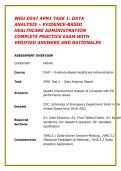
WGU D547 APN1 TASK 1: DATA
ANALYSIS – EVIDENCE-BASED
HEALTHCARE ADMINISTRATION
COMPLETE PRACTICE EXAM WITH
VERIFIED ANSWERS AND RATIONALES
ASSESSMENT OVERVIEW
Component Details
Course D547 – Evidence-Based Healthcare Administration
Task APN1 Task 1 – Data Analysis Report
Quality Improvement Analyst at a hospital with ED
Scenario
performance issues
CDC: Estimates of Emergency Department Visits in the
Dataset
United States from 2016–2021
A1: Data Selection, A2: Pivot Tables/Charts, A3: Notable
Required
Variations, A4: Research Question, A5: Variables
Sections
Justification
7040.3.1 (Data-Driven Decision-Making), 7040.3.2
Competencies (Research Paradigms & Methods), 7040.3.3 (Data
Analytics Application)
,Component Details
Submission Excel workbook + PowerPoint presentation
SECTION 1: FOUNDATIONS OF EVIDENCE-BASED
HEALTHCARE ADMINISTRATION (Questions 1–30)
Question 1
What is the primary purpose of data analysis in healthcare
administration?
A. To identify the most cost-effective medications for individual
patients
B. To evaluate nurse staffing models for each hospital unit
C. To inform evidence-based decision-making and improve patient
outcomes
D. To reduce patient length of stay in the emergency department
C
RATIONALE: The primary purpose of data analysis in
healthcare administration is to inform evidence-based clinical and
administrative decision-making. Data analysis helps healthcare
administrators identify trends, evaluate interventions, and
implement changes that improve patient outcomes and
healthcare quality.
Question 2
Evidence-based practice (EBP) in healthcare administration
integrates which three components?
A. Hospital policies, state regulations, and federal laws
,B. Patient preferences, physician orders, and insurance
requirements
C. Best research evidence, clinical expertise, and patient values
and preferences
D. Cost-effectiveness, staff availability, and facility resources
C
RATIONALE: Evidence-based practice integrates the best
available research evidence, clinical expertise, and patient values
and preferences. In healthcare administration, this same model
applies to administrative decisions, combining data analysis,
leadership expertise, and organizational values.
Question 3
What is the DIKW hierarchy in healthcare data management?
A. Data, Integration, Knowledge, Wisdom
B. Diagnosis, Information, Knowledge, Workflow
C. Data, Information, Knowledge, Wisdom
D. Documentation, Interpretation, Knowledge, Workflow
C
RATIONALE: The DIKW hierarchy defines the transition from
data to information to knowledge to wisdom. Data becomes
information when organized, information becomes knowledge
when analyzed and contextualized, and knowledge becomes
wisdom when applied with experience and ethical judgment.
Question 4
According to the DIKW hierarchy, what is the difference between
data and information?
, A. Data is organized; information is raw
B. Data is useful; information is not
C. Data is raw, unprocessed facts; information is data that has
been organized or structured for usefulness
D. Data and information are the same thing
C
RATIONALE: Data consists of raw, unprocessed facts and
figures. Information is created when raw data is organized,
structured, or processed to give it meaning and context,
answering questions like "who," "what," "where," and "when".
Question 5
Which of the following best describes the role of an advanced
practice nurse (APN) in utilizing data analysis for quality
improvement?
A. APNs primarily focus on direct patient care and do not engage
in data analysis
B. APNs rely on physicians to interpret all clinical data for
decision-making
C. APNs use data analysis to identify trends, evaluate
interventions, guide policy decisions, and implement changes that
improve patient outcomes
D. APNs are only responsible for collecting data, not analyzing it
C
RATIONALE: APNs play a key role in translating data into
actionable insights. They use data analysis to identify trends,
evaluate the effectiveness of interventions, guide policy decisions,
ANALYSIS – EVIDENCE-BASED
HEALTHCARE ADMINISTRATION
COMPLETE PRACTICE EXAM WITH
VERIFIED ANSWERS AND RATIONALES
ASSESSMENT OVERVIEW
Component Details
Course D547 – Evidence-Based Healthcare Administration
Task APN1 Task 1 – Data Analysis Report
Quality Improvement Analyst at a hospital with ED
Scenario
performance issues
CDC: Estimates of Emergency Department Visits in the
Dataset
United States from 2016–2021
A1: Data Selection, A2: Pivot Tables/Charts, A3: Notable
Required
Variations, A4: Research Question, A5: Variables
Sections
Justification
7040.3.1 (Data-Driven Decision-Making), 7040.3.2
Competencies (Research Paradigms & Methods), 7040.3.3 (Data
Analytics Application)
,Component Details
Submission Excel workbook + PowerPoint presentation
SECTION 1: FOUNDATIONS OF EVIDENCE-BASED
HEALTHCARE ADMINISTRATION (Questions 1–30)
Question 1
What is the primary purpose of data analysis in healthcare
administration?
A. To identify the most cost-effective medications for individual
patients
B. To evaluate nurse staffing models for each hospital unit
C. To inform evidence-based decision-making and improve patient
outcomes
D. To reduce patient length of stay in the emergency department
C
RATIONALE: The primary purpose of data analysis in
healthcare administration is to inform evidence-based clinical and
administrative decision-making. Data analysis helps healthcare
administrators identify trends, evaluate interventions, and
implement changes that improve patient outcomes and
healthcare quality.
Question 2
Evidence-based practice (EBP) in healthcare administration
integrates which three components?
A. Hospital policies, state regulations, and federal laws
,B. Patient preferences, physician orders, and insurance
requirements
C. Best research evidence, clinical expertise, and patient values
and preferences
D. Cost-effectiveness, staff availability, and facility resources
C
RATIONALE: Evidence-based practice integrates the best
available research evidence, clinical expertise, and patient values
and preferences. In healthcare administration, this same model
applies to administrative decisions, combining data analysis,
leadership expertise, and organizational values.
Question 3
What is the DIKW hierarchy in healthcare data management?
A. Data, Integration, Knowledge, Wisdom
B. Diagnosis, Information, Knowledge, Workflow
C. Data, Information, Knowledge, Wisdom
D. Documentation, Interpretation, Knowledge, Workflow
C
RATIONALE: The DIKW hierarchy defines the transition from
data to information to knowledge to wisdom. Data becomes
information when organized, information becomes knowledge
when analyzed and contextualized, and knowledge becomes
wisdom when applied with experience and ethical judgment.
Question 4
According to the DIKW hierarchy, what is the difference between
data and information?
, A. Data is organized; information is raw
B. Data is useful; information is not
C. Data is raw, unprocessed facts; information is data that has
been organized or structured for usefulness
D. Data and information are the same thing
C
RATIONALE: Data consists of raw, unprocessed facts and
figures. Information is created when raw data is organized,
structured, or processed to give it meaning and context,
answering questions like "who," "what," "where," and "when".
Question 5
Which of the following best describes the role of an advanced
practice nurse (APN) in utilizing data analysis for quality
improvement?
A. APNs primarily focus on direct patient care and do not engage
in data analysis
B. APNs rely on physicians to interpret all clinical data for
decision-making
C. APNs use data analysis to identify trends, evaluate
interventions, guide policy decisions, and implement changes that
improve patient outcomes
D. APNs are only responsible for collecting data, not analyzing it
C
RATIONALE: APNs play a key role in translating data into
actionable insights. They use data analysis to identify trends,
evaluate the effectiveness of interventions, guide policy decisions,


