

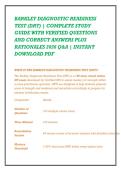
BARKLEY DIAGNOSTIC READINESS
TEST (DRT) | COMPLETE STUDY
GUIDE WITH VERIFIED QUESTIONS
AND CORRECT ANSWERS PLUS
RATIONALES 2026 Q&A | INSTANT
DOWNLOAD PDF
WHAT IS THE BARKLEY DIAGNOSTIC READINESS TEST (DRT)?
The Barkley Diagnostic Readiness Test (DRT) is a 100-item, timed online
NP exam developed by Certified NPs to assess mastery of concepts within
a nurse practitioner specialty. DRTs are designed to help students pinpoint
areas of strength and weakness and remediate accordingly to prepare for
national certification exams.
Component Details
Number of
100 multiple-choice items
Questions
Time Allowed 100 minutes
Remediation
45-minute review of incorrect answers with detailed rationales
Session
Mastery
≥ 80% total score AND within every subject area
Threshold
,Component Details
Contact Hours 2.5 contact hours available (requires ≥ 70% on second attempt)
Each DRT may be taken a maximum of 2 times per purchase (Fir
Retake Policy
Assessment and Final Assessment)
Access Period 6 months from date of purchase
CORE DOMAINS (Varies by Specialty)
Psychiatric-Mental Health NP (PMHNP)
• Scientific Foundation (neurobiology, psychopharmacology,
pathophysiology)
• Assessment and Diagnosis (DSM-5-TR criteria, differential diagnosis)
• Psychotherapy and Related Theories (CBT, DBT, IPT, family therapy)
• Psychopharmacological Treatment
• Ethics, Legal Principles, and Cultural Care
• Crisis Intervention and Safety Planning
Family NP (FNP)
• Health Promotion and Disease Prevention
• Common Acute and Chronic Conditions
• Pharmacology and Prescribing
• Diagnostic Reasoning
• Patient Education and Counseling
• Professional Practice and Ethics
,Women's Health NP (WHNP)
• Well-Woman Gynecology and Preventive Care
• Reproductive Health and Contraception
• Gynecologic Disorders
• Breast Health
• Obstetric Care
• Menopause and Perimenopause
Pediatric NP (PNP)
• Pediatric Growth and Development
• Common Pediatric Conditions
• Pediatric Pharmacology
• Immunizations and Preventive Care
• Acute and Chronic Illness Management
Adult-Gerontology Acute Care NP (AGACNP)
• Acute and Critical Care Management
• Complex Chronic Conditions
• Procedural Skills
• Pharmacology in Acute Care
• End-of-Life and Palliative Care
SECTION A: PSYCHIATRIC-MENTAL HEALTH (PMHNP) –
QUESTIONS 1–30
Question 1
, A patient with major depressive disorder reports diminished interest in
all activities, fatigue, and poor concentration. Which neurotransmitter
systems are most implicated in these symptoms?
A. GABA and glutamate
B. Dopamine and serotonin
C. Acetylcholine and histamine
D. Endorphins and norepinephrine
B
RATIONALE: Major depressive symptoms stem largely from
dysregulation of serotonin and dopamine pathways, which influence
mood, energy, motivation, and concentration. Norepinephrine is also
often involved but dopamine-serotonin imbalance is the foundational
pairing. GABA and glutamate primarily mediate anxiety and cognition
rather than depressive affect.
Question 2
A 30-year-old client with panic disorder experiences episodes of
intense fear, palpitations, and shortness of breath. Which brain structure
is primarily involved in generating the "fight or flight" response?
A. Amygdala
B. Hippocampus
C. Thalamus
D. Prefrontal cortex
A
RATIONALE: The amygdala triggers the sympathetic nervous system
response characteristic of panic attacks. The hippocampus modulates
contextual memory of fear, the thalamus transmits sensory input, and the
prefrontal cortex regulates emotion but does not generate panic.
TEST (DRT) | COMPLETE STUDY
GUIDE WITH VERIFIED QUESTIONS
AND CORRECT ANSWERS PLUS
RATIONALES 2026 Q&A | INSTANT
DOWNLOAD PDF
WHAT IS THE BARKLEY DIAGNOSTIC READINESS TEST (DRT)?
The Barkley Diagnostic Readiness Test (DRT) is a 100-item, timed online
NP exam developed by Certified NPs to assess mastery of concepts within
a nurse practitioner specialty. DRTs are designed to help students pinpoint
areas of strength and weakness and remediate accordingly to prepare for
national certification exams.
Component Details
Number of
100 multiple-choice items
Questions
Time Allowed 100 minutes
Remediation
45-minute review of incorrect answers with detailed rationales
Session
Mastery
≥ 80% total score AND within every subject area
Threshold
,Component Details
Contact Hours 2.5 contact hours available (requires ≥ 70% on second attempt)
Each DRT may be taken a maximum of 2 times per purchase (Fir
Retake Policy
Assessment and Final Assessment)
Access Period 6 months from date of purchase
CORE DOMAINS (Varies by Specialty)
Psychiatric-Mental Health NP (PMHNP)
• Scientific Foundation (neurobiology, psychopharmacology,
pathophysiology)
• Assessment and Diagnosis (DSM-5-TR criteria, differential diagnosis)
• Psychotherapy and Related Theories (CBT, DBT, IPT, family therapy)
• Psychopharmacological Treatment
• Ethics, Legal Principles, and Cultural Care
• Crisis Intervention and Safety Planning
Family NP (FNP)
• Health Promotion and Disease Prevention
• Common Acute and Chronic Conditions
• Pharmacology and Prescribing
• Diagnostic Reasoning
• Patient Education and Counseling
• Professional Practice and Ethics
,Women's Health NP (WHNP)
• Well-Woman Gynecology and Preventive Care
• Reproductive Health and Contraception
• Gynecologic Disorders
• Breast Health
• Obstetric Care
• Menopause and Perimenopause
Pediatric NP (PNP)
• Pediatric Growth and Development
• Common Pediatric Conditions
• Pediatric Pharmacology
• Immunizations and Preventive Care
• Acute and Chronic Illness Management
Adult-Gerontology Acute Care NP (AGACNP)
• Acute and Critical Care Management
• Complex Chronic Conditions
• Procedural Skills
• Pharmacology in Acute Care
• End-of-Life and Palliative Care
SECTION A: PSYCHIATRIC-MENTAL HEALTH (PMHNP) –
QUESTIONS 1–30
Question 1
, A patient with major depressive disorder reports diminished interest in
all activities, fatigue, and poor concentration. Which neurotransmitter
systems are most implicated in these symptoms?
A. GABA and glutamate
B. Dopamine and serotonin
C. Acetylcholine and histamine
D. Endorphins and norepinephrine
B
RATIONALE: Major depressive symptoms stem largely from
dysregulation of serotonin and dopamine pathways, which influence
mood, energy, motivation, and concentration. Norepinephrine is also
often involved but dopamine-serotonin imbalance is the foundational
pairing. GABA and glutamate primarily mediate anxiety and cognition
rather than depressive affect.
Question 2
A 30-year-old client with panic disorder experiences episodes of
intense fear, palpitations, and shortness of breath. Which brain structure
is primarily involved in generating the "fight or flight" response?
A. Amygdala
B. Hippocampus
C. Thalamus
D. Prefrontal cortex
A
RATIONALE: The amygdala triggers the sympathetic nervous system
response characteristic of panic attacks. The hippocampus modulates
contextual memory of fear, the thalamus transmits sensory input, and the
prefrontal cortex regulates emotion but does not generate panic.


