

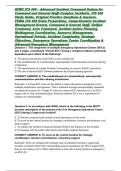
NIMS ICS 400 – Advanced Incident Command System for
Command and General Staff–Complex Incidents, ICS 400
Study Guide, Original Practice Questions & Answers,
FEMA ICS 400 Exam Preparation, Comprehensive Incident
Management Review, Command & General Staff, Unified
Command, Area Command, Incident Action Planning,
Multiagency Coordination, Resource Management,
Operational Periods, Incident Complexity, Strategic
Objectives, Emergency Operations Center Coordination &
Advanced Emergency Management
Question 1: The integration of multiple Emergency Operations Centers (EOCs)
into a single, coordinated "Virtual EOC" during a complex incident is primarily
dependent upon which of the following?
A. The physical proximity of the EOCs to the incident site
B. The establishment of a standardized, interoperable communications and data-sharing
architecture
C. The appointment of a single Incident Commander to oversee all EOC operations
D. The use of identical EOC software platforms by all participating agencies
CORRECT ANSWER: B. The establishment of a standardized, interoperable
communications and data-sharing architecture
Rationale: A Virtual EOC relies on the ability to share information seamlessly across
multiple jurisdictions and agencies. This is achieved through interoperability standards,
not physical location (A). A single IC does not oversee EOC operations (C), as EOCs
support the IC and coordinate policy. Identical software (D) is not a requirement if
systems are interoperable.
Question 2: In accordance with NIMS, which of the following is the MOST
accurate description of the primary role of an Emergency Operations Center
(EOC) during a large-scale incident?
A. To directly command and control tactical operations on the scene
B. To serve as the central location for strategic coordination, resource prioritization, and
policy support
C. To replace the Incident Command System (ICS) for the duration of the incident
D. To manage only the public information and media relations functions
CORRECT ANSWER: B. To serve as the central location for strategic
coordination, resource prioritization, and policy support
Rationale: EOCs are designed for strategic and coordination functions, supporting
incident command rather than commanding tactical operations (A). EOCs support ICS,
they do not replace it (C). Public information is only one of many functions managed at
an EOC (D).
,Question 3: A jurisdiction has activated its EOC in response to a rapidly
evolving flood event. The Policy Group has just issued a strategic objective to
"preserve life and protect critical infrastructure." What is the EOC Director's
MOST appropriate immediate action regarding this guidance?
A. Transmit the objective directly to the Operations Section for tactical implementation
B. Translate the strategic guidance into specific operational priorities and resource
allocation strategies for the EOC staff
C. Convene the Joint Information Center (JIC) to release this objective to the public
D. Advise the Policy Group that objectives must be more granular before EOC planning
can begin
CORRECT ANSWER: B. Translate the strategic guidance into specific
operational priorities and resource allocation strategies for the EOC staff
Rationale: The EOC Director is responsible for translating broad policy and strategic
guidance from the Policy Group into actionable operational priorities for the EOC's
support functions. Directly assigning to Operations (A) bypasses the planning process.
Informing the public (C) is a JIC function, but not the immediate first step. The guidance
is appropriate for directing planning (D).
Question 4: During a multi-agency response, a significant resource request
from a local Incident Commander cannot be fulfilled by the local jurisdiction.
What is the established NIMS process for this request to be addressed at the
EOC?
A. The request is immediately elevated to the National Response Coordination Center
(NRCC)
B. The request is validated by the EOC's Logistics Section and, if unfilled locally,
submitted to the next higher level of government's EOC or mutual aid system
C. The request is denied and the Incident Commander is directed to demobilize the
need
D. The request is forwarded to the Joint Field Office (JFO) for final approval
CORRECT ANSWER: B. The request is validated by the EOC's Logistics Section
and, if unfilled locally, submitted to the next higher level of government's EOC
or mutual aid system
Rationale: Resource requests generally flow through a tiered system. EOC Logistics
validates requests and first tries to fill them locally; if not possible, they are escalated to
the next level (state or regional). Immediate elevation to the NRCC or JFO (A and D)
bypasses intermediate levels. Denying a valid request is not standard practice (C).
,Question 5: Which of the following scenarios BEST demonstrates the concept
of "unity of command" being applied effectively in a complex incident
involving multiple jurisdictions?
A. A single Incident Commander is designated for the entire incident, and all agencies
report directly to that IC
B. Each agency operates independently but shares information through the EOC, with
each agency head directing their own personnel
C. All personnel involved in the response report to a single supervisor within their
respective agency, but the overall strategic direction is coordinated by a Unified
Command
D. The EOC Director issues tactical orders directly to ground units to ensure a unified
response strategy
CORRECT ANSWER: C. All personnel involved in the response report to a
single supervisor within their respective agency, but the overall strategic
direction is coordinated by a Unified Command
Rationale: Unity of command means each person reports to only one designated
supervisor. In a multi-jurisdictional incident, having agency-specific supervisors
maintain that chain of command, while a Unified Command coordinates overall strategy,
is the most practical and effective application. A single IC over all agencies (A) may not
be feasible. Independent operations (B) lack coordination. EOC Director issuing tactical
orders (D) violates the principle that tactical command is on-scene.
Question 6: When expanding an incident organization from a Type 4 to a Type
1 incident, which of the following is the MOST likely consequence for the
EOC's role and function?
A. The EOC will transition from a support role to assuming on-scene command
B. The EOC's function will expand to include more strategic and intergovernmental
coordination, with increased staffing and resource management activity
C. The EOC will be deactivated because the on-scene Incident Command can handle all
needs
D. The EOC will focus exclusively on public information and media relations
CORRECT ANSWER: B. The EOC's function will expand to include more
strategic and intergovernmental coordination, with increased staffing and
resource management activity
Rationale: As incidents grow in complexity, the need for EOC support escalates. EOCs
handle more strategic coordination, resource logistics, and policy issues to relieve the
on-scene command. EOCs do not take over tactical command (A). Deactivation (C) is
the opposite of what happens. EOC functions are comprehensive, not limited to public
information (D).
, Question 7: A major metropolitan area is hosting a large international sporting
event. What is the MOST appropriate NIMS structure for coordinating security,
medical, and transportation services provided by multiple agencies and
jurisdictions?
A. A single Incident Command Post (ICP) for the entire event
B. A Unified Area Command (UAC) to manage the overall event, with multi-agency
coordination at an EOC
C. Each agency operating under its own separate Incident Management Team (IMT)
D. A single Emergency Operations Center (EOC) replacing all other command structures
CORRECT ANSWER: B. A Unified Area Command (UAC) to manage the overall
event, with multi-agency coordination at an EOC
Rationale: A large, planned event with multiple agencies and jurisdictions is best
managed with a Unified Area Command to provide overall strategic direction, while an
EOC provides coordination and support. A single ICP (A) is for on-scene tactical
management of a specific area, not a large geographic event. Separate IMTs (C) would
lack coordination. An EOC does not replace command structures (D).
Question 8: The transition from a response-oriented EOC organization to a
recovery-oriented one is a critical juncture. What is the PRIMARY indicator
that this transition is appropriate?
A. The incident has been declared over by the Incident Commander
B. The focus shifts from immediate life-safety and stabilization to the restoration of
critical infrastructure, economic recovery, and long-term community support
C. All state and federal assistance has been approved and allocated
D. The EOC Director has received a formal demobilization order
CORRECT ANSWER: B. The focus shifts from immediate life-safety and
stabilization to the restoration of critical infrastructure, economic recovery,
and long-term community support
Rationale: The shift from response to recovery is defined by a fundamental change in
objectives: from managing the immediate crisis to restoring normalcy. The IC may
declare the response phase over (A), but the recovery work continues. Resource
approval (C) and demobilization orders (D) are administrative steps that occur during
this transition, but the primary indicator is the change in operational focus.
Question 9: In the context of NIMS, what is the primary distinction between a
"complex incident" and a "large-scale incident"?
A. Large-scale incidents are defined by the number of personnel, while complex
incidents are defined by the geographic area
B. Complex incidents involve multi-agency and multi-jurisdictional coordination, while
Command and General Staff–Complex Incidents, ICS 400
Study Guide, Original Practice Questions & Answers,
FEMA ICS 400 Exam Preparation, Comprehensive Incident
Management Review, Command & General Staff, Unified
Command, Area Command, Incident Action Planning,
Multiagency Coordination, Resource Management,
Operational Periods, Incident Complexity, Strategic
Objectives, Emergency Operations Center Coordination &
Advanced Emergency Management
Question 1: The integration of multiple Emergency Operations Centers (EOCs)
into a single, coordinated "Virtual EOC" during a complex incident is primarily
dependent upon which of the following?
A. The physical proximity of the EOCs to the incident site
B. The establishment of a standardized, interoperable communications and data-sharing
architecture
C. The appointment of a single Incident Commander to oversee all EOC operations
D. The use of identical EOC software platforms by all participating agencies
CORRECT ANSWER: B. The establishment of a standardized, interoperable
communications and data-sharing architecture
Rationale: A Virtual EOC relies on the ability to share information seamlessly across
multiple jurisdictions and agencies. This is achieved through interoperability standards,
not physical location (A). A single IC does not oversee EOC operations (C), as EOCs
support the IC and coordinate policy. Identical software (D) is not a requirement if
systems are interoperable.
Question 2: In accordance with NIMS, which of the following is the MOST
accurate description of the primary role of an Emergency Operations Center
(EOC) during a large-scale incident?
A. To directly command and control tactical operations on the scene
B. To serve as the central location for strategic coordination, resource prioritization, and
policy support
C. To replace the Incident Command System (ICS) for the duration of the incident
D. To manage only the public information and media relations functions
CORRECT ANSWER: B. To serve as the central location for strategic
coordination, resource prioritization, and policy support
Rationale: EOCs are designed for strategic and coordination functions, supporting
incident command rather than commanding tactical operations (A). EOCs support ICS,
they do not replace it (C). Public information is only one of many functions managed at
an EOC (D).
,Question 3: A jurisdiction has activated its EOC in response to a rapidly
evolving flood event. The Policy Group has just issued a strategic objective to
"preserve life and protect critical infrastructure." What is the EOC Director's
MOST appropriate immediate action regarding this guidance?
A. Transmit the objective directly to the Operations Section for tactical implementation
B. Translate the strategic guidance into specific operational priorities and resource
allocation strategies for the EOC staff
C. Convene the Joint Information Center (JIC) to release this objective to the public
D. Advise the Policy Group that objectives must be more granular before EOC planning
can begin
CORRECT ANSWER: B. Translate the strategic guidance into specific
operational priorities and resource allocation strategies for the EOC staff
Rationale: The EOC Director is responsible for translating broad policy and strategic
guidance from the Policy Group into actionable operational priorities for the EOC's
support functions. Directly assigning to Operations (A) bypasses the planning process.
Informing the public (C) is a JIC function, but not the immediate first step. The guidance
is appropriate for directing planning (D).
Question 4: During a multi-agency response, a significant resource request
from a local Incident Commander cannot be fulfilled by the local jurisdiction.
What is the established NIMS process for this request to be addressed at the
EOC?
A. The request is immediately elevated to the National Response Coordination Center
(NRCC)
B. The request is validated by the EOC's Logistics Section and, if unfilled locally,
submitted to the next higher level of government's EOC or mutual aid system
C. The request is denied and the Incident Commander is directed to demobilize the
need
D. The request is forwarded to the Joint Field Office (JFO) for final approval
CORRECT ANSWER: B. The request is validated by the EOC's Logistics Section
and, if unfilled locally, submitted to the next higher level of government's EOC
or mutual aid system
Rationale: Resource requests generally flow through a tiered system. EOC Logistics
validates requests and first tries to fill them locally; if not possible, they are escalated to
the next level (state or regional). Immediate elevation to the NRCC or JFO (A and D)
bypasses intermediate levels. Denying a valid request is not standard practice (C).
,Question 5: Which of the following scenarios BEST demonstrates the concept
of "unity of command" being applied effectively in a complex incident
involving multiple jurisdictions?
A. A single Incident Commander is designated for the entire incident, and all agencies
report directly to that IC
B. Each agency operates independently but shares information through the EOC, with
each agency head directing their own personnel
C. All personnel involved in the response report to a single supervisor within their
respective agency, but the overall strategic direction is coordinated by a Unified
Command
D. The EOC Director issues tactical orders directly to ground units to ensure a unified
response strategy
CORRECT ANSWER: C. All personnel involved in the response report to a
single supervisor within their respective agency, but the overall strategic
direction is coordinated by a Unified Command
Rationale: Unity of command means each person reports to only one designated
supervisor. In a multi-jurisdictional incident, having agency-specific supervisors
maintain that chain of command, while a Unified Command coordinates overall strategy,
is the most practical and effective application. A single IC over all agencies (A) may not
be feasible. Independent operations (B) lack coordination. EOC Director issuing tactical
orders (D) violates the principle that tactical command is on-scene.
Question 6: When expanding an incident organization from a Type 4 to a Type
1 incident, which of the following is the MOST likely consequence for the
EOC's role and function?
A. The EOC will transition from a support role to assuming on-scene command
B. The EOC's function will expand to include more strategic and intergovernmental
coordination, with increased staffing and resource management activity
C. The EOC will be deactivated because the on-scene Incident Command can handle all
needs
D. The EOC will focus exclusively on public information and media relations
CORRECT ANSWER: B. The EOC's function will expand to include more
strategic and intergovernmental coordination, with increased staffing and
resource management activity
Rationale: As incidents grow in complexity, the need for EOC support escalates. EOCs
handle more strategic coordination, resource logistics, and policy issues to relieve the
on-scene command. EOCs do not take over tactical command (A). Deactivation (C) is
the opposite of what happens. EOC functions are comprehensive, not limited to public
information (D).
, Question 7: A major metropolitan area is hosting a large international sporting
event. What is the MOST appropriate NIMS structure for coordinating security,
medical, and transportation services provided by multiple agencies and
jurisdictions?
A. A single Incident Command Post (ICP) for the entire event
B. A Unified Area Command (UAC) to manage the overall event, with multi-agency
coordination at an EOC
C. Each agency operating under its own separate Incident Management Team (IMT)
D. A single Emergency Operations Center (EOC) replacing all other command structures
CORRECT ANSWER: B. A Unified Area Command (UAC) to manage the overall
event, with multi-agency coordination at an EOC
Rationale: A large, planned event with multiple agencies and jurisdictions is best
managed with a Unified Area Command to provide overall strategic direction, while an
EOC provides coordination and support. A single ICP (A) is for on-scene tactical
management of a specific area, not a large geographic event. Separate IMTs (C) would
lack coordination. An EOC does not replace command structures (D).
Question 8: The transition from a response-oriented EOC organization to a
recovery-oriented one is a critical juncture. What is the PRIMARY indicator
that this transition is appropriate?
A. The incident has been declared over by the Incident Commander
B. The focus shifts from immediate life-safety and stabilization to the restoration of
critical infrastructure, economic recovery, and long-term community support
C. All state and federal assistance has been approved and allocated
D. The EOC Director has received a formal demobilization order
CORRECT ANSWER: B. The focus shifts from immediate life-safety and
stabilization to the restoration of critical infrastructure, economic recovery,
and long-term community support
Rationale: The shift from response to recovery is defined by a fundamental change in
objectives: from managing the immediate crisis to restoring normalcy. The IC may
declare the response phase over (A), but the recovery work continues. Resource
approval (C) and demobilization orders (D) are administrative steps that occur during
this transition, but the primary indicator is the change in operational focus.
Question 9: In the context of NIMS, what is the primary distinction between a
"complex incident" and a "large-scale incident"?
A. Large-scale incidents are defined by the number of personnel, while complex
incidents are defined by the geographic area
B. Complex incidents involve multi-agency and multi-jurisdictional coordination, while


