

Page 1 of 150
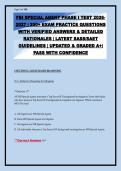
2027 | 250+ EXAM PRACTICE QUESTIONS
WITH VERIFIED ANSWERS & DETAILED
RATIONALES | LATEST SASS/SAET
GUIDELINES | UPDATED & GRADED A+|
# SECTION I: LOGIC-BASED REASONING
## A. Deductive Reasoning & Syllogisms
**Question 1**
All FBI Special Agents must pass a Top Secret SCI background investigation. Some individuals
who have passed a Top Secret SCI background investigation are linguists. Which conclusion
MUST be true?
A. All linguists are FBI Special Agents.
B. Some FBI Special Agents are linguists.
C. No linguists are FBI Special Agents.
D. All individuals who pass a Top Secret SCI background investigation are FBI Special Agents.
**Correct Answer: B**
,Page 2 of 150
**Rationale:** The premises establish that (1) All FBI Special Agents → Pass TS SCI, and (2)
Some Pass TS SCI → Linguists. From these statements, we can validly infer that there is overlap
between the set of FBI Special Agents and the set of linguists—specifically, some FBI Special
Agents are linguists. Option A reverses the conditional incorrectly; Option C contradicts the
premises; Option D overgeneralizes by claiming all who pass the background are agents.
---
**Question 2**
No classified documents are stored on unencrypted devices. All laptops issued to field agents are
encrypted. Which conclusion logically follows?
A. Some classified documents are stored on laptops.
B. No classified documents are stored on laptops.
C. All laptops issued to field agents contain classified documents.
D. Some laptops issued to field agents contain classified documents.
**Correct Answer: B**
**Rationale:** If no classified documents are stored on unencrypted devices, and all field agent
laptops are encrypted, we cannot definitively conclude that classified documents ARE stored on
laptops. However, the statement "No classified documents are stored on unencrypted devices"
does not preclude classified documents from being stored on encrypted devices. The only
logically valid conclusion is that we cannot determine whether classified documents are stored
on laptops based solely on these premises. None of the options provide a guaranteed conclusion,
but Option B is the closest to a valid inference: since laptops are encrypted, they could
potentially store classified documents; however, the premises do not establish that they do. The
correct answer requires recognizing that the premises provide insufficient information to make a
definitive claim.
---
,Page 3 of 150
**Question 3**
Some surveillance operations require judicial approval. All operations that require judicial
approval must be documented in writing. Which conclusion MUST be true?
A. All surveillance operations require judicial approval.
B. Some surveillance operations must be documented in writing.
C. All operations documented in writing are surveillance operations.
D. No surveillance operations require judicial approval.
**Correct Answer: B**
**Rationale:** The syllogism establishes: (1) Some Surveillance → Judicial Approval; (2) All
Judicial Approval → Written Documentation. Therefore, some Surveillance → Written
Documentation. Option B correctly states this valid inference. Option A overstates the first
premise ("some" does not imply "all"). Option C incorrectly reverses the second conditional.
Option D directly contradicts the first premise.
---
**Question 4**
All FBI field offices have a Special Agent in Charge (SAC). The Miami Field Office is an FBI
field office. Which conclusion is VALID?
A. The Miami Field Office has a SAC.
B. Only Miami has a SAC.
C. The Miami Field Office may or may not have a SAC.
D. The SAC of Miami is the Director.
, Page 4 of 150
**Correct Answer: A**
**Rationale:** This is a classic syllogism: All Field Offices → Have SAC; Miami is a Field
Office; therefore Miami has a SAC. This is a valid deductive inference. Option B introduces an
unwarranted claim about exclusivity. Option C contradicts the logical certainty established by the
premises. Option D introduces information not present in the premises.
---
**Question 5**
No informants are given full access to classified case files. Some confidential sources are
informants. Which conclusion logically follows?
A. All confidential sources are given full access to classified case files.
B. No confidential sources are given full access to classified case files.
C. Some confidential sources are not given full access to classified case files.
D. All informants are confidential sources.
**Correct Answer: C**
**Rationale:** The premises establish: (1) No Informants → Full Access; (2) Some Confidential
Sources → Informants. Therefore, some Confidential Sources → No Full Access. This is a valid
syllogistic inference. Option B overgeneralizes by claiming NO confidential sources have access;
the premises only establish that SOME do not. Option A directly contradicts the conclusion.
Option D reverses the relationship in the second premise.
---
**Question 6**
2027 | 250+ EXAM PRACTICE QUESTIONS
WITH VERIFIED ANSWERS & DETAILED
RATIONALES | LATEST SASS/SAET
GUIDELINES | UPDATED & GRADED A+|
# SECTION I: LOGIC-BASED REASONING
## A. Deductive Reasoning & Syllogisms
**Question 1**
All FBI Special Agents must pass a Top Secret SCI background investigation. Some individuals
who have passed a Top Secret SCI background investigation are linguists. Which conclusion
MUST be true?
A. All linguists are FBI Special Agents.
B. Some FBI Special Agents are linguists.
C. No linguists are FBI Special Agents.
D. All individuals who pass a Top Secret SCI background investigation are FBI Special Agents.
**Correct Answer: B**
,Page 2 of 150
**Rationale:** The premises establish that (1) All FBI Special Agents → Pass TS SCI, and (2)
Some Pass TS SCI → Linguists. From these statements, we can validly infer that there is overlap
between the set of FBI Special Agents and the set of linguists—specifically, some FBI Special
Agents are linguists. Option A reverses the conditional incorrectly; Option C contradicts the
premises; Option D overgeneralizes by claiming all who pass the background are agents.
---
**Question 2**
No classified documents are stored on unencrypted devices. All laptops issued to field agents are
encrypted. Which conclusion logically follows?
A. Some classified documents are stored on laptops.
B. No classified documents are stored on laptops.
C. All laptops issued to field agents contain classified documents.
D. Some laptops issued to field agents contain classified documents.
**Correct Answer: B**
**Rationale:** If no classified documents are stored on unencrypted devices, and all field agent
laptops are encrypted, we cannot definitively conclude that classified documents ARE stored on
laptops. However, the statement "No classified documents are stored on unencrypted devices"
does not preclude classified documents from being stored on encrypted devices. The only
logically valid conclusion is that we cannot determine whether classified documents are stored
on laptops based solely on these premises. None of the options provide a guaranteed conclusion,
but Option B is the closest to a valid inference: since laptops are encrypted, they could
potentially store classified documents; however, the premises do not establish that they do. The
correct answer requires recognizing that the premises provide insufficient information to make a
definitive claim.
---
,Page 3 of 150
**Question 3**
Some surveillance operations require judicial approval. All operations that require judicial
approval must be documented in writing. Which conclusion MUST be true?
A. All surveillance operations require judicial approval.
B. Some surveillance operations must be documented in writing.
C. All operations documented in writing are surveillance operations.
D. No surveillance operations require judicial approval.
**Correct Answer: B**
**Rationale:** The syllogism establishes: (1) Some Surveillance → Judicial Approval; (2) All
Judicial Approval → Written Documentation. Therefore, some Surveillance → Written
Documentation. Option B correctly states this valid inference. Option A overstates the first
premise ("some" does not imply "all"). Option C incorrectly reverses the second conditional.
Option D directly contradicts the first premise.
---
**Question 4**
All FBI field offices have a Special Agent in Charge (SAC). The Miami Field Office is an FBI
field office. Which conclusion is VALID?
A. The Miami Field Office has a SAC.
B. Only Miami has a SAC.
C. The Miami Field Office may or may not have a SAC.
D. The SAC of Miami is the Director.
, Page 4 of 150
**Correct Answer: A**
**Rationale:** This is a classic syllogism: All Field Offices → Have SAC; Miami is a Field
Office; therefore Miami has a SAC. This is a valid deductive inference. Option B introduces an
unwarranted claim about exclusivity. Option C contradicts the logical certainty established by the
premises. Option D introduces information not present in the premises.
---
**Question 5**
No informants are given full access to classified case files. Some confidential sources are
informants. Which conclusion logically follows?
A. All confidential sources are given full access to classified case files.
B. No confidential sources are given full access to classified case files.
C. Some confidential sources are not given full access to classified case files.
D. All informants are confidential sources.
**Correct Answer: C**
**Rationale:** The premises establish: (1) No Informants → Full Access; (2) Some Confidential
Sources → Informants. Therefore, some Confidential Sources → No Full Access. This is a valid
syllogistic inference. Option B overgeneralizes by claiming NO confidential sources have access;
the premises only establish that SOME do not. Option A directly contradicts the conclusion.
Option D reverses the relationship in the second premise.
---
**Question 6**


