
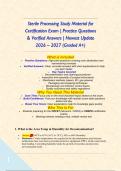
Sterile Processing Study Material for
What is Included
• Practice Questions: High-yield questions covering core sterilization and
reprocessing concepts.
• Verified Answers: Clear, accurate answers with short explanations to help
you learn faster.
• Key Topics Covered:
o Decontamination and cleaning procedures
o Inspection and assembly of surgical instruments
o Sterilization methods (steam, EO, gas plasma)
o Packaging and wrapping techniques
o Microbiology and infection control basics
o Quality assurance and safety regulations
Why You Need This Material
Save Time: Focus only on the most important topics tested on the exam.
•
• Build Confidence: Test your knowledge with realistic exam-style questions
before test day.
• Boost Your Score: Clear explanations help fix knowledge gaps quickly.
Who This Is For
• Students preparing for the CRCST (Iahcsmm / HSPA) or CBSPD certification
exams.
• Working trainees needing a fast, reliable review tool.
1. What is the Area Temp & Humidity for Decontamination?
• Answer✅: 60°F to 65°F (16°C to 18°C), 30% to 60% Humidity
• Rationale: Cooler temperatures are required in the decontamination area because
technicians must wear heavy personal protective equipment (PPE), which causes body
heat buildup. Controlling humidity limits the growth of microbes and prevents
environmental mold.
1
, 2. What is the air exchange rate & pressure type for
Decontamination?
• Answer✅: 10 air exchanges per hour under Negative Pressure
• Rationale: Negative pressure prevents airborne contaminants, bioaerosols, and odors
from escaping into adjacent clean areas of the facility. The high air exchange rate
continually purifies the atmosphere.
3. What is the Area Temp & Humidity for the Sterile Storage Area?
• Answer✅: 68°F to 75°F (20°C to 24°C), 35% to 70% Humidity
• Rationale: Controlled parameters in sterile storage prevent moisture from
compromising sterile packaging. High humidity can cause packaging materials to
absorb moisture and create pathways for microbes ("wicking").
4. What is the Area Temp & Humidity for the Prep & Packaging
Area?
• Answer✅: 68°F to 73°F (20°C to 23°C), Ideal Humidity 50% (not lower than 35%)
• Rationale: This temperature range ensures comfort for technicians wearing standard
gowns. Keeping humidity above 35% prevents structural dryness, which can interfere
with the sterilization penetration of certain gasses and steam.
5. The main role of sterile processing is to:
• Answer✅: Provide dependable reliable services to enhance the quality of patient
care.
• Rationale: The central mission of the sterile processing department is to support
clinical staff and ensure patient safety by rendering medical devices safe, functional,
and completely free of pathogens.
6. Ethics is the practice of:
• Answer✅: Doing the right thing.
• Rationale: Ethics involves conforming to accepted professional standards and
conduct, choosing appropriate actions even when unsupervised, and protecting patient
safety at all times.
2
, 7. Which of the following establishes sterilization practice standards
based on opinion, research, and/or theory:
• Answer✅: AAMI (Association for the Advancement of Medical Instrumentation)
• Rationale: AAMI develops peer-reviewed, industry-recognized benchmarks and
recommended practices that outline optimal standards for safe sterilization and device
reprocessing.
8. EPA, FDA, OSHA and state departments of health (DOH)
primarily issue:
• Answer✅: Regulations.
• Rationale: These entities are government-backed regulatory bodies. Unlike
professional associations that write standards or guidelines, government agencies
enforce legally binding rules (regulations) that facilities must follow by law.
9. Standards for CS/SPD practice are written by:
• Answer✅: AAMI
• Rationale: AAMI is the primary organization responsible for establishing official
standards for cleaning, disinfecting, and sterilizing medical equipment in Central
Sterile Supply/Sterile Processing Departments.
10. The Health Insurance Portability and Accountability Act provides
for which ethical issue?
• Answer✅: Confidentiality
• Rationale: HIPAA protects the privacy of Protected Health Information (PHI).
Maintaining confidentiality means patient data, names, or procedural information
must never be exposed or discussed outside of necessary clinical pathways.
11. If healthcare facilities reprocess single-use devices, the devices
must be cleared by:
• Answer✅: FDA (Food and Drug Administration)
• Rationale: The FDA regulates medical devices. A facility that reprocesses a single-
use device (SUD) is legally classified as a manufacturer and must pass strict FDA
clearance protocols to prove the device is safe to reuse.
3
What is Included
• Practice Questions: High-yield questions covering core sterilization and
reprocessing concepts.
• Verified Answers: Clear, accurate answers with short explanations to help
you learn faster.
• Key Topics Covered:
o Decontamination and cleaning procedures
o Inspection and assembly of surgical instruments
o Sterilization methods (steam, EO, gas plasma)
o Packaging and wrapping techniques
o Microbiology and infection control basics
o Quality assurance and safety regulations
Why You Need This Material
Save Time: Focus only on the most important topics tested on the exam.
•
• Build Confidence: Test your knowledge with realistic exam-style questions
before test day.
• Boost Your Score: Clear explanations help fix knowledge gaps quickly.
Who This Is For
• Students preparing for the CRCST (Iahcsmm / HSPA) or CBSPD certification
exams.
• Working trainees needing a fast, reliable review tool.
1. What is the Area Temp & Humidity for Decontamination?
• Answer✅: 60°F to 65°F (16°C to 18°C), 30% to 60% Humidity
• Rationale: Cooler temperatures are required in the decontamination area because
technicians must wear heavy personal protective equipment (PPE), which causes body
heat buildup. Controlling humidity limits the growth of microbes and prevents
environmental mold.
1
, 2. What is the air exchange rate & pressure type for
Decontamination?
• Answer✅: 10 air exchanges per hour under Negative Pressure
• Rationale: Negative pressure prevents airborne contaminants, bioaerosols, and odors
from escaping into adjacent clean areas of the facility. The high air exchange rate
continually purifies the atmosphere.
3. What is the Area Temp & Humidity for the Sterile Storage Area?
• Answer✅: 68°F to 75°F (20°C to 24°C), 35% to 70% Humidity
• Rationale: Controlled parameters in sterile storage prevent moisture from
compromising sterile packaging. High humidity can cause packaging materials to
absorb moisture and create pathways for microbes ("wicking").
4. What is the Area Temp & Humidity for the Prep & Packaging
Area?
• Answer✅: 68°F to 73°F (20°C to 23°C), Ideal Humidity 50% (not lower than 35%)
• Rationale: This temperature range ensures comfort for technicians wearing standard
gowns. Keeping humidity above 35% prevents structural dryness, which can interfere
with the sterilization penetration of certain gasses and steam.
5. The main role of sterile processing is to:
• Answer✅: Provide dependable reliable services to enhance the quality of patient
care.
• Rationale: The central mission of the sterile processing department is to support
clinical staff and ensure patient safety by rendering medical devices safe, functional,
and completely free of pathogens.
6. Ethics is the practice of:
• Answer✅: Doing the right thing.
• Rationale: Ethics involves conforming to accepted professional standards and
conduct, choosing appropriate actions even when unsupervised, and protecting patient
safety at all times.
2
, 7. Which of the following establishes sterilization practice standards
based on opinion, research, and/or theory:
• Answer✅: AAMI (Association for the Advancement of Medical Instrumentation)
• Rationale: AAMI develops peer-reviewed, industry-recognized benchmarks and
recommended practices that outline optimal standards for safe sterilization and device
reprocessing.
8. EPA, FDA, OSHA and state departments of health (DOH)
primarily issue:
• Answer✅: Regulations.
• Rationale: These entities are government-backed regulatory bodies. Unlike
professional associations that write standards or guidelines, government agencies
enforce legally binding rules (regulations) that facilities must follow by law.
9. Standards for CS/SPD practice are written by:
• Answer✅: AAMI
• Rationale: AAMI is the primary organization responsible for establishing official
standards for cleaning, disinfecting, and sterilizing medical equipment in Central
Sterile Supply/Sterile Processing Departments.
10. The Health Insurance Portability and Accountability Act provides
for which ethical issue?
• Answer✅: Confidentiality
• Rationale: HIPAA protects the privacy of Protected Health Information (PHI).
Maintaining confidentiality means patient data, names, or procedural information
must never be exposed or discussed outside of necessary clinical pathways.
11. If healthcare facilities reprocess single-use devices, the devices
must be cleared by:
• Answer✅: FDA (Food and Drug Administration)
• Rationale: The FDA regulates medical devices. A facility that reprocesses a single-
use device (SUD) is legally classified as a manufacturer and must pass strict FDA
clearance protocols to prove the device is safe to reuse.
3


