

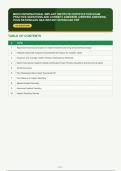
MISCH INTERNATIONAL IMPLANT INSTITUTE CERTIFICATION EXAM
PRACTICE QUESTIONS AND CORRECT ANSWERS (VERIFIED ANSWERS)
PLUS RATIONALES Q&A INSTANT DOWNLOAD PDF
150 QUESTIONS
TABLE OF CONTENTS
# TOPIC
1 Apply biomechanical principles to implant treatment planning and prosthesis design
2 Integrate advanced surgical and prosthetic techniques for complex cases
3 Diagnose and manage implant-related complications effectively
4 Misch International Implant Institute Certification Exam Practice Questions And Correct Answers
5 Verified Answers
6 Plus Rationales Q&A Instant Download Pdf
7 Foundations of Implant Dentistry
8 Applied Implant Dentistry
9 Advanced Implant Dentistry
10 Implant Dentistry Review
Page 1
,Q1 APPLY BIOMECHANICAL PRINCIPLES TO IMPLANT TREATMENT PLANNING AND
PROSTHESIS DESIGN
In the Misch prosthetic loading protocol, what is the primary determinant for
selecting immediate loading over early loading?
A. Patient's aesthetic demands
B. Implant primary stability (insertion torque 35 Ncm) and bone density CORRECT
C. Implant length and diameter
D. Surgeon's preference for surgical approach
RATIONALE: Immediate loading requires high primary stability and favorable bone density to
withstand functional forces during osseointegration. Aesthetic demands, implant dimensions, and
surgeon preference are secondary considerations. The Misch protocol emphasizes
biomechanical factors for predictable outcomes.
Q2 APPLY BIOMECHANICAL PRINCIPLES TO IMPLANT TREATMENT PLANNING AND
PROSTHESIS DESIGN
For a mandibular full-arch fixed prosthesis supported by 4 implants, which implant
configuration best distributes occlusal forces and minimizes cantilever length?
A. Two anterior and two posterior implants with a 20 mm distal cantilever
B. Four implants placed in the anterior region with a 15 mm cantilever
C. Two anterior and two posterior implants with a 10 mm distal cantilever CORRECT
D. All four implants placed with a 5 mm distal cantilever regardless of position
RATIONALE: Placing implants in the posterior region reduces cantilever length and improves
force distribution. A 10 mm cantilever is acceptable with adequate implant support, whereas
longer cantilevers increase stress. Anterior-only placement creates longer cantilevers and
unfavorable leverage.
Page 2
,Q3 APPLY BIOMECHANICAL PRINCIPLES TO IMPLANT TREATMENT PLANNING AND
PROSTHESIS DESIGN
A patient presents with an edentulous maxilla and a knife-edge ridge. Which
surgical technique is most appropriate to increase bone width and allow implant
placement?
A. Guided bone regeneration with particulate graft and resorbable membrane
B. Sinus lift with lateral window approach
C. Ridge splitting and expansion CORRECT
D. Onlay block graft from the ramus
RATIONALE: Ridge splitting is ideal for knife-edge ridges because it preserves bone and
expands the ridge width. GBR is for defects, sinus lift addresses vertical height in posterior
maxilla, and onlay grafts are for severe horizontal deficiencies. Ridge splitting provides a
contained defect for implant placement.
Q4 APPLY BIOMECHANICAL PRINCIPLES TO IMPLANT TREATMENT PLANNING AND
PROSTHESIS DESIGN
Which of the following best describes the biomechanical rationale for using a 4
mm diameter implant in the posterior region with crown-to-implant ratio exceeding
1:1?
A. It increases the surface area for osseointegration
B. It reduces stress on the crestal bone due to a wider platform CORRECT
C. It is contraindicated because of excessive crown-to-implant ratio
D. It allows for a more aesthetic emergence profile
RATIONALE: A wider implant platform distributes occlusal forces over a larger area, reducing
crestal bone stress even with a higher crown-to-implant ratio. Increased surface area is a benefit
of longer implants, not wider. It is not contraindicated if occlusal scheme is controlled, and
aesthetics is not the primary rationale.
Page 3
, Q5 APPLY BIOMECHANICAL PRINCIPLES TO IMPLANT TREATMENT PLANNING AND
PROSTHESIS DESIGN
In the Misch bone density classification, which bone type (D1, D2, D3, D4) has the
highest implant failure rate and requires the most extended healing period?
A. D1 bone
B. D2 bone
C. D3 bone
D. D4 bone CORRECT
RATIONALE: D4 bone is the least dense, often found in the posterior maxilla, and has poor
vascularity and initial stability, leading to higher failure rates. It requires longer healing (up to 8
months) and modified surgical technique. D1 bone is dense but has reduced vascularity; D2 and
D3 are more favorable.
Q6 APPLY BIOMECHANICAL PRINCIPLES TO IMPLANT TREATMENT PLANNING AND
PROSTHESIS DESIGN
A patient has a single missing mandibular first molar. The available bone height is
12 mm and width is 6 mm. Which implant design is most appropriate?
A. 8 mm long, 4 mm diameter implant
B. 10 mm long, 3.5 mm diameter implant
C. 12 mm long, 5 mm diameter implant CORRECT
D. 15 mm long, 3.5 mm diameter implant
RATIONALE: For a molar, a wider implant (5 mm) is preferred to support occlusal forces. A 12
mm length is adequate and fits the available bone. A 4 mm diameter is smaller, and 3.5 mm is
too narrow for a molar. 15 mm length may exceed available bone height.
Page 4
PRACTICE QUESTIONS AND CORRECT ANSWERS (VERIFIED ANSWERS)
PLUS RATIONALES Q&A INSTANT DOWNLOAD PDF
150 QUESTIONS
TABLE OF CONTENTS
# TOPIC
1 Apply biomechanical principles to implant treatment planning and prosthesis design
2 Integrate advanced surgical and prosthetic techniques for complex cases
3 Diagnose and manage implant-related complications effectively
4 Misch International Implant Institute Certification Exam Practice Questions And Correct Answers
5 Verified Answers
6 Plus Rationales Q&A Instant Download Pdf
7 Foundations of Implant Dentistry
8 Applied Implant Dentistry
9 Advanced Implant Dentistry
10 Implant Dentistry Review
Page 1
,Q1 APPLY BIOMECHANICAL PRINCIPLES TO IMPLANT TREATMENT PLANNING AND
PROSTHESIS DESIGN
In the Misch prosthetic loading protocol, what is the primary determinant for
selecting immediate loading over early loading?
A. Patient's aesthetic demands
B. Implant primary stability (insertion torque 35 Ncm) and bone density CORRECT
C. Implant length and diameter
D. Surgeon's preference for surgical approach
RATIONALE: Immediate loading requires high primary stability and favorable bone density to
withstand functional forces during osseointegration. Aesthetic demands, implant dimensions, and
surgeon preference are secondary considerations. The Misch protocol emphasizes
biomechanical factors for predictable outcomes.
Q2 APPLY BIOMECHANICAL PRINCIPLES TO IMPLANT TREATMENT PLANNING AND
PROSTHESIS DESIGN
For a mandibular full-arch fixed prosthesis supported by 4 implants, which implant
configuration best distributes occlusal forces and minimizes cantilever length?
A. Two anterior and two posterior implants with a 20 mm distal cantilever
B. Four implants placed in the anterior region with a 15 mm cantilever
C. Two anterior and two posterior implants with a 10 mm distal cantilever CORRECT
D. All four implants placed with a 5 mm distal cantilever regardless of position
RATIONALE: Placing implants in the posterior region reduces cantilever length and improves
force distribution. A 10 mm cantilever is acceptable with adequate implant support, whereas
longer cantilevers increase stress. Anterior-only placement creates longer cantilevers and
unfavorable leverage.
Page 2
,Q3 APPLY BIOMECHANICAL PRINCIPLES TO IMPLANT TREATMENT PLANNING AND
PROSTHESIS DESIGN
A patient presents with an edentulous maxilla and a knife-edge ridge. Which
surgical technique is most appropriate to increase bone width and allow implant
placement?
A. Guided bone regeneration with particulate graft and resorbable membrane
B. Sinus lift with lateral window approach
C. Ridge splitting and expansion CORRECT
D. Onlay block graft from the ramus
RATIONALE: Ridge splitting is ideal for knife-edge ridges because it preserves bone and
expands the ridge width. GBR is for defects, sinus lift addresses vertical height in posterior
maxilla, and onlay grafts are for severe horizontal deficiencies. Ridge splitting provides a
contained defect for implant placement.
Q4 APPLY BIOMECHANICAL PRINCIPLES TO IMPLANT TREATMENT PLANNING AND
PROSTHESIS DESIGN
Which of the following best describes the biomechanical rationale for using a 4
mm diameter implant in the posterior region with crown-to-implant ratio exceeding
1:1?
A. It increases the surface area for osseointegration
B. It reduces stress on the crestal bone due to a wider platform CORRECT
C. It is contraindicated because of excessive crown-to-implant ratio
D. It allows for a more aesthetic emergence profile
RATIONALE: A wider implant platform distributes occlusal forces over a larger area, reducing
crestal bone stress even with a higher crown-to-implant ratio. Increased surface area is a benefit
of longer implants, not wider. It is not contraindicated if occlusal scheme is controlled, and
aesthetics is not the primary rationale.
Page 3
, Q5 APPLY BIOMECHANICAL PRINCIPLES TO IMPLANT TREATMENT PLANNING AND
PROSTHESIS DESIGN
In the Misch bone density classification, which bone type (D1, D2, D3, D4) has the
highest implant failure rate and requires the most extended healing period?
A. D1 bone
B. D2 bone
C. D3 bone
D. D4 bone CORRECT
RATIONALE: D4 bone is the least dense, often found in the posterior maxilla, and has poor
vascularity and initial stability, leading to higher failure rates. It requires longer healing (up to 8
months) and modified surgical technique. D1 bone is dense but has reduced vascularity; D2 and
D3 are more favorable.
Q6 APPLY BIOMECHANICAL PRINCIPLES TO IMPLANT TREATMENT PLANNING AND
PROSTHESIS DESIGN
A patient has a single missing mandibular first molar. The available bone height is
12 mm and width is 6 mm. Which implant design is most appropriate?
A. 8 mm long, 4 mm diameter implant
B. 10 mm long, 3.5 mm diameter implant
C. 12 mm long, 5 mm diameter implant CORRECT
D. 15 mm long, 3.5 mm diameter implant
RATIONALE: For a molar, a wider implant (5 mm) is preferred to support occlusal forces. A 12
mm length is adequate and fits the available bone. A 4 mm diameter is smaller, and 3.5 mm is
too narrow for a molar. 15 mm length may exceed available bone height.
Page 4


