

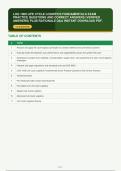
LOG 1000 LIFE CYCLE LOGISTICS FUNDAMENTALS EXAM
PRACTICE QUESTIONS AND CORRECT ANSWERS (VERIFIED
ANSWERS) PLUS RATIONALE Q&A INSTANT DOWNLOAD PDF.
130 QUESTIONS
TABLE OF CONTENTS
# TOPIC
1 Analyze and apply life cycle logistics principles to complex defense and commercial systems
2 Evaluate trade-offs between cost, performance, and supportability across the system life cycle
3 Synthesize concepts from reliability, maintainability, supply chain, and sustainment to solve novel logistics
challenges
4 Interpret and apply regulations and standards such as DoDI 5000
5 LOG 1000 Life Cycle Logistics Fundamentals Exam Practice Questions And Correct Answers
6 Verified Answers
7 Plus Rationale Q&A Instant Download Pdf.
8 Foundations of Life Cycle Logistics
9 Applied Life Cycle Logistics
10 Advanced Life Cycle Logistics
11 Life Cycle Logistics Review
Page 1
,Q1 ANALYZE AND APPLY LIFE CYCLE LOGISTICS PRINCIPLES TO COMPLEX DEFENSE AND
COMMERCIAL SYSTEMS
In a performance-based logistics (PBL) contract, which metric is most indicative of
a system's operational readiness when spare parts availability is the primary
performance driver?
A. Operational availability (Ao) CORRECT
B. Mean time between maintenance (MTBM)
C. Supply response time
D. Logistics footprint
RATIONALE: Operational availability (Ao) directly measures the percentage of time a system is
operationally ready, reflecting the combined effects of reliability and logistics support. MTBM
measures reliability, supply response time is a component, and logistics footprint is a design
constraint, not a readiness metric.
Q2 ANALYZE AND APPLY LIFE CYCLE LOGISTICS PRINCIPLES TO COMPLEX DEFENSE AND
COMMERCIAL SYSTEMS
A program manager is deciding between two alternative designs. Design X has a
higher acquisition cost but lower operating and support costs. Design Y is
cheaper to acquire but has higher sustainment costs. Which analytical approach
best supports this decision, considering the entire life cycle?
A. Cost-benefit analysis
B. Life cycle cost (LCC) analysis CORRECT
C. Total ownership cost (TOC) estimation
D. Design-to-cost (DTC) trade-off
RATIONALE: Life cycle cost (LCC) analysis evaluates all costs from acquisition through disposal,
enabling trade-offs between procurement and sustainment. TOC is broader (includes
infrastructure), DTC is a management philosophy, and cost-benefit analysis is a different
framework.
Page 2
,Q3 ANALYZE AND APPLY LIFE CYCLE LOGISTICS PRINCIPLES TO COMPLEX DEFENSE AND
COMMERCIAL SYSTEMS
In the context of configuration management (CM) per ANSI/EIA-649, which activity
is primarily associated with the 'configuration status accounting' function?
A. Validating that the physical item matches the documentation
B. Recording and reporting the current configuration and proposed changes CORRECT
C. Assessing the impact of proposed changes on system performance
D. Obtaining approval for engineering change proposals
RATIONALE: Configuration status accounting involves recording and reporting information about
the product's configuration, including approved changes and their implementation status.
Verification is part of configuration verification, impact analysis is in change management, and
approval is part of change control.
Q4 ANALYZE AND APPLY LIFE CYCLE LOGISTICS PRINCIPLES TO COMPLEX DEFENSE AND
COMMERCIAL SYSTEMS
A system's failure rate follows a Weibull distribution with shape parameter = 2.5
and scale parameter = 1000 hours. What is the probability that the system
survives beyond 800 hours?
A. e^{-0.8^{2.5}}
B. e^{-(800/1000)^{2.5}} CORRECT
C. 1 - e^{-(800/1000)^{2.5}}
D. (800/1000)^{2.5}
RATIONALE: The reliability function for a Weibull distribution is R(t) = e^{-(t/)^}. Substituting t =
800, = 1000, = 2.5 gives e^{-(800/1000)^{2.5}}. Option A incorrectly swaps parameters, C gives
the cumulative failure probability, and D is the unreliability term.
Page 3
, Q5 ANALYZE AND APPLY LIFE CYCLE LOGISTICS PRINCIPLES TO COMPLEX DEFENSE AND
COMMERCIAL SYSTEMS
In a multi-echelon supply chain, a lateral resupply policy between bases is
implemented to reduce backorders. Which of the following is a primary trade-off
that must be evaluated?
A. Reduced inventory at each base vs. increased transportation costs CORRECT
B. Increased inventory at the depot vs. reduced stock at bases
C. Lower item cost vs. higher holding cost
D. Faster repair vs. higher reliability
RATIONALE: Lateral resupply allows bases to share stock, reducing total inventory but
increasing transportation and coordination costs. The other options do not directly capture the
trade-off inherent in lateral resupply.
Q6 ANALYZE AND APPLY LIFE CYCLE LOGISTICS PRINCIPLES TO COMPLEX DEFENSE AND
COMMERCIAL SYSTEMS
Which statement best describes the role of the Product Support Manager (PSM) in
the system acquisition process under DoDI 5000.91?
A. Primarily responsible for developing the technical data package
B. Leads the development and execution of the product support strategy CORRECT
C. Focuses exclusively on cost estimation and financial management
D. Oversees the reliability testing and evaluation activities
RATIONALE: Under DoDI 5000.91, the PSM is the single point of accountability for product
support integration and the product support strategy. Technical data, cost, and reliability are
separate functional areas.
Page 4
PRACTICE QUESTIONS AND CORRECT ANSWERS (VERIFIED
ANSWERS) PLUS RATIONALE Q&A INSTANT DOWNLOAD PDF.
130 QUESTIONS
TABLE OF CONTENTS
# TOPIC
1 Analyze and apply life cycle logistics principles to complex defense and commercial systems
2 Evaluate trade-offs between cost, performance, and supportability across the system life cycle
3 Synthesize concepts from reliability, maintainability, supply chain, and sustainment to solve novel logistics
challenges
4 Interpret and apply regulations and standards such as DoDI 5000
5 LOG 1000 Life Cycle Logistics Fundamentals Exam Practice Questions And Correct Answers
6 Verified Answers
7 Plus Rationale Q&A Instant Download Pdf.
8 Foundations of Life Cycle Logistics
9 Applied Life Cycle Logistics
10 Advanced Life Cycle Logistics
11 Life Cycle Logistics Review
Page 1
,Q1 ANALYZE AND APPLY LIFE CYCLE LOGISTICS PRINCIPLES TO COMPLEX DEFENSE AND
COMMERCIAL SYSTEMS
In a performance-based logistics (PBL) contract, which metric is most indicative of
a system's operational readiness when spare parts availability is the primary
performance driver?
A. Operational availability (Ao) CORRECT
B. Mean time between maintenance (MTBM)
C. Supply response time
D. Logistics footprint
RATIONALE: Operational availability (Ao) directly measures the percentage of time a system is
operationally ready, reflecting the combined effects of reliability and logistics support. MTBM
measures reliability, supply response time is a component, and logistics footprint is a design
constraint, not a readiness metric.
Q2 ANALYZE AND APPLY LIFE CYCLE LOGISTICS PRINCIPLES TO COMPLEX DEFENSE AND
COMMERCIAL SYSTEMS
A program manager is deciding between two alternative designs. Design X has a
higher acquisition cost but lower operating and support costs. Design Y is
cheaper to acquire but has higher sustainment costs. Which analytical approach
best supports this decision, considering the entire life cycle?
A. Cost-benefit analysis
B. Life cycle cost (LCC) analysis CORRECT
C. Total ownership cost (TOC) estimation
D. Design-to-cost (DTC) trade-off
RATIONALE: Life cycle cost (LCC) analysis evaluates all costs from acquisition through disposal,
enabling trade-offs between procurement and sustainment. TOC is broader (includes
infrastructure), DTC is a management philosophy, and cost-benefit analysis is a different
framework.
Page 2
,Q3 ANALYZE AND APPLY LIFE CYCLE LOGISTICS PRINCIPLES TO COMPLEX DEFENSE AND
COMMERCIAL SYSTEMS
In the context of configuration management (CM) per ANSI/EIA-649, which activity
is primarily associated with the 'configuration status accounting' function?
A. Validating that the physical item matches the documentation
B. Recording and reporting the current configuration and proposed changes CORRECT
C. Assessing the impact of proposed changes on system performance
D. Obtaining approval for engineering change proposals
RATIONALE: Configuration status accounting involves recording and reporting information about
the product's configuration, including approved changes and their implementation status.
Verification is part of configuration verification, impact analysis is in change management, and
approval is part of change control.
Q4 ANALYZE AND APPLY LIFE CYCLE LOGISTICS PRINCIPLES TO COMPLEX DEFENSE AND
COMMERCIAL SYSTEMS
A system's failure rate follows a Weibull distribution with shape parameter = 2.5
and scale parameter = 1000 hours. What is the probability that the system
survives beyond 800 hours?
A. e^{-0.8^{2.5}}
B. e^{-(800/1000)^{2.5}} CORRECT
C. 1 - e^{-(800/1000)^{2.5}}
D. (800/1000)^{2.5}
RATIONALE: The reliability function for a Weibull distribution is R(t) = e^{-(t/)^}. Substituting t =
800, = 1000, = 2.5 gives e^{-(800/1000)^{2.5}}. Option A incorrectly swaps parameters, C gives
the cumulative failure probability, and D is the unreliability term.
Page 3
, Q5 ANALYZE AND APPLY LIFE CYCLE LOGISTICS PRINCIPLES TO COMPLEX DEFENSE AND
COMMERCIAL SYSTEMS
In a multi-echelon supply chain, a lateral resupply policy between bases is
implemented to reduce backorders. Which of the following is a primary trade-off
that must be evaluated?
A. Reduced inventory at each base vs. increased transportation costs CORRECT
B. Increased inventory at the depot vs. reduced stock at bases
C. Lower item cost vs. higher holding cost
D. Faster repair vs. higher reliability
RATIONALE: Lateral resupply allows bases to share stock, reducing total inventory but
increasing transportation and coordination costs. The other options do not directly capture the
trade-off inherent in lateral resupply.
Q6 ANALYZE AND APPLY LIFE CYCLE LOGISTICS PRINCIPLES TO COMPLEX DEFENSE AND
COMMERCIAL SYSTEMS
Which statement best describes the role of the Product Support Manager (PSM) in
the system acquisition process under DoDI 5000.91?
A. Primarily responsible for developing the technical data package
B. Leads the development and execution of the product support strategy CORRECT
C. Focuses exclusively on cost estimation and financial management
D. Oversees the reliability testing and evaluation activities
RATIONALE: Under DoDI 5000.91, the PSM is the single point of accountability for product
support integration and the product support strategy. Technical data, cost, and reliability are
separate functional areas.
Page 4


