

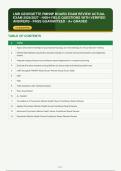
LMR GEORGETTE PMHNP BOARD EXAM REVIEW ACTUAL
EXAM 2026/2027 - HIGH-YIELD QUESTIONS WITH VERIFIED
ANSWERS - PASS GUARANTEED - A+ GRADED
170 QUESTIONS
TABLE OF CONTENTS
# TOPIC
1 Apply advanced knowledge of psychopharmacology and neurobiology to clinical decision-making
2 Differentiate between psychiatric disorders based on nuanced clinical presentations and diagnostic
criteria
3 Integrate biopsychosocial and evidence-based approaches in treatment planning
4 Evaluate the latest research and guidelines to ensure safe and effective patient care
5 LMR Georgette PMHNP Board Exam Review Actual Exam 2026
6 2027
7 High
8 Yield Questions with Verified Answers
9 Pass Guaranteed
10 A+ Graded
11 Foundations of Psychiatric-Mental Health Nurse Practitioner Board Review
12 Applied Psychiatric-Mental Health Nurse Practitioner Board Review
13 Advanced Psychiatric-Mental Health Nurse Practitioner Board Review
14 Psychiatric-Mental Health Nurse Practitioner Board Review Review
Page 1
,Q1 APPLY ADVANCED KNOWLEDGE OF PSYCHOPHARMACOLOGY AND NEUROBIOLOGY
TO CLINICAL DECISION-MAKING
Which of the following best describes the primary mechanism of action of
brexanolone in the treatment of postpartum depression?
A. Positive allosteric modulation of GABA-A receptors CORRECT
B. Inhibition of serotonin reuptake
C. Antagonism of NMDA receptors
D. Inhibition of monoamine oxidase
RATIONALE: Brexanolone is a neuroactive steroid that acts as a positive allosteric modulator of
GABA-A receptors, enhancing inhibitory neurotransmission. It is distinct from traditional
antidepressants that target monoamine systems (SSRIs, MAOIs) or NMDA receptors (ketamine).
Q2 APPLY ADVANCED KNOWLEDGE OF PSYCHOPHARMACOLOGY AND NEUROBIOLOGY
TO CLINICAL DECISION-MAKING
A patient with treatment-resistant depression has failed adequate trials of two
SSRIs and one SNRI. Based on the STAR*D trial, which of the following
augmentation strategies is most strongly supported by evidence?
A. Adding lithium to the current antidepressant
B. Switching to a tricyclic antidepressant
C. Adding bupropion to the current antidepressant CORRECT
D. Switching to a monoamine oxidase inhibitor
RATIONALE: In STAR*D, augmentation with bupropion was as effective as switching to
bupropion and had a more favorable side-effect profile. Lithium augmentation is also effective but
is typically used later due to monitoring requirements. Switching to a TCA or MAOI is not the
first-line augmentation strategy.
Page 2
,Q3 APPLY ADVANCED KNOWLEDGE OF PSYCHOPHARMACOLOGY AND NEUROBIOLOGY
TO CLINICAL DECISION-MAKING
Which of the following pharmacokinetic parameters is most likely to be affected by
the administration of carbamazepine to a patient taking clozapine?
A. Decreased clearance of clozapine due to CYP1A2 inhibition
B. Increased clearance of clozapine due to CYP3A4 induction CORRECT
C. Increased plasma levels of carbamazepine due to CYP3A4 inhibition
D. Decreased plasma levels of carbamazepine due to clozapine's enzyme induction
RATIONALE: Carbamazepine is a potent inducer of CYP3A4, which metabolizes clozapine. This
leads to increased clearance of clozapine, potentially reducing its efficacy and increasing the risk
of seizures. The combination is generally avoided due to this interaction.
Q4 APPLY ADVANCED KNOWLEDGE OF PSYCHOPHARMACOLOGY AND NEUROBIOLOGY
TO CLINICAL DECISION-MAKING
A patient with schizophrenia has persistent negative symptoms despite adequate
antipsychotic treatment. Which of the following agents has the strongest evidence
for improving negative symptoms when added to an antipsychotic?
A. Fluoxetine
B. Naltrexone
C. Modafinil
D. Glycine CORRECT
RATIONALE: Glycine, an NMDA receptor co-agonist, has shown efficacy in reducing negative
symptoms in some trials, though results are mixed. Modafinil has limited evidence, and fluoxetine
and naltrexone are not specifically indicated for negative symptoms.
Page 3
, Q5 APPLY ADVANCED KNOWLEDGE OF PSYCHOPHARMACOLOGY AND NEUROBIOLOGY
TO CLINICAL DECISION-MAKING
Which of the following best distinguishes bipolar II disorder from major
depressive disorder in a patient presenting with depressive symptoms?
A. Presence of psychotic features during depressive episodes
B. History of a hypomanic episode lasting at least 4 days CORRECT
C. Family history of bipolar disorder
D. Lack of response to antidepressant monotherapy
RATIONALE: The diagnosis of bipolar II disorder requires a history of at least one hypomanic
episode (lasting 4 days) and a major depressive episode. Psychotic features, family history, and
antidepressant response are not diagnostic criteria.
Q6 APPLY ADVANCED KNOWLEDGE OF PSYCHOPHARMACOLOGY AND NEUROBIOLOGY
TO CLINICAL DECISION-MAKING
Which of the following assessment tools is most appropriate for evaluating the
severity of a patient's obsessive-compulsive disorder in a clinical setting?
A. Hamilton Anxiety Rating Scale (HAM-A)
B. Yale-Brown Obsessive Compulsive Scale (Y-BOCS) CORRECT
C. Montgomery-Åsberg Depression Rating Scale (MADRS)
D. Mini-Mental State Examination (MMSE)
RATIONALE: The Y-BOCS is the gold standard for assessing OCD severity and treatment
response. HAM-A measures anxiety, MADRS measures depression, and MMSE screens for
cognitive impairment.
Page 4
EXAM 2026/2027 - HIGH-YIELD QUESTIONS WITH VERIFIED
ANSWERS - PASS GUARANTEED - A+ GRADED
170 QUESTIONS
TABLE OF CONTENTS
# TOPIC
1 Apply advanced knowledge of psychopharmacology and neurobiology to clinical decision-making
2 Differentiate between psychiatric disorders based on nuanced clinical presentations and diagnostic
criteria
3 Integrate biopsychosocial and evidence-based approaches in treatment planning
4 Evaluate the latest research and guidelines to ensure safe and effective patient care
5 LMR Georgette PMHNP Board Exam Review Actual Exam 2026
6 2027
7 High
8 Yield Questions with Verified Answers
9 Pass Guaranteed
10 A+ Graded
11 Foundations of Psychiatric-Mental Health Nurse Practitioner Board Review
12 Applied Psychiatric-Mental Health Nurse Practitioner Board Review
13 Advanced Psychiatric-Mental Health Nurse Practitioner Board Review
14 Psychiatric-Mental Health Nurse Practitioner Board Review Review
Page 1
,Q1 APPLY ADVANCED KNOWLEDGE OF PSYCHOPHARMACOLOGY AND NEUROBIOLOGY
TO CLINICAL DECISION-MAKING
Which of the following best describes the primary mechanism of action of
brexanolone in the treatment of postpartum depression?
A. Positive allosteric modulation of GABA-A receptors CORRECT
B. Inhibition of serotonin reuptake
C. Antagonism of NMDA receptors
D. Inhibition of monoamine oxidase
RATIONALE: Brexanolone is a neuroactive steroid that acts as a positive allosteric modulator of
GABA-A receptors, enhancing inhibitory neurotransmission. It is distinct from traditional
antidepressants that target monoamine systems (SSRIs, MAOIs) or NMDA receptors (ketamine).
Q2 APPLY ADVANCED KNOWLEDGE OF PSYCHOPHARMACOLOGY AND NEUROBIOLOGY
TO CLINICAL DECISION-MAKING
A patient with treatment-resistant depression has failed adequate trials of two
SSRIs and one SNRI. Based on the STAR*D trial, which of the following
augmentation strategies is most strongly supported by evidence?
A. Adding lithium to the current antidepressant
B. Switching to a tricyclic antidepressant
C. Adding bupropion to the current antidepressant CORRECT
D. Switching to a monoamine oxidase inhibitor
RATIONALE: In STAR*D, augmentation with bupropion was as effective as switching to
bupropion and had a more favorable side-effect profile. Lithium augmentation is also effective but
is typically used later due to monitoring requirements. Switching to a TCA or MAOI is not the
first-line augmentation strategy.
Page 2
,Q3 APPLY ADVANCED KNOWLEDGE OF PSYCHOPHARMACOLOGY AND NEUROBIOLOGY
TO CLINICAL DECISION-MAKING
Which of the following pharmacokinetic parameters is most likely to be affected by
the administration of carbamazepine to a patient taking clozapine?
A. Decreased clearance of clozapine due to CYP1A2 inhibition
B. Increased clearance of clozapine due to CYP3A4 induction CORRECT
C. Increased plasma levels of carbamazepine due to CYP3A4 inhibition
D. Decreased plasma levels of carbamazepine due to clozapine's enzyme induction
RATIONALE: Carbamazepine is a potent inducer of CYP3A4, which metabolizes clozapine. This
leads to increased clearance of clozapine, potentially reducing its efficacy and increasing the risk
of seizures. The combination is generally avoided due to this interaction.
Q4 APPLY ADVANCED KNOWLEDGE OF PSYCHOPHARMACOLOGY AND NEUROBIOLOGY
TO CLINICAL DECISION-MAKING
A patient with schizophrenia has persistent negative symptoms despite adequate
antipsychotic treatment. Which of the following agents has the strongest evidence
for improving negative symptoms when added to an antipsychotic?
A. Fluoxetine
B. Naltrexone
C. Modafinil
D. Glycine CORRECT
RATIONALE: Glycine, an NMDA receptor co-agonist, has shown efficacy in reducing negative
symptoms in some trials, though results are mixed. Modafinil has limited evidence, and fluoxetine
and naltrexone are not specifically indicated for negative symptoms.
Page 3
, Q5 APPLY ADVANCED KNOWLEDGE OF PSYCHOPHARMACOLOGY AND NEUROBIOLOGY
TO CLINICAL DECISION-MAKING
Which of the following best distinguishes bipolar II disorder from major
depressive disorder in a patient presenting with depressive symptoms?
A. Presence of psychotic features during depressive episodes
B. History of a hypomanic episode lasting at least 4 days CORRECT
C. Family history of bipolar disorder
D. Lack of response to antidepressant monotherapy
RATIONALE: The diagnosis of bipolar II disorder requires a history of at least one hypomanic
episode (lasting 4 days) and a major depressive episode. Psychotic features, family history, and
antidepressant response are not diagnostic criteria.
Q6 APPLY ADVANCED KNOWLEDGE OF PSYCHOPHARMACOLOGY AND NEUROBIOLOGY
TO CLINICAL DECISION-MAKING
Which of the following assessment tools is most appropriate for evaluating the
severity of a patient's obsessive-compulsive disorder in a clinical setting?
A. Hamilton Anxiety Rating Scale (HAM-A)
B. Yale-Brown Obsessive Compulsive Scale (Y-BOCS) CORRECT
C. Montgomery-Åsberg Depression Rating Scale (MADRS)
D. Mini-Mental State Examination (MMSE)
RATIONALE: The Y-BOCS is the gold standard for assessing OCD severity and treatment
response. HAM-A measures anxiety, MADRS measures depression, and MMSE screens for
cognitive impairment.
Page 4


