

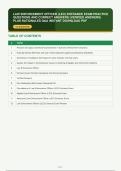
LAW ENFORCEMENT OFFICER (LEO) ENTRANCE EXAM PRACTICE
QUESTIONS AND CORRECT ANSWERS (VERIFIED ANSWERS)
PLUS RATIONALES Q&A INSTANT DOWNLOAD PDF
120 QUESTIONS
TABLE OF CONTENTS
# TOPIC
1 Analyze and apply constitutional protections in dynamic enforcement situations
2 Evaluate ethical dilemmas and use-of-force decisions against professional standards
3 Synthesize investigative techniques to solve complex criminal cases
4 Assess the impact of contemporary issues on policing strategies and community relations
5 Law Enforcement Officer
6 Entrance Exam Practice Questions And Correct Answers
7 Verified Answers
8 Plus Rationales Q&A Instant Download Pdf
9 Foundations of Law Enforcement Officer (LEO) Entrance Exam
10 Applied Law Enforcement Officer (LEO) Entrance Exam
11 Advanced Law Enforcement Officer (LEO) Entrance Exam
12 Law Enforcement Officer (LEO) Entrance Exam Review
Page 1
,Q1 ANALYZE AND APPLY CONSTITUTIONAL PROTECTIONS IN DYNAMIC ENFORCEMENT
SITUATIONS
In a high-risk traffic stop, an officer observes the driver reaching under the seat.
According to the U.S. Supreme Court's ruling in Arizona v. Johnson, which legal
standard justifies a pat-down of the driver for weapons?
A. Reasonable suspicion that the driver is involved in criminal activity CORRECT
B. Probable cause to believe the driver possesses contraband
C. The officer's subjective fear for safety, regardless of objective facts
D. The driver's failure to comply with the officer's commands
RATIONALE: Arizona v. Johnson holds that during a lawful traffic stop, an officer may pat-down a
driver if they have reasonable suspicion that the driver is armed and dangerous. This standard is
lower than probable cause and requires objective justification, not mere subjective fear. Failure to
comply alone does not justify a pat-down, and probable cause for contraband is not required.
Q2 ANALYZE AND APPLY CONSTITUTIONAL PROTECTIONS IN DYNAMIC ENFORCEMENT
SITUATIONS
An officer is considering using a particular type of force. Under the 'objective
reasonableness' standard from Graham v. Connor, which factor is LEAST relevant
to the court's analysis?
A. The severity of the crime at issue
B. Whether the suspect poses an immediate threat to the safety of officers or others
C. The officer's subjective intent or motivation CORRECT
D. Whether the suspect is actively resisting arrest or attempting to evade arrest by flight
RATIONALE: Graham v. Connor established that the reasonableness of force is judged from the
perspective of a reasonable officer on the scene, without regard to the officer's underlying intent
or motivation. The severity of the crime, immediate threat, and active resistance are all objective
factors considered by courts. Subjective intent is irrelevant to the Fourth Amendment analysis.
Page 2
,Q3 ANALYZE AND APPLY CONSTITUTIONAL PROTECTIONS IN DYNAMIC ENFORCEMENT
SITUATIONS
In the context of community policing, the SARA model is a problem-solving
framework. Which stage involves identifying the underlying causes of a recurring
crime pattern?
A. Scanning
B. Analysis CORRECT
C. Response
D. Assessment
RATIONALE: The SARA model consists of Scanning, Analysis, Response, and Assessment.
During the Analysis stage, officers systematically identify the underlying causes and conditions
that contribute to the problem. Scanning identifies the problem, Response develops
interventions, and Assessment evaluates the effectiveness of those interventions.
Q4 ANALYZE AND APPLY CONSTITUTIONAL PROTECTIONS IN DYNAMIC ENFORCEMENT
SITUATIONS
An officer testifies in court that they smelled marijuana emanating from a vehicle,
which led to a search. If the state has since legalized recreational marijuana, how
does this affect the legality of the search under the Fourth Amendment?
A. The search is automatically invalid because marijuana odor no longer indicates a crime
B. The search remains valid if the odor is still a factor in establishing probable cause for other
contraband CORRECT
C. The search is invalid unless the officer also observed other suspicious activity
D. The search is valid only if the officer obtained a warrant before searching
RATIONALE: Even if marijuana is legalized at the state level, the smell of marijuana can still
contribute to probable cause if it is associated with illegal activity, such as driving under the
influence or possession of illegal quantities. The Fourth Amendment analysis focuses on whether
the officer had a reasonable belief that evidence of a crime would be found. Legalization does not
automatically negate probable cause, but the totality of circumstances must be considered.
Page 3
, Q5 ANALYZE AND APPLY CONSTITUTIONAL PROTECTIONS IN DYNAMIC ENFORCEMENT
SITUATIONS
During a custodial interrogation, a suspect invokes their right to remain silent.
According to the Supreme Court's decision in Berghuis v. Thompkins, what must
the suspect do to stop questioning?
A. Simply remain silent for a significant period of time
B. Provide a clear, unambiguous statement that they wish to remain silent CORRECT
C. Request an attorney in writing
D. Refuse to sign a waiver of rights form
RATIONALE: In Berghuis v. Thompkins, the Court held that a suspect must unambiguously
invoke the right to remain silent; remaining silent alone is insufficient. The suspect must make a
clear statement, such as 'I want to remain silent.' Requesting an attorney is a separate right, and
refusing to sign a waiver does not necessarily invoke silence.
Q6 ANALYZE AND APPLY CONSTITUTIONAL PROTECTIONS IN DYNAMIC ENFORCEMENT
SITUATIONS
An officer is investigating a series of burglaries. Which investigative technique is
most likely to generate a lead from the public while also potentially deterring
future crimes?
A. Canvassing the neighborhood door-to-door
B. Issuing a press release with surveillance images CORRECT
C. Increasing patrol presence in the area
D. Conducting a forensic analysis of tool marks
RATIONALE: Issuing a press release with surveillance images leverages the public as force
multipliers, generating tips and leads. It also demonstrates police activity, which can deter
criminals. Canvassing and patrol are proactive but may not reach as wide an audience. Forensic
analysis is reactive and does not engage the public.
Page 4
QUESTIONS AND CORRECT ANSWERS (VERIFIED ANSWERS)
PLUS RATIONALES Q&A INSTANT DOWNLOAD PDF
120 QUESTIONS
TABLE OF CONTENTS
# TOPIC
1 Analyze and apply constitutional protections in dynamic enforcement situations
2 Evaluate ethical dilemmas and use-of-force decisions against professional standards
3 Synthesize investigative techniques to solve complex criminal cases
4 Assess the impact of contemporary issues on policing strategies and community relations
5 Law Enforcement Officer
6 Entrance Exam Practice Questions And Correct Answers
7 Verified Answers
8 Plus Rationales Q&A Instant Download Pdf
9 Foundations of Law Enforcement Officer (LEO) Entrance Exam
10 Applied Law Enforcement Officer (LEO) Entrance Exam
11 Advanced Law Enforcement Officer (LEO) Entrance Exam
12 Law Enforcement Officer (LEO) Entrance Exam Review
Page 1
,Q1 ANALYZE AND APPLY CONSTITUTIONAL PROTECTIONS IN DYNAMIC ENFORCEMENT
SITUATIONS
In a high-risk traffic stop, an officer observes the driver reaching under the seat.
According to the U.S. Supreme Court's ruling in Arizona v. Johnson, which legal
standard justifies a pat-down of the driver for weapons?
A. Reasonable suspicion that the driver is involved in criminal activity CORRECT
B. Probable cause to believe the driver possesses contraband
C. The officer's subjective fear for safety, regardless of objective facts
D. The driver's failure to comply with the officer's commands
RATIONALE: Arizona v. Johnson holds that during a lawful traffic stop, an officer may pat-down a
driver if they have reasonable suspicion that the driver is armed and dangerous. This standard is
lower than probable cause and requires objective justification, not mere subjective fear. Failure to
comply alone does not justify a pat-down, and probable cause for contraband is not required.
Q2 ANALYZE AND APPLY CONSTITUTIONAL PROTECTIONS IN DYNAMIC ENFORCEMENT
SITUATIONS
An officer is considering using a particular type of force. Under the 'objective
reasonableness' standard from Graham v. Connor, which factor is LEAST relevant
to the court's analysis?
A. The severity of the crime at issue
B. Whether the suspect poses an immediate threat to the safety of officers or others
C. The officer's subjective intent or motivation CORRECT
D. Whether the suspect is actively resisting arrest or attempting to evade arrest by flight
RATIONALE: Graham v. Connor established that the reasonableness of force is judged from the
perspective of a reasonable officer on the scene, without regard to the officer's underlying intent
or motivation. The severity of the crime, immediate threat, and active resistance are all objective
factors considered by courts. Subjective intent is irrelevant to the Fourth Amendment analysis.
Page 2
,Q3 ANALYZE AND APPLY CONSTITUTIONAL PROTECTIONS IN DYNAMIC ENFORCEMENT
SITUATIONS
In the context of community policing, the SARA model is a problem-solving
framework. Which stage involves identifying the underlying causes of a recurring
crime pattern?
A. Scanning
B. Analysis CORRECT
C. Response
D. Assessment
RATIONALE: The SARA model consists of Scanning, Analysis, Response, and Assessment.
During the Analysis stage, officers systematically identify the underlying causes and conditions
that contribute to the problem. Scanning identifies the problem, Response develops
interventions, and Assessment evaluates the effectiveness of those interventions.
Q4 ANALYZE AND APPLY CONSTITUTIONAL PROTECTIONS IN DYNAMIC ENFORCEMENT
SITUATIONS
An officer testifies in court that they smelled marijuana emanating from a vehicle,
which led to a search. If the state has since legalized recreational marijuana, how
does this affect the legality of the search under the Fourth Amendment?
A. The search is automatically invalid because marijuana odor no longer indicates a crime
B. The search remains valid if the odor is still a factor in establishing probable cause for other
contraband CORRECT
C. The search is invalid unless the officer also observed other suspicious activity
D. The search is valid only if the officer obtained a warrant before searching
RATIONALE: Even if marijuana is legalized at the state level, the smell of marijuana can still
contribute to probable cause if it is associated with illegal activity, such as driving under the
influence or possession of illegal quantities. The Fourth Amendment analysis focuses on whether
the officer had a reasonable belief that evidence of a crime would be found. Legalization does not
automatically negate probable cause, but the totality of circumstances must be considered.
Page 3
, Q5 ANALYZE AND APPLY CONSTITUTIONAL PROTECTIONS IN DYNAMIC ENFORCEMENT
SITUATIONS
During a custodial interrogation, a suspect invokes their right to remain silent.
According to the Supreme Court's decision in Berghuis v. Thompkins, what must
the suspect do to stop questioning?
A. Simply remain silent for a significant period of time
B. Provide a clear, unambiguous statement that they wish to remain silent CORRECT
C. Request an attorney in writing
D. Refuse to sign a waiver of rights form
RATIONALE: In Berghuis v. Thompkins, the Court held that a suspect must unambiguously
invoke the right to remain silent; remaining silent alone is insufficient. The suspect must make a
clear statement, such as 'I want to remain silent.' Requesting an attorney is a separate right, and
refusing to sign a waiver does not necessarily invoke silence.
Q6 ANALYZE AND APPLY CONSTITUTIONAL PROTECTIONS IN DYNAMIC ENFORCEMENT
SITUATIONS
An officer is investigating a series of burglaries. Which investigative technique is
most likely to generate a lead from the public while also potentially deterring
future crimes?
A. Canvassing the neighborhood door-to-door
B. Issuing a press release with surveillance images CORRECT
C. Increasing patrol presence in the area
D. Conducting a forensic analysis of tool marks
RATIONALE: Issuing a press release with surveillance images leverages the public as force
multipliers, generating tips and leads. It also demonstrates police activity, which can deter
criminals. Canvassing and patrol are proactive but may not reach as wide an audience. Forensic
analysis is reactive and does not engage the public.
Page 4


