

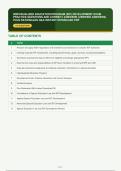
INDIVIDUALIZED EDUCATION PROGRAM (IEP) DEVELOPMENT EXAM
PRACTICE QUESTIONS AND CORRECT ANSWERS (VERIFIED ANSWERS)
PLUS RATIONALES Q&A INSTANT DOWNLOAD PDF
140 QUESTIONS
TABLE OF CONTENTS
# TOPIC
1 Analyze and apply IDEA regulations and landmark court decisions to complex IEP scenarios
2 Critically evaluate IEP components, including present levels, goals, services, and accommodations
3 Synthesize assessment data to determine eligibility and design appropriate IEPs
4 Examine the roles and responsibilities of IEP team members in ensuring FAPE and LRE
5 Evaluate procedural safeguards and dispute resolution mechanisms in special education
6 Individualized Education Program
7 Development Exam Practice Questions And Correct Answers
8 Verified Answers
9 Plus Rationales Q&A Instant Download Pdf
10 Foundations of Special Education Law and IEP Development
11 Applied Special Education Law and IEP Development
12 Advanced Special Education Law and IEP Development
13 Special Education Law and IEP Development Review
Page 1
,Q1 ANALYZE AND APPLY IDEA REGULATIONS AND LANDMARK COURT DECISIONS TO
COMPLEX IEP SCENARIOS
A student with a specific learning disability has made minimal progress toward
IEP goals despite receiving the specified special education services. The IEP team
is considering whether the student's lack of progress is due to inadequate
instruction or a need for a different instructional approach. Under IDEA, what is
the most appropriate immediate action for the team to take?
A. Immediately revise the IEP goals to make them more attainable.
B. Convene an IEP meeting to review data and determine if the student requires a change in
services or placement. CORRECT
C. Discontinue special education services until a new evaluation is conducted.
D. Refer the student for a due process hearing to resolve the instructional dispute.
RATIONALE: When a student is not making progress, the IEP team must convene to review data
and determine if the IEP is appropriate and if services need adjustment. This aligns with the
requirement to ensure FAPE. Revising goals without addressing services may not address the
root cause. Discontinuing services violates IDEA, and a due process hearing is premature
without first attempting to resolve the issue through the IEP team.
Page 2
,Q2 ANALYZE AND APPLY IDEA REGULATIONS AND LANDMARK COURT DECISIONS TO
COMPLEX IEP SCENARIOS
A school district proposes to place a student with autism in a specialized program
outside the student's neighborhood school. The student's parents disagree,
arguing that the student should be educated in the general education classroom
with supplementary aids and services. Which legal standard should the district
apply to determine whether the student's placement in the general education
classroom is appropriate?
A. The student must be placed in the general education classroom unless the district can
demonstrate that education there cannot be achieved satisfactorily with supplementary aids and
services. CORRECT
B. The district may choose any placement that is convenient and cost-effective, as long as it
provides some educational benefit.
C. The student must be placed in the most integrated setting possible, regardless of the
student's individual needs.
D. The district must prove that the student's disability is severe enough to warrant removal from
the general education classroom.
RATIONALE: IDEA's LRE mandate requires that, to the maximum extent appropriate, students
with disabilities are educated with nondisabled peers. Removal from the general education
classroom occurs only when education in general education with supplementary aids and
services cannot be achieved satisfactorily. The district must consider the full continuum of
placements, but the presumption is in favor of inclusion.
Page 3
, Q3 ANALYZE AND APPLY IDEA REGULATIONS AND LANDMARK COURT DECISIONS TO
COMPLEX IEP SCENARIOS
During an IEP meeting, the parents of a student with an intellectual disability
request that the school provide one-on-one paraprofessional support for the entire
school day. The school team believes that the student can be successful with
small-group support and assistive technology. What is the most appropriate way
to address this disagreement?
A. The school must agree to the parents' request because they are equal members of the IEP
team.
B. The school should document the disagreement and proceed with its recommended plan, as
the team has the final say.
C. The school should propose a trial period with the one-on-one support to collect data on its
effectiveness. CORRECT
D. The school should inform the parents that their request is not appropriate and refuse to
discuss it further.
RATIONALE: When there is a disagreement, it is often best to consider a data-driven trial to
evaluate the effectiveness of the proposed support. This approach respects the parents' input
while ensuring that decisions are based on evidence. Unilaterally refusing or imposing a plan
disregards the collaborative nature of the IEP process and may violate procedural safeguards.
Page 4
PRACTICE QUESTIONS AND CORRECT ANSWERS (VERIFIED ANSWERS)
PLUS RATIONALES Q&A INSTANT DOWNLOAD PDF
140 QUESTIONS
TABLE OF CONTENTS
# TOPIC
1 Analyze and apply IDEA regulations and landmark court decisions to complex IEP scenarios
2 Critically evaluate IEP components, including present levels, goals, services, and accommodations
3 Synthesize assessment data to determine eligibility and design appropriate IEPs
4 Examine the roles and responsibilities of IEP team members in ensuring FAPE and LRE
5 Evaluate procedural safeguards and dispute resolution mechanisms in special education
6 Individualized Education Program
7 Development Exam Practice Questions And Correct Answers
8 Verified Answers
9 Plus Rationales Q&A Instant Download Pdf
10 Foundations of Special Education Law and IEP Development
11 Applied Special Education Law and IEP Development
12 Advanced Special Education Law and IEP Development
13 Special Education Law and IEP Development Review
Page 1
,Q1 ANALYZE AND APPLY IDEA REGULATIONS AND LANDMARK COURT DECISIONS TO
COMPLEX IEP SCENARIOS
A student with a specific learning disability has made minimal progress toward
IEP goals despite receiving the specified special education services. The IEP team
is considering whether the student's lack of progress is due to inadequate
instruction or a need for a different instructional approach. Under IDEA, what is
the most appropriate immediate action for the team to take?
A. Immediately revise the IEP goals to make them more attainable.
B. Convene an IEP meeting to review data and determine if the student requires a change in
services or placement. CORRECT
C. Discontinue special education services until a new evaluation is conducted.
D. Refer the student for a due process hearing to resolve the instructional dispute.
RATIONALE: When a student is not making progress, the IEP team must convene to review data
and determine if the IEP is appropriate and if services need adjustment. This aligns with the
requirement to ensure FAPE. Revising goals without addressing services may not address the
root cause. Discontinuing services violates IDEA, and a due process hearing is premature
without first attempting to resolve the issue through the IEP team.
Page 2
,Q2 ANALYZE AND APPLY IDEA REGULATIONS AND LANDMARK COURT DECISIONS TO
COMPLEX IEP SCENARIOS
A school district proposes to place a student with autism in a specialized program
outside the student's neighborhood school. The student's parents disagree,
arguing that the student should be educated in the general education classroom
with supplementary aids and services. Which legal standard should the district
apply to determine whether the student's placement in the general education
classroom is appropriate?
A. The student must be placed in the general education classroom unless the district can
demonstrate that education there cannot be achieved satisfactorily with supplementary aids and
services. CORRECT
B. The district may choose any placement that is convenient and cost-effective, as long as it
provides some educational benefit.
C. The student must be placed in the most integrated setting possible, regardless of the
student's individual needs.
D. The district must prove that the student's disability is severe enough to warrant removal from
the general education classroom.
RATIONALE: IDEA's LRE mandate requires that, to the maximum extent appropriate, students
with disabilities are educated with nondisabled peers. Removal from the general education
classroom occurs only when education in general education with supplementary aids and
services cannot be achieved satisfactorily. The district must consider the full continuum of
placements, but the presumption is in favor of inclusion.
Page 3
, Q3 ANALYZE AND APPLY IDEA REGULATIONS AND LANDMARK COURT DECISIONS TO
COMPLEX IEP SCENARIOS
During an IEP meeting, the parents of a student with an intellectual disability
request that the school provide one-on-one paraprofessional support for the entire
school day. The school team believes that the student can be successful with
small-group support and assistive technology. What is the most appropriate way
to address this disagreement?
A. The school must agree to the parents' request because they are equal members of the IEP
team.
B. The school should document the disagreement and proceed with its recommended plan, as
the team has the final say.
C. The school should propose a trial period with the one-on-one support to collect data on its
effectiveness. CORRECT
D. The school should inform the parents that their request is not appropriate and refuse to
discuss it further.
RATIONALE: When there is a disagreement, it is often best to consider a data-driven trial to
evaluate the effectiveness of the proposed support. This approach respects the parents' input
while ensuring that decisions are based on evidence. Unilaterally refusing or imposing a plan
disregards the collaborative nature of the IEP process and may violate procedural safeguards.
Page 4


