

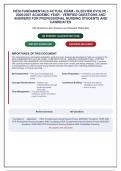
HESI FUNDAMENTALS ACTUAL EXAM - ELSEVIER EVOLVE -
2026/2027 ACADEMIC YEAR - VERIFIED QUESTIONS AND
ANSWERS FOR PROFESSIONAL NURSING STUDENTS AND
CANDIDATES
180 Questions with Answers and Detailed Rationales
100 PERCENT GUARANTEED PASS
INSTANT DOWNLOAD ANSWERS INCLUDED
IMPORTANCE OF THIS DOCUMENT
This comprehensive examination preparation guide has been meticulously developed to help you succeed in the
HESI FUNDAMENTALS ACTUAL EXAM - ELSEVIER EVOLVE - 2026/2027 ACADEMIC YEAR - VERIFIED
QUESTIONS AND ANSWERS FOR PROFESSIONAL NURSING STUDENTS AND CANDIDATES. It contains
180 carefully selected questions that reflect the most current exam content and testing strategies. Each question
is accompanied by a correct answer and a detailed rationale that explains the underlying pathophysiology,
pharmacology, or clinical reasoning.
Self-Assessment – Test your knowledge and Exam Preparation – Familiarize yourself with the
identify areas requiring further question format and content
study areas
Concept Reinforcement – Deepen your Confidence Building – Develop test-taking
understanding through strategies and reduce
evidence-based exam anxiety
rationales
Time Management – Practice answering
questions under simulated
exam conditions
Review Summary 180 Questions
Foundations - Application - HESI Fundamentals Actual Elsevier Evolve 2026/2027 Academic YEAR AND
FOR Professional Nursing Students AND Candidates HESI Fundamentals Actual Elsevier Evolve 2026/2027
Academic YEAR AND FOR Professional Nursing Students AND Candidates University
All answers with rationales
,Table of Contents
Content Area Questions Key Topics
HESI Fundamentals Actual 1-30 Preparing, Administer, Transfusion, Prevent, Indicates
Elsevier Evolve 2026/2027
Academic YEAR AND FOR
Professional Nursing
Students AND Candidates
HESI Fundamentals Actual
Elsevier Evolve 2026/2027
Academic YEAR AND FOR
Professional Nursing
Students AND Candidates
University
Administer 31-60 Finding, Preparing, Medication, Nasogastric TUBE, Patient S
Indicates 61-90 Finding, Preparing, Appropriate, Patient S, Blood
Finding 91-120 Preparing, Administer, Transfusion, Infusion, Caring
Teaching 121-150 Preparing, Administer, Intervention, Indicates, Medication
Transfusion 151-180 Teaching, Preparing, Indicates, Administer, Assessing
TOTAL 180 All questions include answers and detailed rationales
,Section A - HESI Fundamentals Actual Elsevier Evolve
2026/2027 Academic YEAR AND FOR Professional Nursing
Students AND Candidates HESI Fundamentals Actual
Elsevier Evolve 2026/2027 Academic YEAR AND FOR
Professional Nursing Students AND Candidates University
Q1.
A nurse is preparing to administer a transfusion of packed red blood cells. Which action is
most important to prevent a transfusion-associated circulatory overload (TACO) in a
patient with a history of heart failure?
A. Administer a diuretic immediately before B. Transfuse each unit over a minimum of 4
the transfusion. hours.
C. Use a transfusion pump to control the D. Assess breath sounds and weight before
rate. and after transfusion.
Correct: B - Transfuse each unit over a minimum of 4 hours.
Rationale:TACO is a common transfusion reaction in patients with cardiac compromise;
infusing each unit over 4 hours (or slower) reduces the risk of volume overload. Administering
a diuretic is not routine and may cause hypotension. A transfusion pump does not inherently
prevent volume overload. While assessment is important, it is not a preventive action.
Q2.
A patient with a pressure injury has a wound culture positive for methicillin-resistant
Staphylococcus aureus (MRSA). The nurse is applying contact precautions. Which action
is correct?
A. Wear a mask when entering the room. B. Dispose of wound dressings in a red
biohazard bag.
C. Use a dedicated stethoscope that D. Remove gloves and perform hand
remains in the room. hygiene before leaving the room.
Correct: C - Use a dedicated stethoscope that remains in the room.
Rationale:Contact precautions require dedicated equipment (e.g., stethoscope) to prevent
transmission. A mask is not required for MRSA unless there is a respiratory component.
Routine wound dressings are not typically red-bag waste unless saturated. Gloves should be
removed and hand hygiene performed after leaving the room, not before.
Page 3
, Section A - HESI Fundamentals Actual Elsevier Evolve 2026/2027 Academic YEAR AND FOR Professional Nursing Students AND Candidates
HESI Fundamentals Actual Elsevier Evolve 2026/2027 Academic YEAR AND FOR Professional Nursing Students AND Candidates University
Q3.
A nurse is calculating the intake for a patient on a clear liquid diet. The patient consumed
4 oz of gelatin, 6 oz of broth, 8 oz of apple juice, and 120 mL of water. What is the total
intake in milliliters? Record your answer as a whole number.
A. 480 B. 540
C. 600 D. 660
Correct: B - 540
Rationale:Convert ounces to mL (1 oz = 30 mL): 4 oz = 120 mL, 6 oz = 180 mL, 8 oz = 240
mL, plus 120 mL water = 660 mL. The correct calculation is 120+180+240+120 = 660, not
540. Option B is a common miscalculation (omitting the 120 mL water).
Q4.
A patient with chronic kidney disease is prescribed a low-potassium diet. Which meal
selection indicates the patient understands the diet?
A. Grilled chicken sandwich with a side of B. Turkey sub with lettuce, tomato, and a
french fries and a banana glass of orange juice
C. Cheeseburger with a side of coleslaw D. Salmon salad with spinach, avocado, and
and a pear a cup of coffee
Correct: C - Cheeseburger with a side of coleslaw and a pear
Rationale:A low-potassium diet restricts high-potassium foods like bananas, orange juice,
spinach, avocado, and tomatoes. The cheeseburger with coleslaw and pear is lowest in
potassium. Other options contain high-potassium items.
Q5.
A nurse is preparing to administer an IM injection to a patient who is very thin. Which
needle size is most appropriate?
A. 25 gauge, 5/8 inch B. 22 gauge, 1 inch
C. 20 gauge, 1 1/2 inch D. 18 gauge, 1 1/2 inch
Correct: B - 22 gauge, 1 inch
Rationale:For a thin adult, a 1-inch needle is usually sufficient to reach the deltoid or vastus
lateralis muscle without injecting into subcutaneous tissue. A 5/8-inch needle is too short for
IM in most adults. Longer needles may penetrate too deeply. The gauge is not the primary
concern.
Page 4
2026/2027 ACADEMIC YEAR - VERIFIED QUESTIONS AND
ANSWERS FOR PROFESSIONAL NURSING STUDENTS AND
CANDIDATES
180 Questions with Answers and Detailed Rationales
100 PERCENT GUARANTEED PASS
INSTANT DOWNLOAD ANSWERS INCLUDED
IMPORTANCE OF THIS DOCUMENT
This comprehensive examination preparation guide has been meticulously developed to help you succeed in the
HESI FUNDAMENTALS ACTUAL EXAM - ELSEVIER EVOLVE - 2026/2027 ACADEMIC YEAR - VERIFIED
QUESTIONS AND ANSWERS FOR PROFESSIONAL NURSING STUDENTS AND CANDIDATES. It contains
180 carefully selected questions that reflect the most current exam content and testing strategies. Each question
is accompanied by a correct answer and a detailed rationale that explains the underlying pathophysiology,
pharmacology, or clinical reasoning.
Self-Assessment – Test your knowledge and Exam Preparation – Familiarize yourself with the
identify areas requiring further question format and content
study areas
Concept Reinforcement – Deepen your Confidence Building – Develop test-taking
understanding through strategies and reduce
evidence-based exam anxiety
rationales
Time Management – Practice answering
questions under simulated
exam conditions
Review Summary 180 Questions
Foundations - Application - HESI Fundamentals Actual Elsevier Evolve 2026/2027 Academic YEAR AND
FOR Professional Nursing Students AND Candidates HESI Fundamentals Actual Elsevier Evolve 2026/2027
Academic YEAR AND FOR Professional Nursing Students AND Candidates University
All answers with rationales
,Table of Contents
Content Area Questions Key Topics
HESI Fundamentals Actual 1-30 Preparing, Administer, Transfusion, Prevent, Indicates
Elsevier Evolve 2026/2027
Academic YEAR AND FOR
Professional Nursing
Students AND Candidates
HESI Fundamentals Actual
Elsevier Evolve 2026/2027
Academic YEAR AND FOR
Professional Nursing
Students AND Candidates
University
Administer 31-60 Finding, Preparing, Medication, Nasogastric TUBE, Patient S
Indicates 61-90 Finding, Preparing, Appropriate, Patient S, Blood
Finding 91-120 Preparing, Administer, Transfusion, Infusion, Caring
Teaching 121-150 Preparing, Administer, Intervention, Indicates, Medication
Transfusion 151-180 Teaching, Preparing, Indicates, Administer, Assessing
TOTAL 180 All questions include answers and detailed rationales
,Section A - HESI Fundamentals Actual Elsevier Evolve
2026/2027 Academic YEAR AND FOR Professional Nursing
Students AND Candidates HESI Fundamentals Actual
Elsevier Evolve 2026/2027 Academic YEAR AND FOR
Professional Nursing Students AND Candidates University
Q1.
A nurse is preparing to administer a transfusion of packed red blood cells. Which action is
most important to prevent a transfusion-associated circulatory overload (TACO) in a
patient with a history of heart failure?
A. Administer a diuretic immediately before B. Transfuse each unit over a minimum of 4
the transfusion. hours.
C. Use a transfusion pump to control the D. Assess breath sounds and weight before
rate. and after transfusion.
Correct: B - Transfuse each unit over a minimum of 4 hours.
Rationale:TACO is a common transfusion reaction in patients with cardiac compromise;
infusing each unit over 4 hours (or slower) reduces the risk of volume overload. Administering
a diuretic is not routine and may cause hypotension. A transfusion pump does not inherently
prevent volume overload. While assessment is important, it is not a preventive action.
Q2.
A patient with a pressure injury has a wound culture positive for methicillin-resistant
Staphylococcus aureus (MRSA). The nurse is applying contact precautions. Which action
is correct?
A. Wear a mask when entering the room. B. Dispose of wound dressings in a red
biohazard bag.
C. Use a dedicated stethoscope that D. Remove gloves and perform hand
remains in the room. hygiene before leaving the room.
Correct: C - Use a dedicated stethoscope that remains in the room.
Rationale:Contact precautions require dedicated equipment (e.g., stethoscope) to prevent
transmission. A mask is not required for MRSA unless there is a respiratory component.
Routine wound dressings are not typically red-bag waste unless saturated. Gloves should be
removed and hand hygiene performed after leaving the room, not before.
Page 3
, Section A - HESI Fundamentals Actual Elsevier Evolve 2026/2027 Academic YEAR AND FOR Professional Nursing Students AND Candidates
HESI Fundamentals Actual Elsevier Evolve 2026/2027 Academic YEAR AND FOR Professional Nursing Students AND Candidates University
Q3.
A nurse is calculating the intake for a patient on a clear liquid diet. The patient consumed
4 oz of gelatin, 6 oz of broth, 8 oz of apple juice, and 120 mL of water. What is the total
intake in milliliters? Record your answer as a whole number.
A. 480 B. 540
C. 600 D. 660
Correct: B - 540
Rationale:Convert ounces to mL (1 oz = 30 mL): 4 oz = 120 mL, 6 oz = 180 mL, 8 oz = 240
mL, plus 120 mL water = 660 mL. The correct calculation is 120+180+240+120 = 660, not
540. Option B is a common miscalculation (omitting the 120 mL water).
Q4.
A patient with chronic kidney disease is prescribed a low-potassium diet. Which meal
selection indicates the patient understands the diet?
A. Grilled chicken sandwich with a side of B. Turkey sub with lettuce, tomato, and a
french fries and a banana glass of orange juice
C. Cheeseburger with a side of coleslaw D. Salmon salad with spinach, avocado, and
and a pear a cup of coffee
Correct: C - Cheeseburger with a side of coleslaw and a pear
Rationale:A low-potassium diet restricts high-potassium foods like bananas, orange juice,
spinach, avocado, and tomatoes. The cheeseburger with coleslaw and pear is lowest in
potassium. Other options contain high-potassium items.
Q5.
A nurse is preparing to administer an IM injection to a patient who is very thin. Which
needle size is most appropriate?
A. 25 gauge, 5/8 inch B. 22 gauge, 1 inch
C. 20 gauge, 1 1/2 inch D. 18 gauge, 1 1/2 inch
Correct: B - 22 gauge, 1 inch
Rationale:For a thin adult, a 1-inch needle is usually sufficient to reach the deltoid or vastus
lateralis muscle without injecting into subcutaneous tissue. A 5/8-inch needle is too short for
IM in most adults. Longer needles may penetrate too deeply. The gauge is not the primary
concern.
Page 4


