

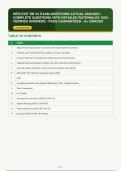
HESI EXIT RN V5 EXAM QUESTIONS ACTUAL 2026/2027 -
COMPLETE QUESTIONS WITH DETAILED RATIONALES 100%
VERIFIED ANSWERS - PASS GUARANTEED - A+ GRADED
200 QUESTIONS
TABLE OF CONTENTS
# TOPIC
1 Apply the nursing process to complex multi-system patient scenarios
2 Prioritize care and interventions based on acuity and safety
3 Analyze laboratory and diagnostic data to guide clinical decisions
4 Integrate pharmacological principles and safe medication administration
5 Evaluate patient education needs across the lifespan and settings
6 HESI EXIT RN V5 Exam Questions Actual 2026
7 2027
8 Complete Questions with Detailed Rationales 100% Verified Answers
9 Pass Guaranteed
10 A+ Graded
11 Foundations of Nursing (HESI Exit RN V5)
12 Applied Nursing (HESI Exit RN V5)
13 Advanced Nursing (HESI Exit RN V5)
14 Nursing (HESI Exit RN V5) Review
Page 1
,Q1 APPLY THE NURSING PROCESS TO COMPLEX MULTI-SYSTEM PATIENT SCENARIOS
A patient with type 1 diabetes is receiving a continuous insulin infusion for
diabetic ketoacidosis. Which laboratory value indicates a potential complication of
overly rapid correction of hyperglycemia?
A. Serum potassium of 3.0 mEq/L CORRECT
B. Serum sodium of 152 mEq/L
C. Serum osmolality of 310 mOsm/kg
D. Bicarbonate of 18 mEq/L
RATIONALE: Rapid correction of hyperglycemia causes intracellular shift of potassium, leading to
hypokalemia. Potassium levels must be monitored and replaced to prevent cardiac arrhythmias.
Hyponatremia (not hypernatremia) is common due to dilution; osmolality decreases with
treatment; bicarbonate rises gradually.
Q2 APPLY THE NURSING PROCESS TO COMPLEX MULTI-SYSTEM PATIENT SCENARIOS
Which assessment finding is most indicative of a developing compartment
syndrome in a patient with a long bone fracture?
A. Pain that is relieved by elevation
B. Weak distal pulse
C. Pain with passive stretch of the muscle CORRECT
D. Visible deformity of the limb
RATIONALE: Pain with passive stretch is an early and reliable indicator of compartment
syndrome. Pulses may remain intact until late because compartment pressure exceeds capillary
perfusion pressure before arterial occlusion. Elevation worsens pain; deformity is not specific.
Page 2
,Q3 APPLY THE NURSING PROCESS TO COMPLEX MULTI-SYSTEM PATIENT SCENARIOS
A patient with heart failure is prescribed furosemide and digoxin. Which serum
potassium level would increase the risk for digoxin toxicity?
A. 3.2 mEq/L CORRECT
B. 4.0 mEq/L
C. 4.5 mEq/L
D. 5.0 mEq/L
RATIONALE: Hypokalemia (K+ <3.5) sensitizes the myocardium to digoxin, increasing toxicity
risk. Normal potassium (4.0-5.0) is safer. Hyperkalemia may reduce digoxin effect but also poses
arrhythmia risk.
Q4 APPLY THE NURSING PROCESS TO COMPLEX MULTI-SYSTEM PATIENT SCENARIOS
Which intervention should the nurse prioritize for a patient with suspected
anaphylaxis?
A. Administer diphenhydramine IV
B. Administer epinephrine IM CORRECT
C. Start an IV line with normal saline
D. Apply oxygen via face mask
RATIONALE: Epinephrine is the first-line treatment for anaphylaxis; it reverses airway edema,
bronchospasm, and hypotension. Antihistamines are adjunctive, IV fluids and oxygen are
supportive but not primary.
Page 3
, Q5 APPLY THE NURSING PROCESS TO COMPLEX MULTI-SYSTEM PATIENT SCENARIOS
A client in active labor is receiving oxytocin. The nurse notes contractions lasting
95 seconds with a fetal heart rate deceleration to 90 bpm after the peak of the
contraction. What is the priority action?
A. Discontinue the oxytocin infusion CORRECT
B. Reposition the client on her left side
C. Increase the IV fluid rate
D. Administer oxygen at 10 L/min via face mask
RATIONALE: Late decelerations indicate uteroplacental insufficiency. The priority is to stop the
oxytocin to reduce uterine activity and improve fetal oxygenation. Repositioning, fluids, and
oxygen are secondary interventions.
Q6 APPLY THE NURSING PROCESS TO COMPLEX MULTI-SYSTEM PATIENT SCENARIOS
A patient with major depressive disorder has been taking fluoxetine for 6 weeks
without improvement. Which action should the nurse anticipate next?
A. Increase the fluoxetine dose CORRECT
B. Switch to a monoamine oxidase inhibitor
C. Add a second antidepressant from a different class
D. Discontinue fluoxetine abruptly
RATIONALE: Fluoxetine has a long half-life; therapeutic response may take 4-8 weeks.
Increasing the dose is appropriate if tolerated. MAOIs require washout and are not first-line;
adding a second agent may be considered later; abrupt discontinuation is unsafe.
Page 4
COMPLETE QUESTIONS WITH DETAILED RATIONALES 100%
VERIFIED ANSWERS - PASS GUARANTEED - A+ GRADED
200 QUESTIONS
TABLE OF CONTENTS
# TOPIC
1 Apply the nursing process to complex multi-system patient scenarios
2 Prioritize care and interventions based on acuity and safety
3 Analyze laboratory and diagnostic data to guide clinical decisions
4 Integrate pharmacological principles and safe medication administration
5 Evaluate patient education needs across the lifespan and settings
6 HESI EXIT RN V5 Exam Questions Actual 2026
7 2027
8 Complete Questions with Detailed Rationales 100% Verified Answers
9 Pass Guaranteed
10 A+ Graded
11 Foundations of Nursing (HESI Exit RN V5)
12 Applied Nursing (HESI Exit RN V5)
13 Advanced Nursing (HESI Exit RN V5)
14 Nursing (HESI Exit RN V5) Review
Page 1
,Q1 APPLY THE NURSING PROCESS TO COMPLEX MULTI-SYSTEM PATIENT SCENARIOS
A patient with type 1 diabetes is receiving a continuous insulin infusion for
diabetic ketoacidosis. Which laboratory value indicates a potential complication of
overly rapid correction of hyperglycemia?
A. Serum potassium of 3.0 mEq/L CORRECT
B. Serum sodium of 152 mEq/L
C. Serum osmolality of 310 mOsm/kg
D. Bicarbonate of 18 mEq/L
RATIONALE: Rapid correction of hyperglycemia causes intracellular shift of potassium, leading to
hypokalemia. Potassium levels must be monitored and replaced to prevent cardiac arrhythmias.
Hyponatremia (not hypernatremia) is common due to dilution; osmolality decreases with
treatment; bicarbonate rises gradually.
Q2 APPLY THE NURSING PROCESS TO COMPLEX MULTI-SYSTEM PATIENT SCENARIOS
Which assessment finding is most indicative of a developing compartment
syndrome in a patient with a long bone fracture?
A. Pain that is relieved by elevation
B. Weak distal pulse
C. Pain with passive stretch of the muscle CORRECT
D. Visible deformity of the limb
RATIONALE: Pain with passive stretch is an early and reliable indicator of compartment
syndrome. Pulses may remain intact until late because compartment pressure exceeds capillary
perfusion pressure before arterial occlusion. Elevation worsens pain; deformity is not specific.
Page 2
,Q3 APPLY THE NURSING PROCESS TO COMPLEX MULTI-SYSTEM PATIENT SCENARIOS
A patient with heart failure is prescribed furosemide and digoxin. Which serum
potassium level would increase the risk for digoxin toxicity?
A. 3.2 mEq/L CORRECT
B. 4.0 mEq/L
C. 4.5 mEq/L
D. 5.0 mEq/L
RATIONALE: Hypokalemia (K+ <3.5) sensitizes the myocardium to digoxin, increasing toxicity
risk. Normal potassium (4.0-5.0) is safer. Hyperkalemia may reduce digoxin effect but also poses
arrhythmia risk.
Q4 APPLY THE NURSING PROCESS TO COMPLEX MULTI-SYSTEM PATIENT SCENARIOS
Which intervention should the nurse prioritize for a patient with suspected
anaphylaxis?
A. Administer diphenhydramine IV
B. Administer epinephrine IM CORRECT
C. Start an IV line with normal saline
D. Apply oxygen via face mask
RATIONALE: Epinephrine is the first-line treatment for anaphylaxis; it reverses airway edema,
bronchospasm, and hypotension. Antihistamines are adjunctive, IV fluids and oxygen are
supportive but not primary.
Page 3
, Q5 APPLY THE NURSING PROCESS TO COMPLEX MULTI-SYSTEM PATIENT SCENARIOS
A client in active labor is receiving oxytocin. The nurse notes contractions lasting
95 seconds with a fetal heart rate deceleration to 90 bpm after the peak of the
contraction. What is the priority action?
A. Discontinue the oxytocin infusion CORRECT
B. Reposition the client on her left side
C. Increase the IV fluid rate
D. Administer oxygen at 10 L/min via face mask
RATIONALE: Late decelerations indicate uteroplacental insufficiency. The priority is to stop the
oxytocin to reduce uterine activity and improve fetal oxygenation. Repositioning, fluids, and
oxygen are secondary interventions.
Q6 APPLY THE NURSING PROCESS TO COMPLEX MULTI-SYSTEM PATIENT SCENARIOS
A patient with major depressive disorder has been taking fluoxetine for 6 weeks
without improvement. Which action should the nurse anticipate next?
A. Increase the fluoxetine dose CORRECT
B. Switch to a monoamine oxidase inhibitor
C. Add a second antidepressant from a different class
D. Discontinue fluoxetine abruptly
RATIONALE: Fluoxetine has a long half-life; therapeutic response may take 4-8 weeks.
Increasing the dose is appropriate if tolerated. MAOIs require washout and are not first-line;
adding a second agent may be considered later; abrupt discontinuation is unsafe.
Page 4


