

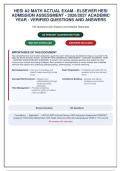
HESI A2 MATH ACTUAL EXAM - ELSEVIER HESI
ADMISSION ASSESSMENT - 2026/2027 ACADEMIC
YEAR - VERIFIED QUESTIONS AND ANSWERS
150 Questions with Answers and Detailed Rationales
100 PERCENT GUARANTEED PASS
INSTANT DOWNLOAD ANSWERS INCLUDED
IMPORTANCE OF THIS DOCUMENT
This comprehensive examination preparation guide has been meticulously developed to help you succeed in the
HESI A2 MATH ACTUAL EXAM - ELSEVIER HESI ADMISSION ASSESSMENT - 2026/2027 ACADEMIC YEAR
- VERIFIED QUESTIONS AND ANSWERS. It contains 150 carefully selected questions that reflect the most
current exam content and testing strategies. Each question is accompanied by a correct answer and a detailed
rationale that explains the underlying pathophysiology, pharmacology, or clinical reasoning.
Self-Assessment – Test your knowledge and Exam Preparation – Familiarize yourself with the
identify areas requiring further question format and content
study areas
Concept Reinforcement – Deepen your Confidence Building – Develop test-taking
understanding through strategies and reduce
evidence-based exam anxiety
rationales
Time Management – Practice answering
questions under simulated
exam conditions
Review Summary 150 Questions
Foundations - Application - HESI A2 MATH Actual Elsevier HESI Admission Assessment 2026/2027
Academic YEAR AND Mathematics FOR Health Sciences HESI A2 Undergraduate YEAR 2 / Pre-nursing
All answers with rationales
,Table of Contents
Content Area Questions Key Topics
HESI A2 MATH Actual 1-25 Hours, Patient S, Medication, DROP Factor, Infused
Elsevier HESI Admission
Assessment 2026/2027
Academic YEAR AND
Mathematics FOR Health
Sciences HESI A2
Undergraduate YEAR 2 /
Pre-nursing
Medication 26-50 Patient S, Solution, Temperature, Order, DROP Factor
Hours 51-75 Solution, Medication, Saline, Patient S, Administered
Solution 76-100 Medication, Patient S, Available, Fluid, Nearest Tenth
Order 101-125 Medication, Patient S, Hours, Weight, Milligrams
DROP Factor 126-150 Patient S, Hours, Medication, Solution, Intake
TOTAL 150 All questions include answers and detailed rationales
,Section A - HESI A2 MATH Actual Elsevier HESI Admission
Assessment 2026/2027 Academic YEAR AND Mathematics
FOR Health Sciences HESI A2 Undergraduate YEAR 2 /
Pre-nursing
Q1.
A patient's IV infusion of 1,000 mL is to run over 8 hours. The drop factor is 15 gtt/mL.
After 3 hours, the patient's IV has infused 450 mL. The nurse recalibrates the flow rate to
deliver the remaining volume over the original remaining time. What is the new flow rate in
gtt/min?
A. 25 gtt/min B. 27 gtt/min
C. 30 gtt/min D. 32 gtt/min
Correct: B - 27 gtt/min
Rationale:Remaining volume = 1000 - 450 = 550 mL; remaining time = 5 hours = 300 min.
Flow rate = (550 mL / 300 min) × 15 gtt/mL = 27.5 gtt/min, rounded to 27 gtt/min. Other
options result from miscalculating remaining time or volume.
Q2.
A solution contains 5% dextrose in water. How many grams of dextrose are present in 750
mL of this solution?
A. 37.5 g B. 3.75 g
C. 375 g D. 0.375 g
Correct: A - 37.5 g
Rationale:5% w/v means 5 g per 100 mL. In 750 mL, dextrose = (5 g/100 mL) × 750 mL =
37.5 g. Option B misplaces decimal, C uses 50%, D uses 0.05%.
Q3.
A nurse needs to administer 0.25 mg of digoxin. The available tablets are 0.125 mg each.
How many tablets should be given?
A. 1 tablet B. 1.5 tablets
C. 2 tablets D. 2.5 tablets
Correct: C - 2 tablets
Page 3
, Section A - HESI A2 MATH Actual Elsevier HESI Admission Assessment 2026/2027 Academic YEAR AND Mathematics FOR Health Sciences
HESI A2 Undergraduate YEAR 2 / Pre-nursing
Rationale: 0.25 mg ÷ 0.125 mg/tablet = 2 tablets. Option B would be for 0.1875 mg, A for
0.125 mg, D for 0.3125 mg.
Q4.
Convert 0.00045 to scientific notation.
A. 4.5 × 10 B. 4.5 × 10
C. 45 × 10 D. 4.5 × 10³
Correct: A - 4.5 × 10
Rationale:0.00045 = 4.5 × 10 { t because the decimal moves 4 places right. B is 45000, C is
0.00045 but not standard form, D is 0.0045.
Q5.
A physician orders 500 mg of a medication. The pharmacy supplies a solution of 250 mg
per 5 mL. How many mL should the nurse administer?
A. 5 mL B. 10 mL
C. 2.5 mL D. 20 mL
Correct: B - 10 mL
Rationale:Set up proportion: 250 mg/5 mL = 500 mg/x mL !’ x = (500×5)/250 = 10 mL. Option
A is for 250 mg, C for 125 mg, D for 1000 mg.
Q6.
Solve for x: 3(x - 4) + 2x = 8x - 10
A. x = -2/3 B. x = 2/3
C. x = -2 D. x = 2
Correct: A - x = -2/3
Rationale:3x - 12 + 2x = 8x - 10 !’ 5x - 12 = 8x - 10 !’ -2 = 3x !’ x = -2/3. Other options result
from algebraic sign errors.
Q7.
A patient's temperature is 101.3°F. What is this temperature in Celsius? (Round to the
nearest tenth.)
A. 38.5°C B. 38.3°C
Page 4
ADMISSION ASSESSMENT - 2026/2027 ACADEMIC
YEAR - VERIFIED QUESTIONS AND ANSWERS
150 Questions with Answers and Detailed Rationales
100 PERCENT GUARANTEED PASS
INSTANT DOWNLOAD ANSWERS INCLUDED
IMPORTANCE OF THIS DOCUMENT
This comprehensive examination preparation guide has been meticulously developed to help you succeed in the
HESI A2 MATH ACTUAL EXAM - ELSEVIER HESI ADMISSION ASSESSMENT - 2026/2027 ACADEMIC YEAR
- VERIFIED QUESTIONS AND ANSWERS. It contains 150 carefully selected questions that reflect the most
current exam content and testing strategies. Each question is accompanied by a correct answer and a detailed
rationale that explains the underlying pathophysiology, pharmacology, or clinical reasoning.
Self-Assessment – Test your knowledge and Exam Preparation – Familiarize yourself with the
identify areas requiring further question format and content
study areas
Concept Reinforcement – Deepen your Confidence Building – Develop test-taking
understanding through strategies and reduce
evidence-based exam anxiety
rationales
Time Management – Practice answering
questions under simulated
exam conditions
Review Summary 150 Questions
Foundations - Application - HESI A2 MATH Actual Elsevier HESI Admission Assessment 2026/2027
Academic YEAR AND Mathematics FOR Health Sciences HESI A2 Undergraduate YEAR 2 / Pre-nursing
All answers with rationales
,Table of Contents
Content Area Questions Key Topics
HESI A2 MATH Actual 1-25 Hours, Patient S, Medication, DROP Factor, Infused
Elsevier HESI Admission
Assessment 2026/2027
Academic YEAR AND
Mathematics FOR Health
Sciences HESI A2
Undergraduate YEAR 2 /
Pre-nursing
Medication 26-50 Patient S, Solution, Temperature, Order, DROP Factor
Hours 51-75 Solution, Medication, Saline, Patient S, Administered
Solution 76-100 Medication, Patient S, Available, Fluid, Nearest Tenth
Order 101-125 Medication, Patient S, Hours, Weight, Milligrams
DROP Factor 126-150 Patient S, Hours, Medication, Solution, Intake
TOTAL 150 All questions include answers and detailed rationales
,Section A - HESI A2 MATH Actual Elsevier HESI Admission
Assessment 2026/2027 Academic YEAR AND Mathematics
FOR Health Sciences HESI A2 Undergraduate YEAR 2 /
Pre-nursing
Q1.
A patient's IV infusion of 1,000 mL is to run over 8 hours. The drop factor is 15 gtt/mL.
After 3 hours, the patient's IV has infused 450 mL. The nurse recalibrates the flow rate to
deliver the remaining volume over the original remaining time. What is the new flow rate in
gtt/min?
A. 25 gtt/min B. 27 gtt/min
C. 30 gtt/min D. 32 gtt/min
Correct: B - 27 gtt/min
Rationale:Remaining volume = 1000 - 450 = 550 mL; remaining time = 5 hours = 300 min.
Flow rate = (550 mL / 300 min) × 15 gtt/mL = 27.5 gtt/min, rounded to 27 gtt/min. Other
options result from miscalculating remaining time or volume.
Q2.
A solution contains 5% dextrose in water. How many grams of dextrose are present in 750
mL of this solution?
A. 37.5 g B. 3.75 g
C. 375 g D. 0.375 g
Correct: A - 37.5 g
Rationale:5% w/v means 5 g per 100 mL. In 750 mL, dextrose = (5 g/100 mL) × 750 mL =
37.5 g. Option B misplaces decimal, C uses 50%, D uses 0.05%.
Q3.
A nurse needs to administer 0.25 mg of digoxin. The available tablets are 0.125 mg each.
How many tablets should be given?
A. 1 tablet B. 1.5 tablets
C. 2 tablets D. 2.5 tablets
Correct: C - 2 tablets
Page 3
, Section A - HESI A2 MATH Actual Elsevier HESI Admission Assessment 2026/2027 Academic YEAR AND Mathematics FOR Health Sciences
HESI A2 Undergraduate YEAR 2 / Pre-nursing
Rationale: 0.25 mg ÷ 0.125 mg/tablet = 2 tablets. Option B would be for 0.1875 mg, A for
0.125 mg, D for 0.3125 mg.
Q4.
Convert 0.00045 to scientific notation.
A. 4.5 × 10 B. 4.5 × 10
C. 45 × 10 D. 4.5 × 10³
Correct: A - 4.5 × 10
Rationale:0.00045 = 4.5 × 10 { t because the decimal moves 4 places right. B is 45000, C is
0.00045 but not standard form, D is 0.0045.
Q5.
A physician orders 500 mg of a medication. The pharmacy supplies a solution of 250 mg
per 5 mL. How many mL should the nurse administer?
A. 5 mL B. 10 mL
C. 2.5 mL D. 20 mL
Correct: B - 10 mL
Rationale:Set up proportion: 250 mg/5 mL = 500 mg/x mL !’ x = (500×5)/250 = 10 mL. Option
A is for 250 mg, C for 125 mg, D for 1000 mg.
Q6.
Solve for x: 3(x - 4) + 2x = 8x - 10
A. x = -2/3 B. x = 2/3
C. x = -2 D. x = 2
Correct: A - x = -2/3
Rationale:3x - 12 + 2x = 8x - 10 !’ 5x - 12 = 8x - 10 !’ -2 = 3x !’ x = -2/3. Other options result
from algebraic sign errors.
Q7.
A patient's temperature is 101.3°F. What is this temperature in Celsius? (Round to the
nearest tenth.)
A. 38.5°C B. 38.3°C
Page 4


