

BIOCHEMISTRY I (CHEM-UA 881)
SPRING 2026
PRACTICE MIDTERM EXAM 1
KEY
Time: 60 minutes
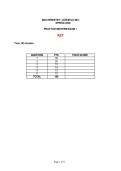
QUESTION PTS YOUR SCORE
1 30
2 20
3 12
4 14
5 12
6 12
TOTAL 100
Page 1 of 9
,1. Multiple Choice. Circle the correct answer for each. (3 points each; 30 total)
i. Which of the following amino acids is least likely to be present in an alpha-helix?
a. Ala
b. Arg
c. Lys
d. Gly
e. Leu
ii. In Anfinsen’s famous protein folding experiment, a trace amount of beta-
mercaptoethanol was added to restore the native state of the protein. Why?
a. Beta-mercaptoethanol addition led to oxidation of Cys needed for disulfide
bond formation.
b. Reduction of Cys residues reduced unfavorable ion-ion interactions present in
the disulfide bonds.
c. Reduction of disulfide bonds allowed the protein to fold prior to the formation of
disulfide bonds.
d. Oxidation of Cys produces the lowest energy state of any protein that contains
Cys residues.
e. Addition of beta-mercaptoethanol encouraged the formation of intermolecular
disulfide bonds between proteins.
iii. What conundrum did Levinthal’s paradox highlight?
a. Cells must need a source of beta-mercaptoethanol in order to encourage
proper protein folding.
b. Proteins must always experience every possible folded state before reaching
the native state.
c. Protein folding must occur by the same defined path for every protein
sequence.
d. Proteins fold to their native state within seconds in cells but it would take >1020
years if every possible conformation was assumed.
e. Both b and c
iv. The amino acid sequence shown below forms a beta-strand:
TIKLSAHFD
Where would you expect to find this sequence?
a. In the interior of a protein
b. In collagen
c. On the exterior of a protein
d. In the core of a bundle
e. In silk
Page 2 of 9
, v. Curve X in the figure below depicts which of the following interactions:
X
32
a. Covalent bond
b. Hydrogen bond
c. Ionic interaction
d. van der Waals interaction
e. Fatal attraction
vi. The origin of the hydrophobic effect is:
a. Water molecules cause hydrophobic interactions because they can disrupt
surfaces with no hydrogen bonds
b. Water prefers to be close to hydrophobic surfaces but not inside.
c. Water molecules become restricted in their rotation when they are next to
hydrophobic surfaces
d. Hydrophobic molecules don't want to be stuck together inside water layers
e. All of the above
vii. The principle of microscopic reversibility for protein folding states that:
a. Identical dihedral angles will be observed for each residue in an alpha-helix
b. Identical transition states will be observed for folding and unfolding
c. beta-sheets have higher stability than alpha-helices
d. alpha-helices are early intermediates in protein folding
e. All of the above
viii. The following is true of native protein conformations versus unfolded proteins:
a. Native proteins have low entropy compared to unfolded proteins
b. Native proteins have medium entropy compared to unfolded proteins
c. Native proteins have high entropy compared to unfolded proteins
d. Native proteins have similar entropy to unfolded proteins
e. Entropy is always increasing
Page 3 of 9
SPRING 2026
PRACTICE MIDTERM EXAM 1
KEY
Time: 60 minutes
QUESTION PTS YOUR SCORE
1 30
2 20
3 12
4 14
5 12
6 12
TOTAL 100
Page 1 of 9
,1. Multiple Choice. Circle the correct answer for each. (3 points each; 30 total)
i. Which of the following amino acids is least likely to be present in an alpha-helix?
a. Ala
b. Arg
c. Lys
d. Gly
e. Leu
ii. In Anfinsen’s famous protein folding experiment, a trace amount of beta-
mercaptoethanol was added to restore the native state of the protein. Why?
a. Beta-mercaptoethanol addition led to oxidation of Cys needed for disulfide
bond formation.
b. Reduction of Cys residues reduced unfavorable ion-ion interactions present in
the disulfide bonds.
c. Reduction of disulfide bonds allowed the protein to fold prior to the formation of
disulfide bonds.
d. Oxidation of Cys produces the lowest energy state of any protein that contains
Cys residues.
e. Addition of beta-mercaptoethanol encouraged the formation of intermolecular
disulfide bonds between proteins.
iii. What conundrum did Levinthal’s paradox highlight?
a. Cells must need a source of beta-mercaptoethanol in order to encourage
proper protein folding.
b. Proteins must always experience every possible folded state before reaching
the native state.
c. Protein folding must occur by the same defined path for every protein
sequence.
d. Proteins fold to their native state within seconds in cells but it would take >1020
years if every possible conformation was assumed.
e. Both b and c
iv. The amino acid sequence shown below forms a beta-strand:
TIKLSAHFD
Where would you expect to find this sequence?
a. In the interior of a protein
b. In collagen
c. On the exterior of a protein
d. In the core of a bundle
e. In silk
Page 2 of 9
, v. Curve X in the figure below depicts which of the following interactions:
X
32
a. Covalent bond
b. Hydrogen bond
c. Ionic interaction
d. van der Waals interaction
e. Fatal attraction
vi. The origin of the hydrophobic effect is:
a. Water molecules cause hydrophobic interactions because they can disrupt
surfaces with no hydrogen bonds
b. Water prefers to be close to hydrophobic surfaces but not inside.
c. Water molecules become restricted in their rotation when they are next to
hydrophobic surfaces
d. Hydrophobic molecules don't want to be stuck together inside water layers
e. All of the above
vii. The principle of microscopic reversibility for protein folding states that:
a. Identical dihedral angles will be observed for each residue in an alpha-helix
b. Identical transition states will be observed for folding and unfolding
c. beta-sheets have higher stability than alpha-helices
d. alpha-helices are early intermediates in protein folding
e. All of the above
viii. The following is true of native protein conformations versus unfolded proteins:
a. Native proteins have low entropy compared to unfolded proteins
b. Native proteins have medium entropy compared to unfolded proteins
c. Native proteins have high entropy compared to unfolded proteins
d. Native proteins have similar entropy to unfolded proteins
e. Entropy is always increasing
Page 3 of 9


