WGU C949 - Data Structures & Algorithms exam with Complete Solution
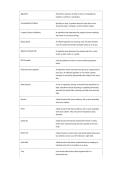
Algorithm Describes a sequence of steps to solve a computational
problem or perform a calculation.
Computational Problem Specifies an input, a question about the input that can be
answered using a computer, and the desired output.
Longest Common Substring An algorithm that determines the longest common substring
that exists in two inputs strings.
Binary Search An efficient algorithm for searching a list. The list's elements
must be sorted and directly accessible (such as an array).
Dijkstra's Shortest Path An algorithm that determines the shortest path from a start
vertex to each vertex in a graph.
NP-Complete A set of problems for which no known efficient algorithm
exists.
Polynomial time algorithm An algorithm whose execution time grows as a polynomial of
input size. An efficient algorithm is one whose runtime
increases no more than polynomially with respect to the input
size.
Data structure A way of organizing, storing, and performing operations on
data. Operations include accessing or updating stored data,
searching for specific data, inserting new data, and removing
data.
Record A data structure that stores subitems, with a name associated
with each subitem.
Array A data structure that stores subitems, with a name associated
with each subitem. May only store homogeneous data
elements.
Linked list A data structure that stores ordered list of items in nodes,
where each node stores data and has a pointer to the next
node.
Binary tree A data structure in which each node stores data and has up to
two children, known as a left child and a right child.
Hash table A data structure that stores unordered items by mapping (or
hashing) each item to a location in an array.
Tree A non-linear data structure that organizes data in a
hierarchical way.
WGU C949 - Data Structures & Algorithms exam with Complete Solution
,WGU C949 - Data Structures & Algorithms exam with Complete Solution
Heap A complete binary tree-based data structure.
Max-heap A tree that maintains the simple property that a node's key is
greater than or equal to the node's childrens' keys.
Min-heap A tree that maintains the simple property that a node's key is
less than or equal to the node's childrens' keys.
Graph A data structure for representing connections among items,
and consists of vertices connected by edges.
Vertex Represents an item in a graph.
Edge Represents a connection between two vertices in a graph.
Abstract Data Type (ADT) A data type described by predefined user operations, such as
"insert data at rear," without indicating how each operation is
implemented.
List An ADT for holding ordered data. Duplicate items are allowed.
Stack An ADT in which items are only inserted on or removed from
the top.
Queue An ADT in which items are inserted at the end and removed
from the front. referred to as a first-in first-out ADT.
Deque An ADT in which items can be inserted and removed at both
the front and back.
Bag An ADT for storing items in which the order does not matter
and duplicate items are allowed.
Set An ADT for a collection of distinct items.
Priority Queue A queue where each item has a priority, and items with higher
priority are closer to the front of the queue than items with
lower priority. Duplicates items are allowed.
Dictionary An ADT that associates (or maps) keys with values. Can be
used to describe associative relationships in Python.
Queue push Inserts an item at the end of the queue.
Queue pop Removes and returns the item at the front of the queue.
Queue peek Returns but does not remove item at the front of the queue
WGU C949 - Data Structures & Algorithms exam with Complete Solution
, WGU C949 - Data Structures & Algorithms exam with Complete Solution
Assignment statement Assigns the name on the left side to reference the value on
the right side.
Mutability Indicates whether the object's value is allowed to change.
type() A Python function that returns the class type of the argument
(object) passed as parameter.
id() A Python function that returns identity (unique integer) of an
object.
name/identifier A sequence of letters (a-z, A-Z, _) and digits (0-9), and must
start with a letter. Note that "_", called an underscore, is
considered to be a letter.
Reserved words Words that have special meaning and therefore cannot be
used as identifiers.
PEP 8 The Python style guide that outlines the basics of how to write
Python code neatly and consistently.
floating-point literal A number with a fractional part, even if that fraction is 0, as in
1.0, 0.0, or 99.573
Scientific notation A floating-point literal written using an e preceding the
power-of-10 exponent, as in 6.02e23 to represent 6.02x10^23.
The e stands for exponent. Likewise, 0.001 is 1x10-^3 so can be
written as 1.0e-3.
Overflow Occurs when a value is too large to be stored in the memory
allocated by the interpreter.
Expression A combination of items such as variables, literals, and
operators that evaluates to a value. Can be just a literal, just a
variable, or some combination of variables, literals, and
operators.
Literal A specific value in code like 2 or "abc".
Operator A symbol for a built-in language calculation like + for addition.
Modulo operator Written as %, evaluates to the remainder of the division of the
two integer operands.
String literal A string value specified in the source code of a program.
Sequence type A type that specifies a collection of objects ordered from left
to right. A string's characters are ordered from the first letter
of the string to the last.
WGU C949 - Data Structures & Algorithms exam with Complete Solution
Algorithm Describes a sequence of steps to solve a computational
problem or perform a calculation.
Computational Problem Specifies an input, a question about the input that can be
answered using a computer, and the desired output.
Longest Common Substring An algorithm that determines the longest common substring
that exists in two inputs strings.
Binary Search An efficient algorithm for searching a list. The list's elements
must be sorted and directly accessible (such as an array).
Dijkstra's Shortest Path An algorithm that determines the shortest path from a start
vertex to each vertex in a graph.
NP-Complete A set of problems for which no known efficient algorithm
exists.
Polynomial time algorithm An algorithm whose execution time grows as a polynomial of
input size. An efficient algorithm is one whose runtime
increases no more than polynomially with respect to the input
size.
Data structure A way of organizing, storing, and performing operations on
data. Operations include accessing or updating stored data,
searching for specific data, inserting new data, and removing
data.
Record A data structure that stores subitems, with a name associated
with each subitem.
Array A data structure that stores subitems, with a name associated
with each subitem. May only store homogeneous data
elements.
Linked list A data structure that stores ordered list of items in nodes,
where each node stores data and has a pointer to the next
node.
Binary tree A data structure in which each node stores data and has up to
two children, known as a left child and a right child.
Hash table A data structure that stores unordered items by mapping (or
hashing) each item to a location in an array.
Tree A non-linear data structure that organizes data in a
hierarchical way.
WGU C949 - Data Structures & Algorithms exam with Complete Solution
,WGU C949 - Data Structures & Algorithms exam with Complete Solution
Heap A complete binary tree-based data structure.
Max-heap A tree that maintains the simple property that a node's key is
greater than or equal to the node's childrens' keys.
Min-heap A tree that maintains the simple property that a node's key is
less than or equal to the node's childrens' keys.
Graph A data structure for representing connections among items,
and consists of vertices connected by edges.
Vertex Represents an item in a graph.
Edge Represents a connection between two vertices in a graph.
Abstract Data Type (ADT) A data type described by predefined user operations, such as
"insert data at rear," without indicating how each operation is
implemented.
List An ADT for holding ordered data. Duplicate items are allowed.
Stack An ADT in which items are only inserted on or removed from
the top.
Queue An ADT in which items are inserted at the end and removed
from the front. referred to as a first-in first-out ADT.
Deque An ADT in which items can be inserted and removed at both
the front and back.
Bag An ADT for storing items in which the order does not matter
and duplicate items are allowed.
Set An ADT for a collection of distinct items.
Priority Queue A queue where each item has a priority, and items with higher
priority are closer to the front of the queue than items with
lower priority. Duplicates items are allowed.
Dictionary An ADT that associates (or maps) keys with values. Can be
used to describe associative relationships in Python.
Queue push Inserts an item at the end of the queue.
Queue pop Removes and returns the item at the front of the queue.
Queue peek Returns but does not remove item at the front of the queue
WGU C949 - Data Structures & Algorithms exam with Complete Solution
, WGU C949 - Data Structures & Algorithms exam with Complete Solution
Assignment statement Assigns the name on the left side to reference the value on
the right side.
Mutability Indicates whether the object's value is allowed to change.
type() A Python function that returns the class type of the argument
(object) passed as parameter.
id() A Python function that returns identity (unique integer) of an
object.
name/identifier A sequence of letters (a-z, A-Z, _) and digits (0-9), and must
start with a letter. Note that "_", called an underscore, is
considered to be a letter.
Reserved words Words that have special meaning and therefore cannot be
used as identifiers.
PEP 8 The Python style guide that outlines the basics of how to write
Python code neatly and consistently.
floating-point literal A number with a fractional part, even if that fraction is 0, as in
1.0, 0.0, or 99.573
Scientific notation A floating-point literal written using an e preceding the
power-of-10 exponent, as in 6.02e23 to represent 6.02x10^23.
The e stands for exponent. Likewise, 0.001 is 1x10-^3 so can be
written as 1.0e-3.
Overflow Occurs when a value is too large to be stored in the memory
allocated by the interpreter.
Expression A combination of items such as variables, literals, and
operators that evaluates to a value. Can be just a literal, just a
variable, or some combination of variables, literals, and
operators.
Literal A specific value in code like 2 or "abc".
Operator A symbol for a built-in language calculation like + for addition.
Modulo operator Written as %, evaluates to the remainder of the division of the
two integer operands.
String literal A string value specified in the source code of a program.
Sequence type A type that specifies a collection of objects ordered from left
to right. A string's characters are ordered from the first letter
of the string to the last.
WGU C949 - Data Structures & Algorithms exam with Complete Solution