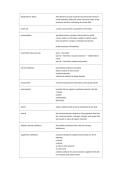
Strength and Conditioning Final Exam ISSa exam with question and answer
sliding-filament theory Actin filaments at each end of the sarcomere slide inward on
myosin filaments, pulling the z-lines toward the center of the
sarcomere and thus contracting the muscle fiber.
motor unit a motor neuron and the muscle fibers it innervates
proprioceptors specialized sensory receptors that provide the central
nervous system w/ information needed to maintain muscle
tone and perform complex coordinated movements.
bodily awareness of kinesthetics
muscle fiber types and uses type I = slow twitch
type IIa = fast twitch; muscular endurance -> middle distance
runner
type IIb = fast twitch; explosive and powerful
role of nutritionist personalized nutritional counseling
dietary analysis of food records
nutritional education
referral and treatment of eating disorders
micronutrient nutrients required by the body that it cannot produce itself
macronutrient nutrients that are required in significant amounts in the diet.
3 classes:
proteins
carbohydrates
lipids (fats)
vitamin organic substance that cannot be synthesized by the body
mineral the chemical elements required by living organisms other than
the 4 elements carbon, hydrogen, nitrogen, and oxygen that
are present in nearly all organic molecules
Anabolic steroids (definition) the synthetic derivatives of the male sex hormone,
testosterone
supplements (definition) a product intended for ingestion that includes one of the
following:
a vitamin
a mineral
an herb or other botanical
an amino acid
a dietary substance for use by humans to supplement the diet
by increasing total dietary intake
Strength and Conditioning Final Exam ISSa exam with question and answer
,Strength and Conditioning Final Exam ISSa exam with question and answer
cori cycle (definition) lactate is transported in the blood to the live where it is
converted into glucose
krebs cycle (definition) takes place in mitochondria. A series of reactions that
continue the oxidation of the substrate begun in glycosis. It's a
way we can continue to produce energy.
Minimal essential strain (MES) the threshold stimulus that initiates new bone formation
approx. 1/10 of the force required to fracture bone
Resting oxygen uptake (MET) estimated at 3.5 mL of oxygen/kg of BW/min. (mL kg ^-1 min. ^
-1)
systolic blood pressure the pressure exerted against the arterial walls as blood is
forcefully ejected during ventricular contraction.
diastolic blood pressure the pressure exerted against the arterial walls when no blood
is being forcefully ejected through the vessels
five food groups grains
vegetables
fruits
dairy
protein
axial skeleton consists of the skull, vertebral column, ribs, and sternum
appendicular skeleton includes shoulder girdle, bones of arms, wrists, hands, pelvic
girdle, and the bones of the legs, ankles, and feet
skeletal musculature a system of muscles that enables the skeleton to move
agonist muscle the muscle most involved in bringing about the movement.
Also known as the prime mover
antagonist muscle a muscle that can slow down or stop the movement
synergist muscle the muscle that assist indirectly in a movement
seasonal training frequency guidelines off-season = 4-6 times
preseason = 3-4 times
in-season = 1-3 times
postseason (active rest) = 0-3 times
superset involves 2 sequentially performed exercises that stress 2
opposing muscles or muscle areas
Strength and Conditioning Final Exam ISSa exam with question and answer
, Strength and Conditioning Final Exam ISSa exam with question and answer
compound set involves sequentially performing 2 different exercises for the
same muscle group
Strength and Conditioning Final Exam ISSa exam with question and answer
sliding-filament theory Actin filaments at each end of the sarcomere slide inward on
myosin filaments, pulling the z-lines toward the center of the
sarcomere and thus contracting the muscle fiber.
motor unit a motor neuron and the muscle fibers it innervates
proprioceptors specialized sensory receptors that provide the central
nervous system w/ information needed to maintain muscle
tone and perform complex coordinated movements.
bodily awareness of kinesthetics
muscle fiber types and uses type I = slow twitch
type IIa = fast twitch; muscular endurance -> middle distance
runner
type IIb = fast twitch; explosive and powerful
role of nutritionist personalized nutritional counseling
dietary analysis of food records
nutritional education
referral and treatment of eating disorders
micronutrient nutrients required by the body that it cannot produce itself
macronutrient nutrients that are required in significant amounts in the diet.
3 classes:
proteins
carbohydrates
lipids (fats)
vitamin organic substance that cannot be synthesized by the body
mineral the chemical elements required by living organisms other than
the 4 elements carbon, hydrogen, nitrogen, and oxygen that
are present in nearly all organic molecules
Anabolic steroids (definition) the synthetic derivatives of the male sex hormone,
testosterone
supplements (definition) a product intended for ingestion that includes one of the
following:
a vitamin
a mineral
an herb or other botanical
an amino acid
a dietary substance for use by humans to supplement the diet
by increasing total dietary intake
Strength and Conditioning Final Exam ISSa exam with question and answer
,Strength and Conditioning Final Exam ISSa exam with question and answer
cori cycle (definition) lactate is transported in the blood to the live where it is
converted into glucose
krebs cycle (definition) takes place in mitochondria. A series of reactions that
continue the oxidation of the substrate begun in glycosis. It's a
way we can continue to produce energy.
Minimal essential strain (MES) the threshold stimulus that initiates new bone formation
approx. 1/10 of the force required to fracture bone
Resting oxygen uptake (MET) estimated at 3.5 mL of oxygen/kg of BW/min. (mL kg ^-1 min. ^
-1)
systolic blood pressure the pressure exerted against the arterial walls as blood is
forcefully ejected during ventricular contraction.
diastolic blood pressure the pressure exerted against the arterial walls when no blood
is being forcefully ejected through the vessels
five food groups grains
vegetables
fruits
dairy
protein
axial skeleton consists of the skull, vertebral column, ribs, and sternum
appendicular skeleton includes shoulder girdle, bones of arms, wrists, hands, pelvic
girdle, and the bones of the legs, ankles, and feet
skeletal musculature a system of muscles that enables the skeleton to move
agonist muscle the muscle most involved in bringing about the movement.
Also known as the prime mover
antagonist muscle a muscle that can slow down or stop the movement
synergist muscle the muscle that assist indirectly in a movement
seasonal training frequency guidelines off-season = 4-6 times
preseason = 3-4 times
in-season = 1-3 times
postseason (active rest) = 0-3 times
superset involves 2 sequentially performed exercises that stress 2
opposing muscles or muscle areas
Strength and Conditioning Final Exam ISSa exam with question and answer
, Strength and Conditioning Final Exam ISSa exam with question and answer
compound set involves sequentially performing 2 different exercises for the
same muscle group
Strength and Conditioning Final Exam ISSa exam with question and answer