
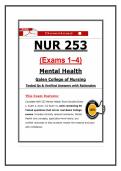
,NUR 253 EXAMS 1 – 4 | MENTAL HEALTH () PDF | GALEN
COLLEGE OF NURSING COMPLETE STUDY GUIDE WITH QUESTIONS,
VERIFIED ANSWERS & DETAILED RATIONALES
Core Domains
• Foundations of Mental Health Nursing: Mental Health Continuum, Risk
Factors, Resilience, Diathesis-Stress Model
• Therapeutic Communication & Nurse-Client Relationship: Peplau's
Theory, Communication Techniques, Defense Mechanisms
• Legal & Ethical Issues: Patient Rights, Informed Consent, Involuntary
Admission, Restraints, HIPAA, Duty to Warn
• Psychiatric Disorders: Schizophrenia, Bipolar Disorder, Major Depressive
Disorder, Anxiety Disorders, Personality Disorders
• Substance Use Disorders: Alcohol Withdrawal, Opioid Overdose, MAOI
Dietary Restrictions, Detoxification Protocols
• Psychopharmacology: Antipsychotics, Antidepressants, Mood Stabilizers,
Anxiolytics
• Grief, Loss & End-of-Life Care: Kübler-Ross Stages, Hospice,
Therapeutic Presence
• Next Generation NCLEX (NGN) Clinical Judgment: Prioritization, Case
Studies, Safety
This comprehensive examination guide is designed for nursing students
preparing for the NUR 253 Mental Health Nursing Exams 1–4 at Galen College
of Nursing for the 2026/2027 academic year. The exam covers essential mental
health nursing concepts including therapeutic communication, psychiatric
disorders, psychopharmacology, legal/ethical issues, and substance use
disorders. Questions are formatted to mirror actual Galen College exams, with
clinically relevant scenarios, application-level content, and detailed rationales to
support mastery of mental health nursing principles.
,EXAM 1: FOUNDATIONS OF MENTAL HEALTH NURSING (Questions 1-
30)
Question 1
A nurse is assessing a client who has major depressive disorder. Which
assessment finding is most concerning and requires IMMEDIATE
intervention?
A. The client reports poor appetite and difficulty sleeping.
B. The client states, "I've been giving away my belongings and saying goodbye
to people."
C. The client has a flat affect and little motivation to participate in groups.
D. The client expresses feelings of hopelessness and low self-worth.
Correct answer: B
RATIONALE: Giving away belongings and saying goodbye to people are
behavioral warning signs of suicide planning and imminent risk. This is a
psychiatric emergency requiring immediate intervention . Options A, C, and
D are symptoms of depression that require attention but do not represent the
level of immediate danger indicated by Option B.
Question 2
According to the diathesis-stress model, mental illness develops when:
A. A person experiences multiple traumatic events in childhood
B. A biological predisposition (diathesis) combines with environmental stress
or trauma
C. A person lacks adequate social support systems
D. A person's defense mechanisms become maladaptive
Correct answer: B
RATIONALE: The diathesis-stress model is the most widely accepted
explanation for mental illness. It proposes that mental disorders result from a
combination of a biological or genetic predisposition (diathesis) and
, environmental stress or trauma . Neither factor alone is sufficient to cause
mental illness.
Question 3
According to Erik Erikson, which psychosocial conflict occurs between ages 2
and 3 years?
A. Trust vs. mistrust
B. Autonomy vs. shame and doubt
C. Initiative vs. guilt
D. Industry vs. inferiority
Correct answer: B
RATIONALE: During ages 2-3, toddlers develop autonomy by learning to
control bodily functions (toilet training) and make simple choices. Success
leads to willpower; failure or excessive criticism results in shame and doubt .
Trust vs. mistrust occurs in infancy, initiative vs. guilt occurs in preschool
years, and industry vs. inferiority occurs in school-age children.
Question 4
A nurse is in the preorientation phase of the nurse-client relationship. Which
activity occurs during this phase?
A. Meeting the client for the first time
B. Preparing to meet with the client
C. Discharging the client from the unit
D. Implementing interventions with the client
Correct answer: B
RATIONALE: The preorientation phase involves preparing to meet with
the client, including reviewing available information and preparing oneself for
the interaction . Meeting the client occurs during the orientation phase;
discharging occurs during the termination phase.
COLLEGE OF NURSING COMPLETE STUDY GUIDE WITH QUESTIONS,
VERIFIED ANSWERS & DETAILED RATIONALES
Core Domains
• Foundations of Mental Health Nursing: Mental Health Continuum, Risk
Factors, Resilience, Diathesis-Stress Model
• Therapeutic Communication & Nurse-Client Relationship: Peplau's
Theory, Communication Techniques, Defense Mechanisms
• Legal & Ethical Issues: Patient Rights, Informed Consent, Involuntary
Admission, Restraints, HIPAA, Duty to Warn
• Psychiatric Disorders: Schizophrenia, Bipolar Disorder, Major Depressive
Disorder, Anxiety Disorders, Personality Disorders
• Substance Use Disorders: Alcohol Withdrawal, Opioid Overdose, MAOI
Dietary Restrictions, Detoxification Protocols
• Psychopharmacology: Antipsychotics, Antidepressants, Mood Stabilizers,
Anxiolytics
• Grief, Loss & End-of-Life Care: Kübler-Ross Stages, Hospice,
Therapeutic Presence
• Next Generation NCLEX (NGN) Clinical Judgment: Prioritization, Case
Studies, Safety
This comprehensive examination guide is designed for nursing students
preparing for the NUR 253 Mental Health Nursing Exams 1–4 at Galen College
of Nursing for the 2026/2027 academic year. The exam covers essential mental
health nursing concepts including therapeutic communication, psychiatric
disorders, psychopharmacology, legal/ethical issues, and substance use
disorders. Questions are formatted to mirror actual Galen College exams, with
clinically relevant scenarios, application-level content, and detailed rationales to
support mastery of mental health nursing principles.
,EXAM 1: FOUNDATIONS OF MENTAL HEALTH NURSING (Questions 1-
30)
Question 1
A nurse is assessing a client who has major depressive disorder. Which
assessment finding is most concerning and requires IMMEDIATE
intervention?
A. The client reports poor appetite and difficulty sleeping.
B. The client states, "I've been giving away my belongings and saying goodbye
to people."
C. The client has a flat affect and little motivation to participate in groups.
D. The client expresses feelings of hopelessness and low self-worth.
Correct answer: B
RATIONALE: Giving away belongings and saying goodbye to people are
behavioral warning signs of suicide planning and imminent risk. This is a
psychiatric emergency requiring immediate intervention . Options A, C, and
D are symptoms of depression that require attention but do not represent the
level of immediate danger indicated by Option B.
Question 2
According to the diathesis-stress model, mental illness develops when:
A. A person experiences multiple traumatic events in childhood
B. A biological predisposition (diathesis) combines with environmental stress
or trauma
C. A person lacks adequate social support systems
D. A person's defense mechanisms become maladaptive
Correct answer: B
RATIONALE: The diathesis-stress model is the most widely accepted
explanation for mental illness. It proposes that mental disorders result from a
combination of a biological or genetic predisposition (diathesis) and
, environmental stress or trauma . Neither factor alone is sufficient to cause
mental illness.
Question 3
According to Erik Erikson, which psychosocial conflict occurs between ages 2
and 3 years?
A. Trust vs. mistrust
B. Autonomy vs. shame and doubt
C. Initiative vs. guilt
D. Industry vs. inferiority
Correct answer: B
RATIONALE: During ages 2-3, toddlers develop autonomy by learning to
control bodily functions (toilet training) and make simple choices. Success
leads to willpower; failure or excessive criticism results in shame and doubt .
Trust vs. mistrust occurs in infancy, initiative vs. guilt occurs in preschool
years, and industry vs. inferiority occurs in school-age children.
Question 4
A nurse is in the preorientation phase of the nurse-client relationship. Which
activity occurs during this phase?
A. Meeting the client for the first time
B. Preparing to meet with the client
C. Discharging the client from the unit
D. Implementing interventions with the client
Correct answer: B
RATIONALE: The preorientation phase involves preparing to meet with
the client, including reviewing available information and preparing oneself for
the interaction . Meeting the client occurs during the orientation phase;
discharging occurs during the termination phase.


