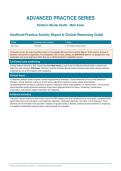
ADVANCED PRACTICE SERIES
Pediatric Mental Health - Mark Kwan
Unofficial Practice Activity Report & Clinical Reasoning Guide
Patient Confirmed chief complaint Series
Mark Kwan Withdrawn APS Pediatric Mental Health 1
This guide mirrors the major workflow shown in the supplied Ramone Garcia Activity Report: Vitals, Inquiry, Review of
Systems, Assessment, Diagnostics, Final Diagnosis, Plan of Care, Billing, and EMPOWER debrief. It is designed for case
preparation and study alignment rather than as an official Sentinel U completion record.
Confirmed case positioning
Publicly indexed Sentinel U APS material identifies Mark Kwan as one of the five Pediatric Mental Health 1 patients and
labels the chief complaint Withdrawn. Sentinel U's official Pediatric Mental Health Encounters description likewise identifies
withdrawal as one of the module's chief complaints.
Clinical focus
A withdrawn pediatric patient requires a broad biopsychosocial evaluation. Social withdrawal can occur with depressive
disorders, anxiety disorders, bullying or school stress, adjustment reactions, trauma-related presentations,
neurodevelopmental conditions, substance exposure, medication effects, sleep problems, or medical illness. The encounter
should therefore avoid prematurely assigning a psychiatric diagnosis before the history, functioning, mental-status
examination, and relevant medical information are integrated.
Evidence boundary
The public sources located for Mark Kwan confirm his APS category and chief complaint but do not expose a complete official
patient transcript, exact vital signs, exact diagnostic selections, medication selections, ICD code, or final diagnosis. Those
elements are not invented in this document. Instead, the guide provides a detailed, evidence-based framework for producing
a complete and defensible response when working through the simulation.
Unofficial educational practice companion - not an official Sentinel U Activity Report 1
, Section-by-Section APS Alignment
The supplied example uses a 20-point patient encounter. This guide retains that architecture so the study workflow stays
aligned with the Activity Report format.
Section Example Mark Kwan preparation target
weighting
Vitals 1 Recognize physiologic clues, growth changes, sleep-related effects, medication effects, or findings
inconsistent with a primary psychiatric explanation.
Inquiry 1 Clarify onset of withdrawal, functional decline, mood/anxiety symptoms, school and peer context, family
observations, medical history, substances/medications, and protective supports.
ROS 2 Identify psychiatric, neurologic, endocrine, sleep, constitutional, and other symptoms that refine the
differential.
Assessment 2 Complete focused physical assessment plus developmentally appropriate mental-status examination and
safety assessment.
Diagnostics 5 Build a prioritized psychiatric/medical differential and use screening or laboratory testing only when
supported by the presentation.
Final Diagnosis 2 Select the best-supported diagnosis using the complete encounter rather than the chief complaint alone.
Plan of Care 5 Combine education, family involvement, psychotherapy, school coordination, referral, monitoring, and
medication only when indicated.
Billing 2 Use the code associated with the diagnosis actually established in the completed simulation.
Current pediatric mental-health standards
The American Academy of Pediatrics' mental-health screening guidance emphasizes systematic screening when concerns
are raised, and GLAD-PC recommends structured assessment using reliable tools, direct youth interview, caregiver input,
diagnostic criteria, family education, and ongoing follow-up for adolescent depression. These principles fit well with a
withdrawn-patient APS encounter.
High-value clinical question
The key question is not simply 'Why is Mark withdrawn?' but rather: What changed, how long has it been present, how
much is functioning affected, what symptoms cluster with the withdrawal, and what medical or environmental
explanations must be excluded?
Unofficial educational practice companion - not an official Sentinel U Activity Report 2
Pediatric Mental Health - Mark Kwan
Unofficial Practice Activity Report & Clinical Reasoning Guide
Patient Confirmed chief complaint Series
Mark Kwan Withdrawn APS Pediatric Mental Health 1
This guide mirrors the major workflow shown in the supplied Ramone Garcia Activity Report: Vitals, Inquiry, Review of
Systems, Assessment, Diagnostics, Final Diagnosis, Plan of Care, Billing, and EMPOWER debrief. It is designed for case
preparation and study alignment rather than as an official Sentinel U completion record.
Confirmed case positioning
Publicly indexed Sentinel U APS material identifies Mark Kwan as one of the five Pediatric Mental Health 1 patients and
labels the chief complaint Withdrawn. Sentinel U's official Pediatric Mental Health Encounters description likewise identifies
withdrawal as one of the module's chief complaints.
Clinical focus
A withdrawn pediatric patient requires a broad biopsychosocial evaluation. Social withdrawal can occur with depressive
disorders, anxiety disorders, bullying or school stress, adjustment reactions, trauma-related presentations,
neurodevelopmental conditions, substance exposure, medication effects, sleep problems, or medical illness. The encounter
should therefore avoid prematurely assigning a psychiatric diagnosis before the history, functioning, mental-status
examination, and relevant medical information are integrated.
Evidence boundary
The public sources located for Mark Kwan confirm his APS category and chief complaint but do not expose a complete official
patient transcript, exact vital signs, exact diagnostic selections, medication selections, ICD code, or final diagnosis. Those
elements are not invented in this document. Instead, the guide provides a detailed, evidence-based framework for producing
a complete and defensible response when working through the simulation.
Unofficial educational practice companion - not an official Sentinel U Activity Report 1
, Section-by-Section APS Alignment
The supplied example uses a 20-point patient encounter. This guide retains that architecture so the study workflow stays
aligned with the Activity Report format.
Section Example Mark Kwan preparation target
weighting
Vitals 1 Recognize physiologic clues, growth changes, sleep-related effects, medication effects, or findings
inconsistent with a primary psychiatric explanation.
Inquiry 1 Clarify onset of withdrawal, functional decline, mood/anxiety symptoms, school and peer context, family
observations, medical history, substances/medications, and protective supports.
ROS 2 Identify psychiatric, neurologic, endocrine, sleep, constitutional, and other symptoms that refine the
differential.
Assessment 2 Complete focused physical assessment plus developmentally appropriate mental-status examination and
safety assessment.
Diagnostics 5 Build a prioritized psychiatric/medical differential and use screening or laboratory testing only when
supported by the presentation.
Final Diagnosis 2 Select the best-supported diagnosis using the complete encounter rather than the chief complaint alone.
Plan of Care 5 Combine education, family involvement, psychotherapy, school coordination, referral, monitoring, and
medication only when indicated.
Billing 2 Use the code associated with the diagnosis actually established in the completed simulation.
Current pediatric mental-health standards
The American Academy of Pediatrics' mental-health screening guidance emphasizes systematic screening when concerns
are raised, and GLAD-PC recommends structured assessment using reliable tools, direct youth interview, caregiver input,
diagnostic criteria, family education, and ongoing follow-up for adolescent depression. These principles fit well with a
withdrawn-patient APS encounter.
High-value clinical question
The key question is not simply 'Why is Mark withdrawn?' but rather: What changed, how long has it been present, how
much is functioning affected, what symptoms cluster with the withdrawal, and what medical or environmental
explanations must be excluded?
Unofficial educational practice companion - not an official Sentinel U Activity Report 2