
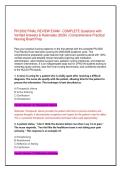
PN 2002 FINAL REVIEW EXAM - COMPLETE Questions with
Verified Answers & Rationales (2026) | Comprehensive Practical
Nursing Board Prep
Pass your practical nursing capstone on the first attempt with this complete PN 2002
Final Review Exam test bank covering the 2025/2026 academic cycle. This
comprehensive preparation guide features high-yield exam questions paired with 100%
verified answers and detailed clinical rationales exploring safe medication
administration, adult medical-surgical care, pediatric nursing milestones, and maternal-
newborn interventions. It is an indispensable study tool for LPN/LVN students looking to
compress study routines, clear their final nursing benchmarks, and confidently transition
to the NCLEX-PN boards.
1. A nurse is caring for a patient who is visibly upset after receiving a difficult
diagnosis. The nurse sits quietly with the patient, allowing time for the patient to
process the information. This technique is best described as:
A) Therapeutic silence
B) Active listening
C) Clarification
D) Restatement
Correct Answer: A) Therapeutic silence
Rationale: Therapeutic silence provides the patient with time to process emotions and
organize thoughts. It demonstrates acceptance and respect for the patient's need to reflect.
This is a powerful therapeutic communication technique when used appropriately .
2. A patient states, "I don't think the doctors believe me when I say I'm in pain."
The nurse responds, "You feel like the healthcare team is not taking your pain
seriously." This response is an example of:
A) Paraphrasing
B) Restatement
C) Reflection of feeling
D) Clarification
Correct Answer: C) Reflection of feeling
,Rationale: Reflection of feeling involves identifying the patient's emotional state and
verbalizing it back to validate the patient's experience. The nurse is recognizing the
patient's feeling of being dismissed and reflecting it back .
3. A nurse is communicating with a patient who speaks a different language.
Which of the following is the MOST appropriate action?
A) Use the patient's family member as an interpreter
B) Speak loudly and slowly in English
C) Use a certified medical interpreter
D) Write instructions in English
Correct Answer: C) Use a certified medical interpreter
Rationale: A certified medical interpreter should be used to ensure accurate and complete
communication. Family members may not provide accurate interpretation and may lack
medical vocabulary .
4. The use of "I" statements in conflict resolution is effective because they:
A) Place blame on the other person
B) Express the speaker's feelings without accusing the listener
C) Avoid addressing the conflict directly
D) Allow the speaker to control the conversation
Correct Answer: B) Express the speaker's feelings without accusing the listener
Rationale: "I" statements allow the speaker to express feelings and needs without blaming
the other person. This reduces defensiveness and promotes effective conflict resolution .
5. A nurse notices that a colleague is frequently late to shift handoff. The nurse
should address this issue by:
A) Reporting the colleague to the manager immediately
B) Speaking to the colleague privately about the impact on patient care
C) Ignoring the behavior
D) Making a public announcement about punctuality
Correct Answer: B) Speaking to the colleague privately about the impact on patient
care
Rationale: Addressing issues privately and directly with a colleague is often the most
appropriate first step. This allows for constructive feedback and avoids embarrassment .
,6. A family is experiencing conflict about a loved one's end-of-life care decisions.
The nurse's role in this situation is to:
A) Choose which family member should make decisions
B) Act as a mediator to facilitate family communication
C) Make the medical decisions for the family
D) Avoid getting involved in family conflicts
Correct Answer: B) Act as a mediator to facilitate family communication
Rationale: The nurse serves as a mediator to facilitate communication among family
members, helping them express concerns and reach consensus. The nurse should remain
neutral and advocate for the patient's best interests .
7. Which of the following is a key element of the therapeutic relationship?
A) Mutuality and reciprocity
B) The relationship is focused on the patient's needs
C) The relationship is primarily social
D) The nurse's needs are the priority
Correct Answer: B) The relationship is focused on the patient's needs
Rationale: The therapeutic relationship is focused on the patient's healthcare needs and is
professional rather than social. The nurse's personal needs should not be the focus of the
relationship .
8. A patient who is anxious about an upcoming procedure asks the nurse, "What if
something goes wrong?" The nurse's best response is:
A) "Don't worry, everything will be fine"
B) "That's not something you should think about"
C) "I understand you're worried. Let me tell you what we do to keep you safe during the
procedure"
D) "You need to trust the doctor"
Correct Answer: C) "I understand you're worried. Let me tell you what we do to
keep you safe during the procedure"
Rationale: This response validates the patient's feelings and provides factual information
about safety measures, which can reduce anxiety. It avoids false reassurance and respects
the patient's concerns .
, 9. The "B" in the SBAR communication tool stands for:
A) Background
B) Brief
C) Behavior
D) Baseline
Correct Answer: A) Background
Rationale: In SBAR, B stands for Background—the relevant clinical context, including the
patient's diagnosis, history, and current treatment .
10. A nurse is caring for a patient who is in the denial stage of grief. Which of the
following is the MOST appropriate nursing response?
A) Confront the denial to help the patient accept reality
B) Support the patient and allow the denial as a coping mechanism
C) Encourage the patient to talk about their feelings
D) Refer the patient to a psychiatrist
Correct Answer: B) Support the patient and allow the denial as a coping
mechanism
Rationale: Denial is a normal coping mechanism, especially in the early stages of grief.
The nurse should support the patient and allow the denial while being available to discuss
reality when the patient is ready .
11. A patient states, "I just don't see the point in continuing treatment anymore."
The nurse responds, "You're feeling hopeless about your treatment." This is an
example of:
A) Paraphrasing
B) Reflection of feeling
C) Clarification
D) Restatement
Correct Answer: B) Reflection of feeling
Rationale: The nurse is identifying and verbalizing the patient's emotional state
(hopelessness). This validates the patient's feelings and encourages further discussion .
12. A nurse is teaching a patient about a new medication. Which of the following
communication strategies is MOST effective?
Verified Answers & Rationales (2026) | Comprehensive Practical
Nursing Board Prep
Pass your practical nursing capstone on the first attempt with this complete PN 2002
Final Review Exam test bank covering the 2025/2026 academic cycle. This
comprehensive preparation guide features high-yield exam questions paired with 100%
verified answers and detailed clinical rationales exploring safe medication
administration, adult medical-surgical care, pediatric nursing milestones, and maternal-
newborn interventions. It is an indispensable study tool for LPN/LVN students looking to
compress study routines, clear their final nursing benchmarks, and confidently transition
to the NCLEX-PN boards.
1. A nurse is caring for a patient who is visibly upset after receiving a difficult
diagnosis. The nurse sits quietly with the patient, allowing time for the patient to
process the information. This technique is best described as:
A) Therapeutic silence
B) Active listening
C) Clarification
D) Restatement
Correct Answer: A) Therapeutic silence
Rationale: Therapeutic silence provides the patient with time to process emotions and
organize thoughts. It demonstrates acceptance and respect for the patient's need to reflect.
This is a powerful therapeutic communication technique when used appropriately .
2. A patient states, "I don't think the doctors believe me when I say I'm in pain."
The nurse responds, "You feel like the healthcare team is not taking your pain
seriously." This response is an example of:
A) Paraphrasing
B) Restatement
C) Reflection of feeling
D) Clarification
Correct Answer: C) Reflection of feeling
,Rationale: Reflection of feeling involves identifying the patient's emotional state and
verbalizing it back to validate the patient's experience. The nurse is recognizing the
patient's feeling of being dismissed and reflecting it back .
3. A nurse is communicating with a patient who speaks a different language.
Which of the following is the MOST appropriate action?
A) Use the patient's family member as an interpreter
B) Speak loudly and slowly in English
C) Use a certified medical interpreter
D) Write instructions in English
Correct Answer: C) Use a certified medical interpreter
Rationale: A certified medical interpreter should be used to ensure accurate and complete
communication. Family members may not provide accurate interpretation and may lack
medical vocabulary .
4. The use of "I" statements in conflict resolution is effective because they:
A) Place blame on the other person
B) Express the speaker's feelings without accusing the listener
C) Avoid addressing the conflict directly
D) Allow the speaker to control the conversation
Correct Answer: B) Express the speaker's feelings without accusing the listener
Rationale: "I" statements allow the speaker to express feelings and needs without blaming
the other person. This reduces defensiveness and promotes effective conflict resolution .
5. A nurse notices that a colleague is frequently late to shift handoff. The nurse
should address this issue by:
A) Reporting the colleague to the manager immediately
B) Speaking to the colleague privately about the impact on patient care
C) Ignoring the behavior
D) Making a public announcement about punctuality
Correct Answer: B) Speaking to the colleague privately about the impact on patient
care
Rationale: Addressing issues privately and directly with a colleague is often the most
appropriate first step. This allows for constructive feedback and avoids embarrassment .
,6. A family is experiencing conflict about a loved one's end-of-life care decisions.
The nurse's role in this situation is to:
A) Choose which family member should make decisions
B) Act as a mediator to facilitate family communication
C) Make the medical decisions for the family
D) Avoid getting involved in family conflicts
Correct Answer: B) Act as a mediator to facilitate family communication
Rationale: The nurse serves as a mediator to facilitate communication among family
members, helping them express concerns and reach consensus. The nurse should remain
neutral and advocate for the patient's best interests .
7. Which of the following is a key element of the therapeutic relationship?
A) Mutuality and reciprocity
B) The relationship is focused on the patient's needs
C) The relationship is primarily social
D) The nurse's needs are the priority
Correct Answer: B) The relationship is focused on the patient's needs
Rationale: The therapeutic relationship is focused on the patient's healthcare needs and is
professional rather than social. The nurse's personal needs should not be the focus of the
relationship .
8. A patient who is anxious about an upcoming procedure asks the nurse, "What if
something goes wrong?" The nurse's best response is:
A) "Don't worry, everything will be fine"
B) "That's not something you should think about"
C) "I understand you're worried. Let me tell you what we do to keep you safe during the
procedure"
D) "You need to trust the doctor"
Correct Answer: C) "I understand you're worried. Let me tell you what we do to
keep you safe during the procedure"
Rationale: This response validates the patient's feelings and provides factual information
about safety measures, which can reduce anxiety. It avoids false reassurance and respects
the patient's concerns .
, 9. The "B" in the SBAR communication tool stands for:
A) Background
B) Brief
C) Behavior
D) Baseline
Correct Answer: A) Background
Rationale: In SBAR, B stands for Background—the relevant clinical context, including the
patient's diagnosis, history, and current treatment .
10. A nurse is caring for a patient who is in the denial stage of grief. Which of the
following is the MOST appropriate nursing response?
A) Confront the denial to help the patient accept reality
B) Support the patient and allow the denial as a coping mechanism
C) Encourage the patient to talk about their feelings
D) Refer the patient to a psychiatrist
Correct Answer: B) Support the patient and allow the denial as a coping
mechanism
Rationale: Denial is a normal coping mechanism, especially in the early stages of grief.
The nurse should support the patient and allow the denial while being available to discuss
reality when the patient is ready .
11. A patient states, "I just don't see the point in continuing treatment anymore."
The nurse responds, "You're feeling hopeless about your treatment." This is an
example of:
A) Paraphrasing
B) Reflection of feeling
C) Clarification
D) Restatement
Correct Answer: B) Reflection of feeling
Rationale: The nurse is identifying and verbalizing the patient's emotional state
(hopelessness). This validates the patient's feelings and encourages further discussion .
12. A nurse is teaching a patient about a new medication. Which of the following
communication strategies is MOST effective?


