
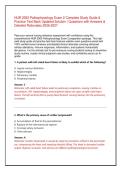
NUR 2063 Pathophysiology Exam 2 Complete Study Guide &
Practice Test Bank Updated Solution | Questions with Answers &
Detailed Rationales 2026-2027
Pass your second nursing milestone assessment with confidence using this
comprehensive NUR 2063 Pathophysiology Exam 2 preparation package. This high-
yield study guide and practice test bank features realistic exam questions paired with
100% verified correct answers and detailed clinical rationales covering advanced
cellular alterations, immune responses, inflammation, and systemic homeostatic
disruptions. It is the ultimate tool for pre-licensure nursing students looking to streamline
study routines, master clinical judgment case studies, and confidently secure an A+
grade.
1. A patient with left-sided heart failure is likely to exhibit which of the following?
A. Jugular venous distention
B. Hepatomegaly
C. Pulmonary crackles
D. Peripheral edema
Answer: C
Rationale: Left-sided heart failure leads to pulmonary congestion, causing crackles on
auscultation. JVD, hepatomegaly, and peripheral edema are signs of right-sided heart
failure. The left ventricle fails to pump blood forward, causing backup into the pulmonary
circulation.
2. What is the primary cause of cardiac tamponade?
A. Accumulation of fluid in the pericardial sac
B. Rupture of the interventricular septum
C. Coronary artery occlusion
D. Valve stenosis
Answer: A
Rationale: Cardiac tamponade is caused by rapid accumulation of fluid in the pericardial
sac, compressing the heart and impairing diastolic filling. This leads to decreased cardiac
output. Rupture, occlusion, and stenosis are different pathophysiological processes.
,3. A patient with severe atherosclerosis is at highest risk for which complication?
A. Myocardial infarction
B. Stroke
C. Peripheral artery disease
D. All of the above
Answer: D
Rationale: Atherosclerosis can lead to MI, stroke, and peripheral artery disease by
narrowing arteries and reducing blood flow. It is a systemic disease. Risk factors include
hypertension, hyperlipidemia, and smoking.
4. Which medication is most likely to cause orthostatic hypotension?
A. Beta-blockers
B. ACE inhibitors
C. Diuretics
D. Alpha-blockers
Answer: D
Rationale: Alpha-blockers block sympathetic vasoconstriction, leading to orthostatic
hypotension. Beta-blockers decrease heart rate, ACE inhibitors cause vasodilation, and
diuretics decrease fluid volume. Orthostatic hypotension is a common side effect of alpha-
blockers.
5. A patient with a history of atrial fibrillation is at highest risk for which
complication?
A. Stroke
B. Myocardial infarction
C. Heart failure
D. Pulmonary embolism
,Answer: A
Rationale: Atrial fibrillation increases the risk of stroke due to the formation of clots in the
atria. These clots can embolize to the cerebral circulation. MI, heart failure, and PE are also
risks but stroke is the most common complication.
6. What is the most common cause of aortic regurgitation?
A. Rheumatic fever
B. Infective endocarditis
C. Aortic root dilation
D. Bicuspid aortic valve
Answer: C
Rationale: Aortic root dilation is the most common cause of aortic regurgitation, often due
to hypertension or Marfan syndrome. Rheumatic fever and infective endocarditis are less
common causes. A bicuspid valve is a congenital risk factor.
7. A patient with an abdominal aortic aneurysm is at risk for which complication?
A. Rupture
B. Thromboembolism
C. Compression of surrounding structures
D. All of the above
Answer: D
Rationale: Abdominal aortic aneurysms can rupture, cause thromboembolism, and
compress surrounding structures. Rupture is a life-threatening emergency. Monitoring and
surgical repair are indicated for large aneurysms.
8. Which of the following is a modifiable risk factor for coronary artery disease?
A. Age
B. Gender
, C. Hyperlipidemia
D. Family history
Answer: C
Rationale: Hyperlipidemia is a modifiable risk factor for CAD. Age, gender, and family
history are non-modifiable. Lifestyle modifications and medications can manage
hyperlipidemia and reduce CAD risk.
9. A patient with Raynaud's phenomenon is likely to experience:
A. Cold-induced vasospasm of the fingers
B. Warm-induced vasodilation
C. Painful ulcers
D. Gangrene
Answer: A
Rationale: Raynaud's phenomenon is characterized by cold-induced vasospasm of the
fingers, causing color changes (white to blue to red). It can be primary or secondary to
connective tissue disease. Treatment includes avoiding cold and vasodilators.
10. Which of the following is a cause of secondary hypertension?
A. Renal artery stenosis
B. Primary aldosteronism
C. Pheochromocytoma
D. All of the above
Answer: D
Rationale: Renal artery stenosis, primary aldosteronism, and pheochromocytoma are all
causes of secondary hypertension. These conditions require specific treatments beyond
lifestyle modifications and standard antihypertensive medications.
Practice Test Bank Updated Solution | Questions with Answers &
Detailed Rationales 2026-2027
Pass your second nursing milestone assessment with confidence using this
comprehensive NUR 2063 Pathophysiology Exam 2 preparation package. This high-
yield study guide and practice test bank features realistic exam questions paired with
100% verified correct answers and detailed clinical rationales covering advanced
cellular alterations, immune responses, inflammation, and systemic homeostatic
disruptions. It is the ultimate tool for pre-licensure nursing students looking to streamline
study routines, master clinical judgment case studies, and confidently secure an A+
grade.
1. A patient with left-sided heart failure is likely to exhibit which of the following?
A. Jugular venous distention
B. Hepatomegaly
C. Pulmonary crackles
D. Peripheral edema
Answer: C
Rationale: Left-sided heart failure leads to pulmonary congestion, causing crackles on
auscultation. JVD, hepatomegaly, and peripheral edema are signs of right-sided heart
failure. The left ventricle fails to pump blood forward, causing backup into the pulmonary
circulation.
2. What is the primary cause of cardiac tamponade?
A. Accumulation of fluid in the pericardial sac
B. Rupture of the interventricular septum
C. Coronary artery occlusion
D. Valve stenosis
Answer: A
Rationale: Cardiac tamponade is caused by rapid accumulation of fluid in the pericardial
sac, compressing the heart and impairing diastolic filling. This leads to decreased cardiac
output. Rupture, occlusion, and stenosis are different pathophysiological processes.
,3. A patient with severe atherosclerosis is at highest risk for which complication?
A. Myocardial infarction
B. Stroke
C. Peripheral artery disease
D. All of the above
Answer: D
Rationale: Atherosclerosis can lead to MI, stroke, and peripheral artery disease by
narrowing arteries and reducing blood flow. It is a systemic disease. Risk factors include
hypertension, hyperlipidemia, and smoking.
4. Which medication is most likely to cause orthostatic hypotension?
A. Beta-blockers
B. ACE inhibitors
C. Diuretics
D. Alpha-blockers
Answer: D
Rationale: Alpha-blockers block sympathetic vasoconstriction, leading to orthostatic
hypotension. Beta-blockers decrease heart rate, ACE inhibitors cause vasodilation, and
diuretics decrease fluid volume. Orthostatic hypotension is a common side effect of alpha-
blockers.
5. A patient with a history of atrial fibrillation is at highest risk for which
complication?
A. Stroke
B. Myocardial infarction
C. Heart failure
D. Pulmonary embolism
,Answer: A
Rationale: Atrial fibrillation increases the risk of stroke due to the formation of clots in the
atria. These clots can embolize to the cerebral circulation. MI, heart failure, and PE are also
risks but stroke is the most common complication.
6. What is the most common cause of aortic regurgitation?
A. Rheumatic fever
B. Infective endocarditis
C. Aortic root dilation
D. Bicuspid aortic valve
Answer: C
Rationale: Aortic root dilation is the most common cause of aortic regurgitation, often due
to hypertension or Marfan syndrome. Rheumatic fever and infective endocarditis are less
common causes. A bicuspid valve is a congenital risk factor.
7. A patient with an abdominal aortic aneurysm is at risk for which complication?
A. Rupture
B. Thromboembolism
C. Compression of surrounding structures
D. All of the above
Answer: D
Rationale: Abdominal aortic aneurysms can rupture, cause thromboembolism, and
compress surrounding structures. Rupture is a life-threatening emergency. Monitoring and
surgical repair are indicated for large aneurysms.
8. Which of the following is a modifiable risk factor for coronary artery disease?
A. Age
B. Gender
, C. Hyperlipidemia
D. Family history
Answer: C
Rationale: Hyperlipidemia is a modifiable risk factor for CAD. Age, gender, and family
history are non-modifiable. Lifestyle modifications and medications can manage
hyperlipidemia and reduce CAD risk.
9. A patient with Raynaud's phenomenon is likely to experience:
A. Cold-induced vasospasm of the fingers
B. Warm-induced vasodilation
C. Painful ulcers
D. Gangrene
Answer: A
Rationale: Raynaud's phenomenon is characterized by cold-induced vasospasm of the
fingers, causing color changes (white to blue to red). It can be primary or secondary to
connective tissue disease. Treatment includes avoiding cold and vasodilators.
10. Which of the following is a cause of secondary hypertension?
A. Renal artery stenosis
B. Primary aldosteronism
C. Pheochromocytoma
D. All of the above
Answer: D
Rationale: Renal artery stenosis, primary aldosteronism, and pheochromocytoma are all
causes of secondary hypertension. These conditions require specific treatments beyond
lifestyle modifications and standard antihypertensive medications.


