

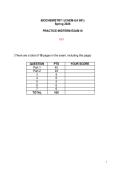
BIOCHEMISTRY I (CHEM-UA 881)
Spring 2026
PRACTICE MIDTERM EXAM III
KEY
(There are a total of 10 pages in the exam, including this page)
QUESTION PTS YOUR SCORE
Part 1 45
Part 2 24
3 8
4 6
5 5
6 6
7 6
TOTAL 100
1
, Part I. Multiple Choice. Circle one correct answer for each. (3 pts each; 45 pts total)
i. In which of the following metabolic conversions is ATP “consumed” during glycolysis?
a. 1,3-bisphosphoglycerate → 3-phosphoglycerate
b. glucose → glucose-6-phosphate
c. 2-phosphoglycerate → 3-phosphoglycerate
d. glucose-6-phosphate → fructose-6-phosphate
e. all of the above
ii. How many moles of pyruvate would result if 5 moles of glucose were completely
metabolized through glycolysis? Assume that all of the glucose is converted to
pyruvate and the reactions are performed using all active glycolysis enzymes in a test
tube.
a. 2.5 moles of pyruvate
b. 5 moles of pyruvate
c. 10 moles of pyruvate
d. 50 moles of pyruvate
e. 100 moles of pyruvate
iii. The scheme below depicts a reaction that occurs in the gluconeogenesis pathway.
What type of enzyme catalyzes the reaction above?
a. phosphatase
b. kinase
c. lyase
d. transferase
e. mutase
iv. Circle all of the following enzymes that catalyze reactions in glycolysis that are
considered irreversible.
A. pyruvate kinase
B. glyceraldehyde-3-phosphate dehydrogenase
C. aldolase
D. none of the above
2
Spring 2026
PRACTICE MIDTERM EXAM III
KEY
(There are a total of 10 pages in the exam, including this page)
QUESTION PTS YOUR SCORE
Part 1 45
Part 2 24
3 8
4 6
5 5
6 6
7 6
TOTAL 100
1
, Part I. Multiple Choice. Circle one correct answer for each. (3 pts each; 45 pts total)
i. In which of the following metabolic conversions is ATP “consumed” during glycolysis?
a. 1,3-bisphosphoglycerate → 3-phosphoglycerate
b. glucose → glucose-6-phosphate
c. 2-phosphoglycerate → 3-phosphoglycerate
d. glucose-6-phosphate → fructose-6-phosphate
e. all of the above
ii. How many moles of pyruvate would result if 5 moles of glucose were completely
metabolized through glycolysis? Assume that all of the glucose is converted to
pyruvate and the reactions are performed using all active glycolysis enzymes in a test
tube.
a. 2.5 moles of pyruvate
b. 5 moles of pyruvate
c. 10 moles of pyruvate
d. 50 moles of pyruvate
e. 100 moles of pyruvate
iii. The scheme below depicts a reaction that occurs in the gluconeogenesis pathway.
What type of enzyme catalyzes the reaction above?
a. phosphatase
b. kinase
c. lyase
d. transferase
e. mutase
iv. Circle all of the following enzymes that catalyze reactions in glycolysis that are
considered irreversible.
A. pyruvate kinase
B. glyceraldehyde-3-phosphate dehydrogenase
C. aldolase
D. none of the above
2


