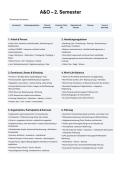
A&O – 2. Semester
Themen des Semesters:
Berufswahl Handlungsregulation Stress & Erholung / Work- Organisation & Führung Teams &
Emotionen Life Fairness Diversität
1. Arbeit & Person 2. Handlungsregulation
• Arbeit: Sinn, Identität, soziale Kontakte, Entwicklung und • Handlung: Ziel → Orientierung → Planung → Entscheidung →
Wohlbefinden. Ausführung → Feedback.
• Holland: RIASEC – Interessen und Beruf sollten • Ebenen: sensumotorisch → flexible Handlungsmuster →
zusammenpassen. intellektuell.
• Super: Wachstum → Exploration → Festlegung → Festigung → • Gute Arbeit: sequenziell und hierarchisch vollständig.
Abbau. • Handlungsspielraum fördert Motivation, Zufriedenheit und
• Abele: Person + Ziel + Handlung + Umwelt. Leistung.
• Lent: Selbstwirksamkeit + Ergebniserwartung + Ziele. • Fehler: Slip – Regel – Wissen.
3. Emotionen, Stress & Erholung 4. Work-Life-Balance
• Emotion = aktueller State; stabile Neigung = Trait. • Arbeit und Privatleben beeinflussen sich gegenseitig.
• Emotionsarbeit: eigene Gefühle/Ausdruck regulieren. • Work-Family Conflict: Zeit – Beanspruchung – Verhalten.
• Regulation: automatisch – Surface Acting – Deep Acting. • Work-Family Facilitation: ein Bereich bereichert den anderen.
• Emotionale Dissonanz: fühlen ≠ zeigen; erhöht Belastungs- • Boundary Management: Segmentation – Integration –
/Burnout-Risiko. Entgrenzung.
• Effort-Recovery: Belastung weg → Erholung. • Gute Passung zwischen eigener Präferenz und
• COR: Ressourcen erhalten und aufbauen. Arbeitsbedingungen ist entscheidend.
• Erholung: Detachment – Relaxation – Mastery – Control. • Zu starke Integration kann Stress fördern.
• Pausen: kurz – früh – verteilt – vorhersehbar.
5. Organisation, Partizipation & Fairness 6. Führung
• Organisation: gemeinsames Ziel + formale Struktur. • Great Man: Persönlichkeit spielt eine Rolle, reicht aber nicht.
• Partizipation = Mitbestimmung; direkt oder indirekt. • Mitarbeiterorientierung: Unterstützung und Wertschätzung.
• De jure = vorgesehen; de facto = tatsächlich umgesetzt. • Aufgabenorientierung: Ziele, Struktur und Kontrolle.
• Kognitiver Ansatz: mehr Information → bessere Entscheidung → • Fiedler: guter Führungsstil hängt von der Situation ab.
Produktivität. • Transaktional: Leistung ↔ Belohnung.
• Motivationaler Ansatz: Autonomie/Anerkennung → Motivation → • Transformational: Vorbild – Inspiration – intellektuelle Stimulation
Produktivität. – individuelle Förderung.
• Fairness: distributiv – prozedural – interaktional. • LMX: Qualität der individuellen Führungskraft-Mitarbeiter-
• Warum Fairness? instrumental – relational – deontologisch. Beziehung.
• Equity Theory: eigenes Beitrag-Ergebnis-Verhältnis mit anderen • Authentisch – ethisch – dienend.
vergleichen. • Abusive Supervision: destruktive/feindselige Führung.
• Fairness Theory: Would – Could – Should. • Gesundheit: Beziehung + Arbeitsgestaltung + Vorbild.
• Psychologischer Vertrag: transaktional vs. relational.
Themen des Semesters:
Berufswahl Handlungsregulation Stress & Erholung / Work- Organisation & Führung Teams &
Emotionen Life Fairness Diversität
1. Arbeit & Person 2. Handlungsregulation
• Arbeit: Sinn, Identität, soziale Kontakte, Entwicklung und • Handlung: Ziel → Orientierung → Planung → Entscheidung →
Wohlbefinden. Ausführung → Feedback.
• Holland: RIASEC – Interessen und Beruf sollten • Ebenen: sensumotorisch → flexible Handlungsmuster →
zusammenpassen. intellektuell.
• Super: Wachstum → Exploration → Festlegung → Festigung → • Gute Arbeit: sequenziell und hierarchisch vollständig.
Abbau. • Handlungsspielraum fördert Motivation, Zufriedenheit und
• Abele: Person + Ziel + Handlung + Umwelt. Leistung.
• Lent: Selbstwirksamkeit + Ergebniserwartung + Ziele. • Fehler: Slip – Regel – Wissen.
3. Emotionen, Stress & Erholung 4. Work-Life-Balance
• Emotion = aktueller State; stabile Neigung = Trait. • Arbeit und Privatleben beeinflussen sich gegenseitig.
• Emotionsarbeit: eigene Gefühle/Ausdruck regulieren. • Work-Family Conflict: Zeit – Beanspruchung – Verhalten.
• Regulation: automatisch – Surface Acting – Deep Acting. • Work-Family Facilitation: ein Bereich bereichert den anderen.
• Emotionale Dissonanz: fühlen ≠ zeigen; erhöht Belastungs- • Boundary Management: Segmentation – Integration –
/Burnout-Risiko. Entgrenzung.
• Effort-Recovery: Belastung weg → Erholung. • Gute Passung zwischen eigener Präferenz und
• COR: Ressourcen erhalten und aufbauen. Arbeitsbedingungen ist entscheidend.
• Erholung: Detachment – Relaxation – Mastery – Control. • Zu starke Integration kann Stress fördern.
• Pausen: kurz – früh – verteilt – vorhersehbar.
5. Organisation, Partizipation & Fairness 6. Führung
• Organisation: gemeinsames Ziel + formale Struktur. • Great Man: Persönlichkeit spielt eine Rolle, reicht aber nicht.
• Partizipation = Mitbestimmung; direkt oder indirekt. • Mitarbeiterorientierung: Unterstützung und Wertschätzung.
• De jure = vorgesehen; de facto = tatsächlich umgesetzt. • Aufgabenorientierung: Ziele, Struktur und Kontrolle.
• Kognitiver Ansatz: mehr Information → bessere Entscheidung → • Fiedler: guter Führungsstil hängt von der Situation ab.
Produktivität. • Transaktional: Leistung ↔ Belohnung.
• Motivationaler Ansatz: Autonomie/Anerkennung → Motivation → • Transformational: Vorbild – Inspiration – intellektuelle Stimulation
Produktivität. – individuelle Förderung.
• Fairness: distributiv – prozedural – interaktional. • LMX: Qualität der individuellen Führungskraft-Mitarbeiter-
• Warum Fairness? instrumental – relational – deontologisch. Beziehung.
• Equity Theory: eigenes Beitrag-Ergebnis-Verhältnis mit anderen • Authentisch – ethisch – dienend.
vergleichen. • Abusive Supervision: destruktive/feindselige Führung.
• Fairness Theory: Would – Could – Should. • Gesundheit: Beziehung + Arbeitsgestaltung + Vorbild.
• Psychologischer Vertrag: transaktional vs. relational.