
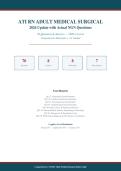
ATI RN ADULT MEDICAL SURGICAL
2026 Update with Actual NGN Questions
70 Questions & Answers - 100% Correct
Comprehensive Rationales | A+ Graded
70 8 8 7
Questions Sections NGN Items Body Systems
Exam Blueprint
Q1-12 Respiratory System Disorders
Q13-24 Cardiovascular System Disorders
Q25-34 Neurological System Disorders
Q35-42 Gastrointestinal System Disorders
Q43-50 Renal, Urinary & Endocrine Disorders
Q51-56 Musculoskeletal, Immune, Hematologic & Oncologic
Q57-62 Emergencies & Perioperative Care
Q63-70 NGN Clinical Judgment (SATA, Bowtie, Case Studies)
Cognitive Level Distribution
Recall 25% | Application 50% | Analysis 25%
Comprehensive ATI RN Adult Medical-Surgical Study Guide
, How to Use This ATI Med-Surgical Study Guide
ATI RN ADULT MEDICAL SURGICAL
This 70-question practice exam mirrors the ATI RN Adult Medical-Surgical Proctored CMS blueprint and integrates
Next Generation NCLEX (NGN) clinical judgment items. Sections 1 through 7 cover the major body systems and
2026 Update with Actual NGN Questions
medical-surgical emergencies with single-best-answer questions using ATI testing format (75% scenario-based, 20%
prioritization/clinical judgment, 5% recall). Section 8 contains eight NGN-format items: three Select-All-That-Apply
70 Questions & Answers - 100% Correct
(SATA) questions with NGN partial-credit scoring, one Bowtie question linking Condition to Interventions to
Evaluation, and four Extended CaseComprehensive Rationales
Studies with integrated clinical| data
A+ requiring
Graded multi-step clinical reasoning.
For each question, attempt your answer first, then read the full rationale, which explains why the correct option is
right and why each distractor is wrong using ATI-specific clinical reasoning: pathophysiology, priority-setting
frameworks (ABC, Maslow, Nursing Process ADPIE, acute vs. chronic, urgent vs. nonurgent, least restrictive),
nursing interventions, safety considerations, complication recognition, evidence-based practice, and 2026 guideline
updates. Priority-setting questions ask for the first, next, or best action; medication questions address mechanism,
70 8 8 7
indications, adverse effects, and nursing implications; and NGN items test the full Clinical Judgment Measurement
Model (Recognize/Analyze Cues, Prioritize Hypotheses, Generate Solutions, Take Action, Evaluate Outcomes).
Questions Sections NGN Items Body Systems
Master rationales for both correct and incorrect options to reinforce safe medical-surgical nursing practice and ATI
test-taking strategy.
Exam Blueprint
Q1-12 Respiratory System Disorders
Q13-24 Cardiovascular System Disorders
Q25-34 Neurological System Disorders
Q35-42 Gastrointestinal System Disorders
Q43-50 Renal, Urinary & Endocrine Disorders
Q51-56 Musculoskeletal, Immune, Hematologic & Oncologic
Q57-62 Emergencies & Perioperative Care
Q63-70 NGN Clinical Judgment (SATA, Bowtie, Case Studies)
Cognitive Level Distribution
Recall 25% | Application 50% | Analysis 25%
Comprehensive ATI RN Adult Medical-Surgical Study Guide
,ATI RN Adult Medical-Surgical 2026 Update | 70 Questions + Actual NGN | 100% Correct A+ Graded
SECTION 1: Respiratory System Disorders
COPD, Asthma, Pneumonia, Pulmonary Embolism, Tuberculosis, ARDS, Mechanical Ventilation, Thoracic Surgery
Questions 1 - 12
Q1: A client with COPD is receiving oxygen at 4 L/min via nasal cannula. The nurse notes the client is drowsy
with a respiratory rate of 10/min and PaCO2 of 68 mmHg. Which action is most appropriate?
A. Increase the oxygen flow rate to 6 L/min to improve oxygenation.
B. Decrease the oxygen flow rate, notify the provider, and prepare for possible noninvasive ventilation;
this client may rely on a hypoxic drive. [CORRECT]
C. Document the findings; this is an expected response to oxygen therapy.
D. Administer a bronchodilator and reassess in 1 hour.
Correct Answer: B
Rationale:
Clients with COPD often rely on a hypoxic drive to breathe; excessive oxygen can blunt this drive, causing
hypoventilation with rising PaCO2 and CO2 narcosis. The nurse should decrease the oxygen flow, notify the provider,
and prepare for noninvasive ventilation (BiPAP) if needed. Increasing oxygen worsens hypercapnia. The finding is not
expected and requires intervention. Oxygen in COPD is titrated to target SpO2 88-92%. Recognizing oxygen-induced
hypercapnia prevents respiratory failure.
Q2: A client with acute asthma exacerbation has severe dyspnea, speaks in fragments, has an SpO2 of 88%,
and peak expiratory flow of 40% of personal best after one SABA treatment. Which action should the nurse
take next?
A. Administer one more SABA treatment and reassess in 2 hours.
B. Administer systemic corticosteroids and continue SABA, apply oxygen, and prepare for possible
intubation given signs of severe exacerbation. [CORRECT]
C. Discharge the client with a prescription for an inhaled corticosteroid.
D. Administer a long-acting beta-2 agonist (LABA).
Correct Answer: B
Rationale:
Inability to speak in full sentences, SpO2 below 90%, and PEF below 50% of personal best after SABA indicate a
severe asthma exacerbation requiring systemic corticosteroids, oxygen, continuous SABA, and close monitoring with
intubation prepared. Waiting 2 hours delays needed escalation. LABA monotherapy is contraindicated in acute
exacerbations. Discharge is unsafe. Severe exacerbations require escalation to systemic therapy and intensive
monitoring. Recognizing severe signs prevents respiratory failure.
Aligned with ATI RN Adult Medical-Surgical CMS Blueprint + NGN Clinical Judgment Page 3
, ATI RN Adult Medical-Surgical 2026 Update | 70 Questions + Actual NGN | 100% Correct A+ Graded
Q3: An 80-year-old client is admitted with community-acquired pneumonia. Which assessment finding most
strongly indicates a worsening condition requiring immediate intervention?
A. Productive cough with yellow sputum.
B. Confusion, respiratory rate 32, blood pressure 86/52, and SpO2 88% on room air. [CORRECT]
C. Temperature 38.3 C (101 F).
D. Crackles in the right lower lobe.
Correct Answer: B
Rationale:
Confusion, tachypnea, hypotension, and hypoxemia in pneumonia signal severe sepsis or impending septic shock
requiring immediate stabilization, cultures, antibiotics, and fluids (CURB-65 includes confusion, uremia, RR >=30, low
BP, age >=65). The other findings are expected in pneumonia but do not indicate impending deterioration. The nurse
applies ABC and sepsis screening. Prompt recognition and the sepsis bundle reduce mortality. Older adults may present
with confusion as the primary sign of severe infection.
Q4: A postoperative client suddenly develops dyspnea, pleuritic chest pain, tachycardia, and SpO2 88%. The
provider orders a CT pulmonary angiogram. Which provider order should the nurse anticipate next?
A. Administer a bolus of IV fluids to treat hypotension.
B. Administer oxygen, start IV heparin per protocol, and obtain baseline coagulation and renal studies.
[CORRECT]
C. Perform chest physiotherapy to clear secretions.
D. Administer a bronchodilator for bronchospasm.
Correct Answer: B
Rationale:
Sudden dyspnea, pleuritic chest pain, and tachycardia in a postoperative client suggest pulmonary embolism; once PE is
suspected, the nurse administers oxygen, starts anticoagulation (IV heparin) per protocol pending imaging, and obtains
baseline labs (PT/INR, aPTT, platelets, BMP for renal function before contrast). A fluid bolus may worsen right heart
strain, chest physiotherapy and bronchodilators do not address PE. Anticoagulation prevents clot extension while
awaiting definitive diagnosis. Rapid intervention prevents cardiogenic shock and death.
Q5: A client is admitted with suspected pulmonary tuberculosis. Which isolation precautions and personal
protective equipment are required until the diagnosis is ruled out?
A. Contact precautions in a semi-private room with surgical masks.
B. Airborne precautions in a negative-pressure room with N95 respirators for staff and visitors.
[CORRECT]
C. Droplet precautions in a private room with surgical masks.
D. Standard precautions only until sputum results return.
Correct Answer: B
Rationale:
Pulmonary TB is transmitted via airborne droplet nuclei that remain suspended and travel on air currents, requiring
airborne precautions in a negative-pressure room and N95 (or higher) respirators for staff and visitors. Contact and
droplet precautions and standard precautions alone are insufficient. The client should wear a surgical mask during
transport. Isolation continues until three negative acid-fast sputum smears on separate days. Prompt isolation prevents
unit-wide transmission.
Aligned with ATI RN Adult Medical-Surgical CMS Blueprint + NGN Clinical Judgment Page 4
2026 Update with Actual NGN Questions
70 Questions & Answers - 100% Correct
Comprehensive Rationales | A+ Graded
70 8 8 7
Questions Sections NGN Items Body Systems
Exam Blueprint
Q1-12 Respiratory System Disorders
Q13-24 Cardiovascular System Disorders
Q25-34 Neurological System Disorders
Q35-42 Gastrointestinal System Disorders
Q43-50 Renal, Urinary & Endocrine Disorders
Q51-56 Musculoskeletal, Immune, Hematologic & Oncologic
Q57-62 Emergencies & Perioperative Care
Q63-70 NGN Clinical Judgment (SATA, Bowtie, Case Studies)
Cognitive Level Distribution
Recall 25% | Application 50% | Analysis 25%
Comprehensive ATI RN Adult Medical-Surgical Study Guide
, How to Use This ATI Med-Surgical Study Guide
ATI RN ADULT MEDICAL SURGICAL
This 70-question practice exam mirrors the ATI RN Adult Medical-Surgical Proctored CMS blueprint and integrates
Next Generation NCLEX (NGN) clinical judgment items. Sections 1 through 7 cover the major body systems and
2026 Update with Actual NGN Questions
medical-surgical emergencies with single-best-answer questions using ATI testing format (75% scenario-based, 20%
prioritization/clinical judgment, 5% recall). Section 8 contains eight NGN-format items: three Select-All-That-Apply
70 Questions & Answers - 100% Correct
(SATA) questions with NGN partial-credit scoring, one Bowtie question linking Condition to Interventions to
Evaluation, and four Extended CaseComprehensive Rationales
Studies with integrated clinical| data
A+ requiring
Graded multi-step clinical reasoning.
For each question, attempt your answer first, then read the full rationale, which explains why the correct option is
right and why each distractor is wrong using ATI-specific clinical reasoning: pathophysiology, priority-setting
frameworks (ABC, Maslow, Nursing Process ADPIE, acute vs. chronic, urgent vs. nonurgent, least restrictive),
nursing interventions, safety considerations, complication recognition, evidence-based practice, and 2026 guideline
updates. Priority-setting questions ask for the first, next, or best action; medication questions address mechanism,
70 8 8 7
indications, adverse effects, and nursing implications; and NGN items test the full Clinical Judgment Measurement
Model (Recognize/Analyze Cues, Prioritize Hypotheses, Generate Solutions, Take Action, Evaluate Outcomes).
Questions Sections NGN Items Body Systems
Master rationales for both correct and incorrect options to reinforce safe medical-surgical nursing practice and ATI
test-taking strategy.
Exam Blueprint
Q1-12 Respiratory System Disorders
Q13-24 Cardiovascular System Disorders
Q25-34 Neurological System Disorders
Q35-42 Gastrointestinal System Disorders
Q43-50 Renal, Urinary & Endocrine Disorders
Q51-56 Musculoskeletal, Immune, Hematologic & Oncologic
Q57-62 Emergencies & Perioperative Care
Q63-70 NGN Clinical Judgment (SATA, Bowtie, Case Studies)
Cognitive Level Distribution
Recall 25% | Application 50% | Analysis 25%
Comprehensive ATI RN Adult Medical-Surgical Study Guide
,ATI RN Adult Medical-Surgical 2026 Update | 70 Questions + Actual NGN | 100% Correct A+ Graded
SECTION 1: Respiratory System Disorders
COPD, Asthma, Pneumonia, Pulmonary Embolism, Tuberculosis, ARDS, Mechanical Ventilation, Thoracic Surgery
Questions 1 - 12
Q1: A client with COPD is receiving oxygen at 4 L/min via nasal cannula. The nurse notes the client is drowsy
with a respiratory rate of 10/min and PaCO2 of 68 mmHg. Which action is most appropriate?
A. Increase the oxygen flow rate to 6 L/min to improve oxygenation.
B. Decrease the oxygen flow rate, notify the provider, and prepare for possible noninvasive ventilation;
this client may rely on a hypoxic drive. [CORRECT]
C. Document the findings; this is an expected response to oxygen therapy.
D. Administer a bronchodilator and reassess in 1 hour.
Correct Answer: B
Rationale:
Clients with COPD often rely on a hypoxic drive to breathe; excessive oxygen can blunt this drive, causing
hypoventilation with rising PaCO2 and CO2 narcosis. The nurse should decrease the oxygen flow, notify the provider,
and prepare for noninvasive ventilation (BiPAP) if needed. Increasing oxygen worsens hypercapnia. The finding is not
expected and requires intervention. Oxygen in COPD is titrated to target SpO2 88-92%. Recognizing oxygen-induced
hypercapnia prevents respiratory failure.
Q2: A client with acute asthma exacerbation has severe dyspnea, speaks in fragments, has an SpO2 of 88%,
and peak expiratory flow of 40% of personal best after one SABA treatment. Which action should the nurse
take next?
A. Administer one more SABA treatment and reassess in 2 hours.
B. Administer systemic corticosteroids and continue SABA, apply oxygen, and prepare for possible
intubation given signs of severe exacerbation. [CORRECT]
C. Discharge the client with a prescription for an inhaled corticosteroid.
D. Administer a long-acting beta-2 agonist (LABA).
Correct Answer: B
Rationale:
Inability to speak in full sentences, SpO2 below 90%, and PEF below 50% of personal best after SABA indicate a
severe asthma exacerbation requiring systemic corticosteroids, oxygen, continuous SABA, and close monitoring with
intubation prepared. Waiting 2 hours delays needed escalation. LABA monotherapy is contraindicated in acute
exacerbations. Discharge is unsafe. Severe exacerbations require escalation to systemic therapy and intensive
monitoring. Recognizing severe signs prevents respiratory failure.
Aligned with ATI RN Adult Medical-Surgical CMS Blueprint + NGN Clinical Judgment Page 3
, ATI RN Adult Medical-Surgical 2026 Update | 70 Questions + Actual NGN | 100% Correct A+ Graded
Q3: An 80-year-old client is admitted with community-acquired pneumonia. Which assessment finding most
strongly indicates a worsening condition requiring immediate intervention?
A. Productive cough with yellow sputum.
B. Confusion, respiratory rate 32, blood pressure 86/52, and SpO2 88% on room air. [CORRECT]
C. Temperature 38.3 C (101 F).
D. Crackles in the right lower lobe.
Correct Answer: B
Rationale:
Confusion, tachypnea, hypotension, and hypoxemia in pneumonia signal severe sepsis or impending septic shock
requiring immediate stabilization, cultures, antibiotics, and fluids (CURB-65 includes confusion, uremia, RR >=30, low
BP, age >=65). The other findings are expected in pneumonia but do not indicate impending deterioration. The nurse
applies ABC and sepsis screening. Prompt recognition and the sepsis bundle reduce mortality. Older adults may present
with confusion as the primary sign of severe infection.
Q4: A postoperative client suddenly develops dyspnea, pleuritic chest pain, tachycardia, and SpO2 88%. The
provider orders a CT pulmonary angiogram. Which provider order should the nurse anticipate next?
A. Administer a bolus of IV fluids to treat hypotension.
B. Administer oxygen, start IV heparin per protocol, and obtain baseline coagulation and renal studies.
[CORRECT]
C. Perform chest physiotherapy to clear secretions.
D. Administer a bronchodilator for bronchospasm.
Correct Answer: B
Rationale:
Sudden dyspnea, pleuritic chest pain, and tachycardia in a postoperative client suggest pulmonary embolism; once PE is
suspected, the nurse administers oxygen, starts anticoagulation (IV heparin) per protocol pending imaging, and obtains
baseline labs (PT/INR, aPTT, platelets, BMP for renal function before contrast). A fluid bolus may worsen right heart
strain, chest physiotherapy and bronchodilators do not address PE. Anticoagulation prevents clot extension while
awaiting definitive diagnosis. Rapid intervention prevents cardiogenic shock and death.
Q5: A client is admitted with suspected pulmonary tuberculosis. Which isolation precautions and personal
protective equipment are required until the diagnosis is ruled out?
A. Contact precautions in a semi-private room with surgical masks.
B. Airborne precautions in a negative-pressure room with N95 respirators for staff and visitors.
[CORRECT]
C. Droplet precautions in a private room with surgical masks.
D. Standard precautions only until sputum results return.
Correct Answer: B
Rationale:
Pulmonary TB is transmitted via airborne droplet nuclei that remain suspended and travel on air currents, requiring
airborne precautions in a negative-pressure room and N95 (or higher) respirators for staff and visitors. Contact and
droplet precautions and standard precautions alone are insufficient. The client should wear a surgical mask during
transport. Isolation continues until three negative acid-fast sputum smears on separate days. Prompt isolation prevents
unit-wide transmission.
Aligned with ATI RN Adult Medical-Surgical CMS Blueprint + NGN Clinical Judgment Page 4


