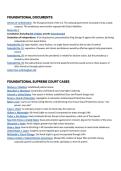
FOUNDATIONAL DOCUMENTS
Articles of Confederation: The first government of the U.S. The national government consisted of only a weak
congress. The weaknesses were further exposed with Shay's Rebellion.
Brutus No. 1
Constitution (including Bill of Rights and the Amendments)
Declaration of Independence: A list of grievances perpetrated by King George III against the colonies, declaring
independence from Great Britain.
Federalist No. 10: large republic, many factions, no single faction would be able to take all control
Federalist No. 51: separation of powers and checks and balances would be effective against total government
control
Federalist No. 70: an executive branch (the president) is needed for decisive action, but the presidency is
limited by other branches
Federalist No. 78: the judicial branch would not be that powerful and they would serve to check powers of
other branches through judicial review
Letter from a Birmingham Jail
FOUNDATIONAL SUPREME COURT CASES
Marbury v. Madison: established judicial review
McCulloch v. Maryland: Constitution and federal laws have higher authority
Schenck v. United States: free speech is limited, established Clear and Present Danger test
Brown v. Board of Education: segregation in education violates Equal Protections clause
Baker v. Carr: courts can review voting districts, and districting must ensure Equal Protections clause, "one
person, one vote"
Engel v. Vitale: no voluntary prayer to start of school day; free exercise
Gideon v. Wainwright: 6th Amdt (right to counsel) incorporated to states through 14th
Tinker v. Des Moines: black armbands did not disrupt school operations, valid use of free speech
New York Times v. United States: heavy presumption against prior restraint, big win for freedom of the press
Wisconsin v. Yoder: Amish religion greater than high school education
Shaw v. Reno: bizarre districting in NC exceeded what was reasonably necessary to avoid racial imbalances
United States v. Lopez: Congress cannot regulate guns using the Commerce clause
McDonald v. City of Chicago: 2nd Amdt (right to guns) incorporated through 14th
Citizens United v. Federal Election Commission: allowed the creation of Super PACs and dark money,
corporate speech is protected by the 1st Amdt, spending is a form of speech
,OVERVIEW OF THE AMENDMENTS
1. [details] freedom of speech, press, petition, assembly, and religion; however these freedoms are not
absolute
2. [details] right to bear arms
3. no quartering of troops
4. [details] no unreasonable searches or seizures
5. [details] indictment, no double jeopardy, protection against self-incrimination, due process
6. [details] speedy and public trial by jury of peers, cross-examination, right to defense counsel
7. [details] right to trial by jury in common-law cases
8. [details] no cruel or unusual punishments, excessive fines, excessive bail
9. [details] listing rights in the Constitution doesn't deny others
10.[details] delegated and reserved powers for states
11.restricts individuals' ability to bring suit against states of which they are not citizens in federal court
12.electors cast distinct votes for president and vice president
13.[details] abolition of slavery
14.[details] citizenship rights, equal protection, due process clause, apportionment, civil war debt
15.[details] right to vote not denied by race
16.federal income tax
17.senators popularly elected
18.alcohol prohibited
19.[details] right to vote not denied by sex
20.shortened time between election and inauguration, required yearly Congress assembly, president
succession
21.repeal of alcohol prohibition (repeal of the 18th)
22.2-term limit for presidents
23.D.C. and vote for president
24.[details] abolition of poll taxes
25.presidential disability and succession
26.lowered minimum age to vote to 18
27.congressional compensation
1. FOUNDATIONS OF AMERICAN DEMOCRACY 15% – 22%
NOTE: Enlightenment philosophers are not tested.
Hobbes, Thomas: Hobbes wrote Leviathan (1660) which argued that if humans were left to themselves, life
would be chaotic, violent, and miserable. An absolute monarch is necessary. Rule of law is essential and
the government must protect people's natural rights. Citizens enter a social contract with the
government: giving up freedoms to receive protection.
,Locke, John: Liberty and property must be respected. The government must preserve natural rights (life,
liberty, property) and if they don't, citizens have the right to revolt.
Montesquieu, Charles de: Promoted the idea of separation of powers into three branches with checks and
balances. He was against the monarchy.
Rousseau, Jean-Jacques: People should act in the interest of greater good, not self-interest. A good
government must be given by consent by the people. He wrote The Social Contract (1762).
Voltaire: Advocated for freedom of thought, speech, religion, and politics.
Diderot, Denis: Advocated for freedom of expression and education and criticized the theory of divine right,
traditional values, and religion.
There are three types of representative democracies:
participatory democracy: emphasizes broad participation in politics and civil society by citizens
pluralist democracy: group-based activism by nongovernmental interests striving for impact on political
decision making
elite democracy: limited participation in politics and civil society to those who are educated and/or wealthy
The U.S. government is based on the following ideals:
natural rights: all people have rights that cannot be taken away
social contract: people give up freedoms to ensure social order
popular sovereignty: all government power comes from the consent of its people
limited government: the government's power is not absolute
Limited government is ensured by:
separation of powers
checks and balances
federalism: A system of power split between national and local (state) governments. Advantages include
regional autonomy, allows for experimental policies, diffusion of power (difficult for a single part of
interest group to dominate everywhere). Disadvantages include lack of consistency (i.e. differing
policies), inefficiency, power spread out too much, national unity harder to maintain, state may
disagree with national policies, possibilities of inequality.
dual federalism (layer cake federalism, divided sovereignty): power is divided between federal and state
governments, describes U.S.
- more prevalent pre 1937
cooperative federalism (marble cake federalism, shared federalism): federal and state government share
powers (think cooperation)
- more prevalent post 1937
republicanism: A government run by elected representatives, popular sovereignty, encourages broad-based
civic participation in political affairs. It must have rule of law to protect individual liberties, focus on
common good rather than individual interests, and use checks and balances to prevent tyranny.
Declaration of Independence: See description in Foundational Documents.
,Articles of Confederation: See description in Foundational Documents.
- Congress was unicameral, needed 2/3 majority to pass legislation, managed disputes between states,
and managed the Navy.
- No executive or judicial branch.
- Amendment and ratification required agreement from all states.
- Congress could ask for money from the states but the states are not required to give them any.
- The federal government under the Articles could not: draft soldiers, controls interstate commerce,
enforce law, establish national currency, interpret law with any court, raise a national army
- There were weaknesses: Shays' Rebellion, territorial disputes, economic recession
Shays' Rebellion: Farmers attacked government buildings in protest of an increase in taxes that was needed to
pay off debt. It exposed how the government under the Articles were unable to enforce, raise armies,
and pay off debt.
confederation: loose alliance between states, states ultimately have more power over their own territories
Constitutional Convention: Framers of the constitution met in Philadelphia in 1787 to discuss how they should
fix the government.
Virginia Plan: Madison's Virginia Plan called for a bicameral legislature with each state represented
proportionately to its population.
New Jersey Plan: Smaller states worried the larger states would be too powerful. This plan proposed equal
representation of every state regardless of population size and a unicameral legislature.
Great Compromise (Connecticut Compromise): A bicameral legislature with a House of Representatives based
on population and a Senate with equal state representation.
Three-Fifths Compromise: Northerners believed slaves should not be counted toward representation when
determining a state's number of electoral votes while southerners disagreed. The compromise was that
enslaved people would be counted as 3/5ths of a person.
Electoral College: The founders believed most people were not educated or informed enough to choose a
president. The Electoral College would fix this. They also believed it would safeguard against the
influence of small groups and make sure the larger states did not overshadow smaller states. In this
process, people vote for a slate of electors. The winning slate of electors then vote for the president
and vice president of their choosing.
Importing slaves cannot be banned until after 1808.
There was debate between Federalists (supporters of the Constitution) and the Anti-Federalists (those against
the Constitution).
Federalists: Believed that a stronger central government is needed for a more decisive government, and that
there are systems in place to keep the government from becoming too powerful.
Anti-Federalists: They believed the government would be too powerful and could infringe on people's rights.
They preferred a smaller decentralized government. They also believed a Bill of Rights was necessary,
which the Federalists agreed they would add.
Federalist No. 10: James Madison explained that a large republic would have many factions, and no single
faction would be able to take complete control, which could lead to the minority opinion being
, suppressed. Opponents believed that states' and groups' varying interests would result in great conflict
(such as the Civil War).
Federalist No. 51: Madison claimed that separation of powers and checks and balances would ensure that no
one faction can take control of the entire government. Separation of powers would also make the
national government more efficient. Opponents argued that separation of power is imperfect and one
branch would eventually gain more control.
Federalist No. 70: Hamilton explained that a strong executive branch is needed to act decisively to protect
against threats, enforce laws, and protect property and is limited by transparency and accountability. It
is more unified than an executive made up of a council of people. Additionally, a single executive is
safer than a group of executives because the president is watched more carefully and is less able to
hide their misconduct. Those who disagreed believed that only the president's "minions" would work
with him. They were also alarmed by the fact that military control was given to just one person.
Federalist No. 78: Hamilton claimed that the judiciary actually has the least amount of power because they
don't have the "sword" (military) and the "purse" (money), addressing Anti-Federalist concerns. The
judicial branch has the power of judicial review, which would check the powers of Congress and uphold
the Constitution. Anti-Federalists argued that a federal judiciary would overpower state judicial
systems, and lifetime appointments could lead to corruption.
Brutus No. 1: The proposed government would be too powerful, a standing army could infringe upon rights
and liberty, and representatives may not represent the people very well.
The original Constitution is composed of:
Article I: Discusses the powers of the legislative branch. Congress can write laws, confirm/reject presidential
appointments, ratify treaties by 2/3 of the Senate, grant money, declare war, impeach president,
determine the naturalization process, override veto through 2/3 majority in both houses, propose
amendments, impeach Supreme Court justices, approve/reject presidential nominations by the Senate.
necessary and proper clause (elastic clause): Allows Congress to "make all laws" that are "necessary and
proper" to implement its delegated powers. For example, the Federal Reserve System, Federal District
Courts, the Court of Appeals, etc. were created even though the Constitution never explicitly said to
create those.
Article II: Powers of the executive. The executive can propose laws, enforce laws, command armed forces,
appoint ambassadors and other officials, conduct foreign policy, veto and pocket veto bills, appoint
judges, nominate officials, and may adjourn Congress in certain situations
executive order: Although it is not mentioned in the Constitution, presidents use executive orders to perform
enforcement duties. These have the same effect as a law.
Article III: Judiciary branch. Interprets constitution and other laws, reviews lower-court decisions, declares
laws or executive actions unconstitutional.
Article IV: Relation among states.
Article V: Amendment process.
To approve a proposed amendment: 1: A proposed amendment must be approved by 2/3 of both houses. 2: A
constitutional convention called by 2/3 of state legislatures (never used before).
Articles of Confederation: The first government of the U.S. The national government consisted of only a weak
congress. The weaknesses were further exposed with Shay's Rebellion.
Brutus No. 1
Constitution (including Bill of Rights and the Amendments)
Declaration of Independence: A list of grievances perpetrated by King George III against the colonies, declaring
independence from Great Britain.
Federalist No. 10: large republic, many factions, no single faction would be able to take all control
Federalist No. 51: separation of powers and checks and balances would be effective against total government
control
Federalist No. 70: an executive branch (the president) is needed for decisive action, but the presidency is
limited by other branches
Federalist No. 78: the judicial branch would not be that powerful and they would serve to check powers of
other branches through judicial review
Letter from a Birmingham Jail
FOUNDATIONAL SUPREME COURT CASES
Marbury v. Madison: established judicial review
McCulloch v. Maryland: Constitution and federal laws have higher authority
Schenck v. United States: free speech is limited, established Clear and Present Danger test
Brown v. Board of Education: segregation in education violates Equal Protections clause
Baker v. Carr: courts can review voting districts, and districting must ensure Equal Protections clause, "one
person, one vote"
Engel v. Vitale: no voluntary prayer to start of school day; free exercise
Gideon v. Wainwright: 6th Amdt (right to counsel) incorporated to states through 14th
Tinker v. Des Moines: black armbands did not disrupt school operations, valid use of free speech
New York Times v. United States: heavy presumption against prior restraint, big win for freedom of the press
Wisconsin v. Yoder: Amish religion greater than high school education
Shaw v. Reno: bizarre districting in NC exceeded what was reasonably necessary to avoid racial imbalances
United States v. Lopez: Congress cannot regulate guns using the Commerce clause
McDonald v. City of Chicago: 2nd Amdt (right to guns) incorporated through 14th
Citizens United v. Federal Election Commission: allowed the creation of Super PACs and dark money,
corporate speech is protected by the 1st Amdt, spending is a form of speech
,OVERVIEW OF THE AMENDMENTS
1. [details] freedom of speech, press, petition, assembly, and religion; however these freedoms are not
absolute
2. [details] right to bear arms
3. no quartering of troops
4. [details] no unreasonable searches or seizures
5. [details] indictment, no double jeopardy, protection against self-incrimination, due process
6. [details] speedy and public trial by jury of peers, cross-examination, right to defense counsel
7. [details] right to trial by jury in common-law cases
8. [details] no cruel or unusual punishments, excessive fines, excessive bail
9. [details] listing rights in the Constitution doesn't deny others
10.[details] delegated and reserved powers for states
11.restricts individuals' ability to bring suit against states of which they are not citizens in federal court
12.electors cast distinct votes for president and vice president
13.[details] abolition of slavery
14.[details] citizenship rights, equal protection, due process clause, apportionment, civil war debt
15.[details] right to vote not denied by race
16.federal income tax
17.senators popularly elected
18.alcohol prohibited
19.[details] right to vote not denied by sex
20.shortened time between election and inauguration, required yearly Congress assembly, president
succession
21.repeal of alcohol prohibition (repeal of the 18th)
22.2-term limit for presidents
23.D.C. and vote for president
24.[details] abolition of poll taxes
25.presidential disability and succession
26.lowered minimum age to vote to 18
27.congressional compensation
1. FOUNDATIONS OF AMERICAN DEMOCRACY 15% – 22%
NOTE: Enlightenment philosophers are not tested.
Hobbes, Thomas: Hobbes wrote Leviathan (1660) which argued that if humans were left to themselves, life
would be chaotic, violent, and miserable. An absolute monarch is necessary. Rule of law is essential and
the government must protect people's natural rights. Citizens enter a social contract with the
government: giving up freedoms to receive protection.
,Locke, John: Liberty and property must be respected. The government must preserve natural rights (life,
liberty, property) and if they don't, citizens have the right to revolt.
Montesquieu, Charles de: Promoted the idea of separation of powers into three branches with checks and
balances. He was against the monarchy.
Rousseau, Jean-Jacques: People should act in the interest of greater good, not self-interest. A good
government must be given by consent by the people. He wrote The Social Contract (1762).
Voltaire: Advocated for freedom of thought, speech, religion, and politics.
Diderot, Denis: Advocated for freedom of expression and education and criticized the theory of divine right,
traditional values, and religion.
There are three types of representative democracies:
participatory democracy: emphasizes broad participation in politics and civil society by citizens
pluralist democracy: group-based activism by nongovernmental interests striving for impact on political
decision making
elite democracy: limited participation in politics and civil society to those who are educated and/or wealthy
The U.S. government is based on the following ideals:
natural rights: all people have rights that cannot be taken away
social contract: people give up freedoms to ensure social order
popular sovereignty: all government power comes from the consent of its people
limited government: the government's power is not absolute
Limited government is ensured by:
separation of powers
checks and balances
federalism: A system of power split between national and local (state) governments. Advantages include
regional autonomy, allows for experimental policies, diffusion of power (difficult for a single part of
interest group to dominate everywhere). Disadvantages include lack of consistency (i.e. differing
policies), inefficiency, power spread out too much, national unity harder to maintain, state may
disagree with national policies, possibilities of inequality.
dual federalism (layer cake federalism, divided sovereignty): power is divided between federal and state
governments, describes U.S.
- more prevalent pre 1937
cooperative federalism (marble cake federalism, shared federalism): federal and state government share
powers (think cooperation)
- more prevalent post 1937
republicanism: A government run by elected representatives, popular sovereignty, encourages broad-based
civic participation in political affairs. It must have rule of law to protect individual liberties, focus on
common good rather than individual interests, and use checks and balances to prevent tyranny.
Declaration of Independence: See description in Foundational Documents.
,Articles of Confederation: See description in Foundational Documents.
- Congress was unicameral, needed 2/3 majority to pass legislation, managed disputes between states,
and managed the Navy.
- No executive or judicial branch.
- Amendment and ratification required agreement from all states.
- Congress could ask for money from the states but the states are not required to give them any.
- The federal government under the Articles could not: draft soldiers, controls interstate commerce,
enforce law, establish national currency, interpret law with any court, raise a national army
- There were weaknesses: Shays' Rebellion, territorial disputes, economic recession
Shays' Rebellion: Farmers attacked government buildings in protest of an increase in taxes that was needed to
pay off debt. It exposed how the government under the Articles were unable to enforce, raise armies,
and pay off debt.
confederation: loose alliance between states, states ultimately have more power over their own territories
Constitutional Convention: Framers of the constitution met in Philadelphia in 1787 to discuss how they should
fix the government.
Virginia Plan: Madison's Virginia Plan called for a bicameral legislature with each state represented
proportionately to its population.
New Jersey Plan: Smaller states worried the larger states would be too powerful. This plan proposed equal
representation of every state regardless of population size and a unicameral legislature.
Great Compromise (Connecticut Compromise): A bicameral legislature with a House of Representatives based
on population and a Senate with equal state representation.
Three-Fifths Compromise: Northerners believed slaves should not be counted toward representation when
determining a state's number of electoral votes while southerners disagreed. The compromise was that
enslaved people would be counted as 3/5ths of a person.
Electoral College: The founders believed most people were not educated or informed enough to choose a
president. The Electoral College would fix this. They also believed it would safeguard against the
influence of small groups and make sure the larger states did not overshadow smaller states. In this
process, people vote for a slate of electors. The winning slate of electors then vote for the president
and vice president of their choosing.
Importing slaves cannot be banned until after 1808.
There was debate between Federalists (supporters of the Constitution) and the Anti-Federalists (those against
the Constitution).
Federalists: Believed that a stronger central government is needed for a more decisive government, and that
there are systems in place to keep the government from becoming too powerful.
Anti-Federalists: They believed the government would be too powerful and could infringe on people's rights.
They preferred a smaller decentralized government. They also believed a Bill of Rights was necessary,
which the Federalists agreed they would add.
Federalist No. 10: James Madison explained that a large republic would have many factions, and no single
faction would be able to take complete control, which could lead to the minority opinion being
, suppressed. Opponents believed that states' and groups' varying interests would result in great conflict
(such as the Civil War).
Federalist No. 51: Madison claimed that separation of powers and checks and balances would ensure that no
one faction can take control of the entire government. Separation of powers would also make the
national government more efficient. Opponents argued that separation of power is imperfect and one
branch would eventually gain more control.
Federalist No. 70: Hamilton explained that a strong executive branch is needed to act decisively to protect
against threats, enforce laws, and protect property and is limited by transparency and accountability. It
is more unified than an executive made up of a council of people. Additionally, a single executive is
safer than a group of executives because the president is watched more carefully and is less able to
hide their misconduct. Those who disagreed believed that only the president's "minions" would work
with him. They were also alarmed by the fact that military control was given to just one person.
Federalist No. 78: Hamilton claimed that the judiciary actually has the least amount of power because they
don't have the "sword" (military) and the "purse" (money), addressing Anti-Federalist concerns. The
judicial branch has the power of judicial review, which would check the powers of Congress and uphold
the Constitution. Anti-Federalists argued that a federal judiciary would overpower state judicial
systems, and lifetime appointments could lead to corruption.
Brutus No. 1: The proposed government would be too powerful, a standing army could infringe upon rights
and liberty, and representatives may not represent the people very well.
The original Constitution is composed of:
Article I: Discusses the powers of the legislative branch. Congress can write laws, confirm/reject presidential
appointments, ratify treaties by 2/3 of the Senate, grant money, declare war, impeach president,
determine the naturalization process, override veto through 2/3 majority in both houses, propose
amendments, impeach Supreme Court justices, approve/reject presidential nominations by the Senate.
necessary and proper clause (elastic clause): Allows Congress to "make all laws" that are "necessary and
proper" to implement its delegated powers. For example, the Federal Reserve System, Federal District
Courts, the Court of Appeals, etc. were created even though the Constitution never explicitly said to
create those.
Article II: Powers of the executive. The executive can propose laws, enforce laws, command armed forces,
appoint ambassadors and other officials, conduct foreign policy, veto and pocket veto bills, appoint
judges, nominate officials, and may adjourn Congress in certain situations
executive order: Although it is not mentioned in the Constitution, presidents use executive orders to perform
enforcement duties. These have the same effect as a law.
Article III: Judiciary branch. Interprets constitution and other laws, reviews lower-court decisions, declares
laws or executive actions unconstitutional.
Article IV: Relation among states.
Article V: Amendment process.
To approve a proposed amendment: 1: A proposed amendment must be approved by 2/3 of both houses. 2: A
constitutional convention called by 2/3 of state legislatures (never used before).