

AIR CANADA SEP
FLIGHT ATTENDANT EXAM
Safety & Emergency Procedures • Comprehensive Certification Practice • 2026/2027 Edition
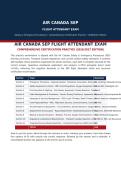
AIR CANADA SEP FLIGHT ATTENDANT EXAM
COMPREHENSIVE CERTIFICATION PRACTICE (2026/2027 EDITION)
This practice examination is aligned with the Air Canada Safety & Emergency Procedures (SEP)
training curriculum, Transport Canada regulations, and current aviation safety standards. It contains
200 multiple-choice questions organized into eleven sections, each with a complete rationale for the
correct answer. Questions emphasize application and analysis (≈75%) alongside direct recall
(≈25%), reflecting the cognitive demands of the SEP flight attendant initial and recurrent
certification examination.
Section Topic Questions
Section 1 Emergency Procedures – Depressurization, Turbulence, Evacuation, Emergency
25 Landings, Shouted Comman
Section 2 Safety Equipment & Checks – PBE, Fire Extinguishers, Oxygen Equipment, Restrain
25 Kits, Flashlights, ELT
Section 3 Fire Prevention & Fighting – Fire Classes, Equipment, Smoke Detectors, Teamwork
20
Section 4 Cabin Management & Procedures – Service During Turbulence, Inoperative Equipment,
20 Unaccompanied Min
Section 5 Passenger & Security Management – IFSO, Level 4 Threats, Bomb Threats, Lithium
20 Batteries, Dangerous Go
Section 6 Crew Responsibilities – RAIC, Flight Deck Security, Communications, Controlled
20 Rest
Section 7 Aircraft Systems & Equipment – Circuit Breakers, Smoke Detectors, Oxygen 15
Bottles, Electrical Outlets
Section 8 Deplanement & Evacuation – Rapid Deplanement, Prepared/Unprepared Emergencies,
15 Slide/Raft Malfunctio
Section 9 Medical & Special Situations – Medipak, First Aid, Oxygen Administration, In-Flight
10 Medical Emergencies
Section 10 Regulatory & Operational Requirements – Transport Canada Inspectors, CARs,
10 FAM vs. MEL, DG Documenta
Section 11 Integrated Scenario-Based Questions – Complex Emergency & Safety Scenarios
20
TOTAL 200
How to use this exam: Work through the sections in order, marking your answers. Each item shows
four options (A–D) with exactly one correct response, followed by the answer and a rationale. A
consolidated answer key appears at the end for quick scoring.
,AIR CANADA SEP — Flight Attendant Exam Comprehensive Certification Practice (2026/2027)
Section 1: Emergency Procedures – Depressurization, Turbulence, Evacuation,
Emergency Landings, Shouted Commands
Q1: A rapid (explosive) decompression of the cabin most commonly occurs unexpectedly and may be
caused by:
A. a slow leak from a worn door seal
B. a gradual bleed through the outflow valve
C. failure of a cabin window or fuselage skin [CORRECT]
D. a blocked lavatory ventilation duct
Correct Answer: C
Rationale: Rapid decompression is sudden and may result from a window or fuselage failure. Slow leaks and
outflow-valve bleeds produce slow (gradual) depressurization.
Q2: Which statement best describes a slow (gradual) depressurization?
A. It is explosive and immediately obvious
B. It develops gradually and gives the crew advance warning [CORRECT]
C. It is always caused by a window failure
D. It can never be detected by the aircraft systems
Correct Answer: B
Rationale: A slow depressurization is felt gradually (e.g., ear discomfort), giving the crew advance warning.
Window failure is associated with rapid decompression.
Q3: During light turbulence, the correct cabin service policy is to:
A. stop all service immediately and return carts to the galley
B. continue service but relieve the cabin of hot beverages [CORRECT]
C. continue full service including hot beverages
D. begin an evacuation briefing
Correct Answer: B
Rationale: In light turbulence service may continue, but hot beverages must be removed to prevent scalding.
Full service with hot liquids is unsafe.
Q4: During moderate turbulence, cabin crew must:
A. continue meal service normally
B. continue service but remove only the coffee
C. stop service immediately [CORRECT]
D. deploy the drop-down oxygen masks
Correct Answer: C
Rationale: During moderate turbulence, service must be stopped. Continuing service would risk injury to crew
and passengers.
Q5: According to the SEP, during severe turbulence the service procedure is to:
A. stop all service and evacuate the cabin
B. continue service but ensure hot beverages are removed [CORRECT]
C. continue full service including hot beverages
D. serve only cold beverages from the galley
Correct Answer: B
Rationale: Per the SEP, during severe turbulence service is continued but hot beverages must be removed to
prevent scalding. Full hot-beverage service is unsafe.
Page 2 of 40
,AIR CANADA SEP — Flight Attendant Exam Comprehensive Certification Practice (2026/2027)
Q6: A rapid deplanement differs from an evacuation because it:
A. uses ground equipment and does NOT require an evacuation [CORRECT]
B. always uses the emergency slides
C. is used only for ditching
D. requires passengers to leave through every door simultaneously
Correct Answer: A
Rationale: A rapid deplanement uses ground equipment (stairs/bridges) and does not require an evacuation.
Slides are used in evacuations, not rapid deplanement.
Q7: Who determines whether operational circumstances permit controlled rest for crew members?
A. the most senior cabin crew member
B. the In-charge flight attendant
C. the pilot-in-command (PIC) [CORRECT]
D. Transport Canada
Correct Answer: C
Rationale: The PIC determines if operational circumstances permit controlled rest. Cabin crew do not make
this decision on their own.
Q8: In a prepared emergency, the cabin crew:
A. have no warning and must react instantly
B. have advance warning and time to prepare the cabin [CORRECT]
C. are not required to brief the passengers
D. must not brief able-bodied passengers
Correct Answer: B
Rationale: A prepared emergency gives the crew advance warning and time to prepare, brief able-bodied
passengers, and secure the cabin.
Q9: An unprepared emergency is best described as one that:
A. occurs unexpectedly, without advance warning [CORRECT]
B. is announced well in advance
C. is limited to medical situations
D. never requires an evacuation
Correct Answer: A
Rationale: An unprepared emergency happens without warning, so the crew must immediately begin
emergency actions and shouted commands.
Q10: If a slide or slide-raft malfunctions during a LAND evacuation, cabin crew:
A. must never use that exit
B. must abandon the exit and do nothing
C. can use the slide even if only partly inflated or not inflated [CORRECT]
D. must inflate it manually with a pump
Correct Answer: C
Rationale: On land, crew CAN use partly or non-inflated slides to help passengers down. This exit may remain
usable.
Page 3 of 40
, AIR CANADA SEP — Flight Attendant Exam Comprehensive Certification Practice (2026/2027)
Q11: If a slide-raft fails to inflate during a WATER evacuation, cabin crew:
A. may use the partly deflated raft as a floating aid
B. cannot use a deflated or partly deflated slide/raft [CORRECT]
C. may use it if at least one side inflates
D. must inflate it using cabin air pressure
Correct Answer: B
Rationale: In water, crew CANNOT use deflated or partly deflated slides/rafts because they would not support
occupants safely.
Q12: When the PIC commands 'Brace for landing! Brace for landing!', cabin crew must:
A. remain standing at the exits
B. begin the evacuation commands
C. continue meal service
D. assume the bracing position and shout the brace commands [CORRECT]
Correct Answer: D
Rationale: On the brace command, crew immediately assume the bracing position and shout the commanded
brace commands to passengers.
Q13: The shouted evacuation commands used by cabin crew at the exits include:
A. Release seat belts! Leave everything! Come this way! [CORRECT]
B. Remain seated with belts fastened
C. Please remain calm and await instructions
D. Take your hand baggage before exiting
Correct Answer: A
Rationale: Evacuation commands are shouted loudly and continuously: release seat belts, leave everything,
and come this way. Passengers must not take baggage.
Q14: During an evacuation, when a passenger hesitates at the exit, the crew shouts which command to
keep the flow moving?
A. Jump! Jump! [CORRECT]
B. Stop and wait
C. Return to your seat
D. Secure your tray table
Correct Answer: A
Rationale: The command 'Jump! Jump!' urges hesitant passengers onto the slide to maintain continuous flow
at the exit.
Q15: Which condition would make an exit UNUSABLE during an evacuation?
A. a fully inflated slide
B. fire, smoke, water, or obstruction at that exit [CORRECT]
C. a working assist handle
D. normal cabin lighting
Correct Answer: B
Rationale: An exit is unusable if blocked by fire, smoke, water, or obstruction; passengers must be redirected
to another usable exit.
Page 4 of 40
FLIGHT ATTENDANT EXAM
Safety & Emergency Procedures • Comprehensive Certification Practice • 2026/2027 Edition
AIR CANADA SEP FLIGHT ATTENDANT EXAM
COMPREHENSIVE CERTIFICATION PRACTICE (2026/2027 EDITION)
This practice examination is aligned with the Air Canada Safety & Emergency Procedures (SEP)
training curriculum, Transport Canada regulations, and current aviation safety standards. It contains
200 multiple-choice questions organized into eleven sections, each with a complete rationale for the
correct answer. Questions emphasize application and analysis (≈75%) alongside direct recall
(≈25%), reflecting the cognitive demands of the SEP flight attendant initial and recurrent
certification examination.
Section Topic Questions
Section 1 Emergency Procedures – Depressurization, Turbulence, Evacuation, Emergency
25 Landings, Shouted Comman
Section 2 Safety Equipment & Checks – PBE, Fire Extinguishers, Oxygen Equipment, Restrain
25 Kits, Flashlights, ELT
Section 3 Fire Prevention & Fighting – Fire Classes, Equipment, Smoke Detectors, Teamwork
20
Section 4 Cabin Management & Procedures – Service During Turbulence, Inoperative Equipment,
20 Unaccompanied Min
Section 5 Passenger & Security Management – IFSO, Level 4 Threats, Bomb Threats, Lithium
20 Batteries, Dangerous Go
Section 6 Crew Responsibilities – RAIC, Flight Deck Security, Communications, Controlled
20 Rest
Section 7 Aircraft Systems & Equipment – Circuit Breakers, Smoke Detectors, Oxygen 15
Bottles, Electrical Outlets
Section 8 Deplanement & Evacuation – Rapid Deplanement, Prepared/Unprepared Emergencies,
15 Slide/Raft Malfunctio
Section 9 Medical & Special Situations – Medipak, First Aid, Oxygen Administration, In-Flight
10 Medical Emergencies
Section 10 Regulatory & Operational Requirements – Transport Canada Inspectors, CARs,
10 FAM vs. MEL, DG Documenta
Section 11 Integrated Scenario-Based Questions – Complex Emergency & Safety Scenarios
20
TOTAL 200
How to use this exam: Work through the sections in order, marking your answers. Each item shows
four options (A–D) with exactly one correct response, followed by the answer and a rationale. A
consolidated answer key appears at the end for quick scoring.
,AIR CANADA SEP — Flight Attendant Exam Comprehensive Certification Practice (2026/2027)
Section 1: Emergency Procedures – Depressurization, Turbulence, Evacuation,
Emergency Landings, Shouted Commands
Q1: A rapid (explosive) decompression of the cabin most commonly occurs unexpectedly and may be
caused by:
A. a slow leak from a worn door seal
B. a gradual bleed through the outflow valve
C. failure of a cabin window or fuselage skin [CORRECT]
D. a blocked lavatory ventilation duct
Correct Answer: C
Rationale: Rapid decompression is sudden and may result from a window or fuselage failure. Slow leaks and
outflow-valve bleeds produce slow (gradual) depressurization.
Q2: Which statement best describes a slow (gradual) depressurization?
A. It is explosive and immediately obvious
B. It develops gradually and gives the crew advance warning [CORRECT]
C. It is always caused by a window failure
D. It can never be detected by the aircraft systems
Correct Answer: B
Rationale: A slow depressurization is felt gradually (e.g., ear discomfort), giving the crew advance warning.
Window failure is associated with rapid decompression.
Q3: During light turbulence, the correct cabin service policy is to:
A. stop all service immediately and return carts to the galley
B. continue service but relieve the cabin of hot beverages [CORRECT]
C. continue full service including hot beverages
D. begin an evacuation briefing
Correct Answer: B
Rationale: In light turbulence service may continue, but hot beverages must be removed to prevent scalding.
Full service with hot liquids is unsafe.
Q4: During moderate turbulence, cabin crew must:
A. continue meal service normally
B. continue service but remove only the coffee
C. stop service immediately [CORRECT]
D. deploy the drop-down oxygen masks
Correct Answer: C
Rationale: During moderate turbulence, service must be stopped. Continuing service would risk injury to crew
and passengers.
Q5: According to the SEP, during severe turbulence the service procedure is to:
A. stop all service and evacuate the cabin
B. continue service but ensure hot beverages are removed [CORRECT]
C. continue full service including hot beverages
D. serve only cold beverages from the galley
Correct Answer: B
Rationale: Per the SEP, during severe turbulence service is continued but hot beverages must be removed to
prevent scalding. Full hot-beverage service is unsafe.
Page 2 of 40
,AIR CANADA SEP — Flight Attendant Exam Comprehensive Certification Practice (2026/2027)
Q6: A rapid deplanement differs from an evacuation because it:
A. uses ground equipment and does NOT require an evacuation [CORRECT]
B. always uses the emergency slides
C. is used only for ditching
D. requires passengers to leave through every door simultaneously
Correct Answer: A
Rationale: A rapid deplanement uses ground equipment (stairs/bridges) and does not require an evacuation.
Slides are used in evacuations, not rapid deplanement.
Q7: Who determines whether operational circumstances permit controlled rest for crew members?
A. the most senior cabin crew member
B. the In-charge flight attendant
C. the pilot-in-command (PIC) [CORRECT]
D. Transport Canada
Correct Answer: C
Rationale: The PIC determines if operational circumstances permit controlled rest. Cabin crew do not make
this decision on their own.
Q8: In a prepared emergency, the cabin crew:
A. have no warning and must react instantly
B. have advance warning and time to prepare the cabin [CORRECT]
C. are not required to brief the passengers
D. must not brief able-bodied passengers
Correct Answer: B
Rationale: A prepared emergency gives the crew advance warning and time to prepare, brief able-bodied
passengers, and secure the cabin.
Q9: An unprepared emergency is best described as one that:
A. occurs unexpectedly, without advance warning [CORRECT]
B. is announced well in advance
C. is limited to medical situations
D. never requires an evacuation
Correct Answer: A
Rationale: An unprepared emergency happens without warning, so the crew must immediately begin
emergency actions and shouted commands.
Q10: If a slide or slide-raft malfunctions during a LAND evacuation, cabin crew:
A. must never use that exit
B. must abandon the exit and do nothing
C. can use the slide even if only partly inflated or not inflated [CORRECT]
D. must inflate it manually with a pump
Correct Answer: C
Rationale: On land, crew CAN use partly or non-inflated slides to help passengers down. This exit may remain
usable.
Page 3 of 40
, AIR CANADA SEP — Flight Attendant Exam Comprehensive Certification Practice (2026/2027)
Q11: If a slide-raft fails to inflate during a WATER evacuation, cabin crew:
A. may use the partly deflated raft as a floating aid
B. cannot use a deflated or partly deflated slide/raft [CORRECT]
C. may use it if at least one side inflates
D. must inflate it using cabin air pressure
Correct Answer: B
Rationale: In water, crew CANNOT use deflated or partly deflated slides/rafts because they would not support
occupants safely.
Q12: When the PIC commands 'Brace for landing! Brace for landing!', cabin crew must:
A. remain standing at the exits
B. begin the evacuation commands
C. continue meal service
D. assume the bracing position and shout the brace commands [CORRECT]
Correct Answer: D
Rationale: On the brace command, crew immediately assume the bracing position and shout the commanded
brace commands to passengers.
Q13: The shouted evacuation commands used by cabin crew at the exits include:
A. Release seat belts! Leave everything! Come this way! [CORRECT]
B. Remain seated with belts fastened
C. Please remain calm and await instructions
D. Take your hand baggage before exiting
Correct Answer: A
Rationale: Evacuation commands are shouted loudly and continuously: release seat belts, leave everything,
and come this way. Passengers must not take baggage.
Q14: During an evacuation, when a passenger hesitates at the exit, the crew shouts which command to
keep the flow moving?
A. Jump! Jump! [CORRECT]
B. Stop and wait
C. Return to your seat
D. Secure your tray table
Correct Answer: A
Rationale: The command 'Jump! Jump!' urges hesitant passengers onto the slide to maintain continuous flow
at the exit.
Q15: Which condition would make an exit UNUSABLE during an evacuation?
A. a fully inflated slide
B. fire, smoke, water, or obstruction at that exit [CORRECT]
C. a working assist handle
D. normal cabin lighting
Correct Answer: B
Rationale: An exit is unusable if blocked by fire, smoke, water, or obstruction; passengers must be redirected
to another usable exit.
Page 4 of 40


