

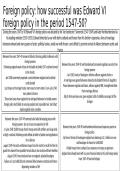
Foreign policy: how successful was Edward VI
foreign policy in the period 1547-50?
During the years 1547 to 50 Edward VI’s foreign ploicy was dicated by his ‘lord protector’ Somerest (1547-1549) and later Northumberland as
his leading minister (1550-1553). Edward inherited a war with both scotland and france from his farther- expensive. Aims of marriage
between edward and mary queen of scots- political union, avoid war with france- cant afford it, prevent revival of allience between scotts and
france
Between the years 1547-49 somerset failed at forming political alliences with
foreign powers:
Between the years 1549-50 northumberland increased englands security from
. Following england week victory at the battle of pinkie 1547 scotland turned
foreign powers
to the french.
. Jan 1550, treaty of boulogne- defnsive allience against charles v
. Jan 1548 somereset proposed a union between england and scotland-
. A marriage was agreed between edward and elizabeth (henry ii daughter)
scotts denied
. Peace between england and france, allience against HRE, strengthened links
. Lost hopes of marriage treaty, marry was to marry henry ii son- july 1548
from marriage allience
mary taken to france
. Big fix from previous year, gave england a bit of stability amoungst all the
. These two loses show england to be entraped between to hostile powers
changes
.foreign policy had failed at securing england and a possible heir, had infact
made england more vunrable
Between the years 1547-49 somerset also failed at keeping peace with
foreign powers- aim as it was too expensive for h8:
Between the years 1549-50 northumberland decreased expenses spent on
. In june 1548 10,000 troops french troops sent with artillery and siege land
foreign policy
at leigh- scotland, following scotts defeat at battle of pinkie and negotiations
. By time of treaty of boulougne england was bankrupt, £2.1 million on war-
for a allience
sold boulogne to france for £400,000
.august 1549- forced to withdraw troops from the north to recall the fleet to
. Pulled troops from scotland, less expenses on troops an garrisons
guard the channel from possible french attack- also to deal with ket rebellion
. England had already been left in a poor financial state by h8, and foreign policy
. August 1549, france declared war on england, attacked boulogne
from 1547-49 had not helped.
. Failure as it cost £600,00 and cemented links between scotland and france
. Repeating mistakes of h8
,By 1509, henry vii had established his authority across the whole
of england For: Against
Point: local government/law and order - justice’s of the peace Point: opposition through pretenders
Evidence: these were not noble men, rather gentry and knights that were Evidence: the Simnel Rebellin 1487 – was crowned King in Dublin on 24th May 1487.
appointed local to perform unpaid work. Enforced law and order, including The Earl of Linclon was a leading figuer, he was on Henrys council. Led to the battle
implementing the kings laws and financial rules. Met four times a year at the of stoke in June 1487, Linclon had an army of 8000
Quarter sessions Explain: did not control his nobility as they were plotting against them. Pretenders
Explain: ensured noblemen did not gain too much power locally. As JPs were showed a serious threat to his claim to the throne, and therefore his autority
appointed by the king they had to be commpletely loyal to him or their Evidence: Warbeck imposture 1491-99 – Sir William Stanely (held position of
position would be taken away Chamberlan) was implemented in Warbecks plot to invade England in 1495.
Evidence: a total of 21 statutes were linked to JPs, 10% of legislation Explain: although the invasion failed and Stanely was executed, it showed that
Explain: increasing powers and regulations allowed for better control of the Henry did not have control over the people closest to him. Undermines his authority
country and how it was run Analyse: whilst both these pretenders never came close to ceizing the throne, the
Analyse: sheriffs were also used as local authority, but H7 decreased their domestic and foreign support they gained possed a real threat to Henrys authority
importance in favour of JPs Against
For: Point: it was his ministers rather than him who established royal authority
Point: controlled the nobility through threats, and restricted opportunities to Evidence: the court of the Star Chamber, established in 1487. it heard charges
challenge his authority against noblemen who broke the laws over maintenance and retaining
Evidence: acts of attainder- immediately dated his reign from august 21st Explain: the Kings most favourable advisors sat on the court to make judgements,
1485, so anyone who fought against him was a tartor and acts of attainders for this reason it was possible to haul even the greatest nobles before it. The power
could be passed against them. Passed 138 AOA in total of this court and its judges decisions established Henrys authority
Explain: dating his reign from this point gave him instsatnt control not only Evidence: the Council Learned in Law, established in 1495. it dealt with pursuing the
cause of AOA but also because it implied he was the rightful king kings feudal rights linked to crown lands, and was linked with bonds and recognises.
Evidence: bonds and recognisances- during his reign 36 out of the 62 nobel It was lead by Sir Reginald Bray until 1503, and then by Edmund Dudely and Richard
families where put under bonds and/or recognisances Empson until 1509. this was able to establish authority as it could weaken the power
Explain: bonds- agreement to pay a sum of money if they don’t stay in line. of nobles
Recognisances- formal acknologment of a dept that already exists Explain: it was Henrys ministers, specifically Dudley and Empson who ensured this,
Analyse: allowed henry to ensure nobels did not have the ability to challenge rather than the king
his authority. Aswell as it gaining lands and funds for him, making him more Analyse: was universaly hated by nobles and was corrupt, Dudley confessed he
powerful. acted illegaly for the king in more than 80 cases
,How far did Henry VII achieve his aims in foreign policy
Henry Vll’s overall aims were: natioanl security, recognition of the tudor dynasty, and defence of Englands trading interests
For: Against:
Point: secured national security aswell as the recognition of the tudor Point: Henry was not a major player in international politics and therefore could
dynasty by securing the marriage alliance between Prince Arthur and not secure a strong standing umongst other European powers
Evidence: failure of the Treaty of Redon between Brittany and England, as despite
Catherine of Aragon Henry sending 3000 troops which helped to defeat the French at the battle of
Evidence: secured the dowry of Catherine of 100,000 crowns when she Dixmude in june 1489, Franch attacked Brittany again and in Dec 1491 they
arrived in England in 1501 accepted defeat
Explain: economic support offered Henry greater strength Explain: show England did not have the power to defend a foreign nation, Henry
Evidence: Medina del campo (1489) established that neither would also lost any control he had over Dutches Anne, aswell as now having another
make any agreements with France without consulting eachother country allied with France
Explain: significant as England had previously (1487) been involved in Evidence: Holy League (1495) – anti-French alliance, invloving the Pope,
Ferdinand, Maximillian and other
the Fench invasion of Brittany, where England had failed to secure
Explain: as henry was not involved with this initally, brought in in Oct 1496, shows
Brittany is lack of significance in European affairs
Analyse: allience fell threw when Arthur died in 1502, H8 did not marry Analyse: peace treaties, rather than being involved in aggressive foregin policy
Catherine 11 June 1509, after H7 death (April 1509) were better fot his aims
For:
Against:
Point: national security – peace treaties with foreign powers
Point: failed to defend English trading interests
Evidence: Treaty of Etaples between England and France (Nov 1492) –Charles VIII
Evidence: the Merchant Adventures were unable to overcome the trading
agreed to withdraw his support for Warbeck and pay henry a pension of £5,000,
privilages enjoyed by the Hanseatic League which had been reasserted by treaty
and cover the costs of him raising an army ….
in 1474 and again in 1504
Explain: ensured a period of peace between France and England, aswell as
Explain: despite making advances in English trade, they could not dominate it
improving is financial position
Evidence: 1506 – signing of the Malus Intercursus with Philip of Burgandy,
Evidence: Treaty of Perpetual Peace, between England and Scotland (1502), James
demanding things such as, Trade between England and the Low Countries would
IV married HVII sister Margaret in 1503. also Treaty of Ayton with Scott in 1497
be free
after scotland invaded England in 1496 for Warbeck
Explain: was never implemented, too one sided
Explain: secured the border, aswell as gaining influence in scotland
Analyse: 60% more cloth was being exported in 1509 than had been at the
Analyse: whilst this insured peace, it did not show England as a European power,
beginning of the reign
rather a weak one
, Despite the need to secure his dynasty it was the desire to expand Englands overseas trade
that underpinned H7’s foreign policy
For Against
Point: promotion of English trade through legislation Point: his need do secure his dynastic security through a marriage alliance –
Evidence: a Navigation Act of 1486 stated wines from Gascony were to be marriage allience between Catherine of Aragon and Prince Arthur
imported only in English ships with crews made up of no less than 50% of the Evidence: secured the dowry of Catherine of 100,000 crowns when she arrived in
kings subjects England in 1501
Explain: this was with the aim of breaking the monopoly the Hanseatic League Explain: economic support offered Henry greater strength
had over trade, especially in the Baltic. This in turn assisted the activities of the Evidence: Medina del campo (1489) established that neither would make any
London-based Merchant Adventures agreements with France without consulting eachother
Evidence: a Navigation Act of 1489 stated that English merchants should only Explain: significant as England had previously (1487) been involved in the Fench
import goods in foreign ships if no English ones were available invasion of Brittany, where England had failed to secure Brittany
Explain: to limit the foreign grip on English trade. To encourage the use of English Analyse: allience fell threw when Arthur died in 1502, H8 did not marry Catherine
ships to carry goods rather than foreign goods 11 June 1509, after H7 death (April 1509)
Against:
For Point: need to secure his dynasty through ensuring Englands security – peace
Point: trade agreements with foreign powers treaties
Evidence: Trade with Burgandy – Magnus Intercurus, 1496 – this treaty stated that Evidence: Treaty of Etaples between England and France (Nov 1492) –Charles VIII
the English merchants would be allowed to trade freely across Phillip’s kingdom, agreed to withdraw his support for Warbeck and pay henry a pension of £5,000,
except Flanders and cover the costs of him raising an army ….
Explain: this was following a trade embagro which had been put in place by both Explain: ensured a period of peace between France and England, aswell as
countries as Warbeck had been taken in by Margret of Burgandy – but these improving is financial position
embargos helped no one as both needed eachothers trade Evidence: Treaty of Perpetual Peace, between England and Scotland (1502), James
Evidence: Trade with Spain – following the Treaty of Medina del Campo in 1489, IV married HVII sister Margaret in 1503
both England and Spain received the same trading rights as each other, and had Explain: secured the border, aswell as gaining influence in scotland
duties fixed at an favourably low price Analyse: whilst this insured peace, it did not show England as a European power,
rather a weak one
foreign policy in the period 1547-50?
During the years 1547 to 50 Edward VI’s foreign ploicy was dicated by his ‘lord protector’ Somerest (1547-1549) and later Northumberland as
his leading minister (1550-1553). Edward inherited a war with both scotland and france from his farther- expensive. Aims of marriage
between edward and mary queen of scots- political union, avoid war with france- cant afford it, prevent revival of allience between scotts and
france
Between the years 1547-49 somerset failed at forming political alliences with
foreign powers:
Between the years 1549-50 northumberland increased englands security from
. Following england week victory at the battle of pinkie 1547 scotland turned
foreign powers
to the french.
. Jan 1550, treaty of boulogne- defnsive allience against charles v
. Jan 1548 somereset proposed a union between england and scotland-
. A marriage was agreed between edward and elizabeth (henry ii daughter)
scotts denied
. Peace between england and france, allience against HRE, strengthened links
. Lost hopes of marriage treaty, marry was to marry henry ii son- july 1548
from marriage allience
mary taken to france
. Big fix from previous year, gave england a bit of stability amoungst all the
. These two loses show england to be entraped between to hostile powers
changes
.foreign policy had failed at securing england and a possible heir, had infact
made england more vunrable
Between the years 1547-49 somerset also failed at keeping peace with
foreign powers- aim as it was too expensive for h8:
Between the years 1549-50 northumberland decreased expenses spent on
. In june 1548 10,000 troops french troops sent with artillery and siege land
foreign policy
at leigh- scotland, following scotts defeat at battle of pinkie and negotiations
. By time of treaty of boulougne england was bankrupt, £2.1 million on war-
for a allience
sold boulogne to france for £400,000
.august 1549- forced to withdraw troops from the north to recall the fleet to
. Pulled troops from scotland, less expenses on troops an garrisons
guard the channel from possible french attack- also to deal with ket rebellion
. England had already been left in a poor financial state by h8, and foreign policy
. August 1549, france declared war on england, attacked boulogne
from 1547-49 had not helped.
. Failure as it cost £600,00 and cemented links between scotland and france
. Repeating mistakes of h8
,By 1509, henry vii had established his authority across the whole
of england For: Against
Point: local government/law and order - justice’s of the peace Point: opposition through pretenders
Evidence: these were not noble men, rather gentry and knights that were Evidence: the Simnel Rebellin 1487 – was crowned King in Dublin on 24th May 1487.
appointed local to perform unpaid work. Enforced law and order, including The Earl of Linclon was a leading figuer, he was on Henrys council. Led to the battle
implementing the kings laws and financial rules. Met four times a year at the of stoke in June 1487, Linclon had an army of 8000
Quarter sessions Explain: did not control his nobility as they were plotting against them. Pretenders
Explain: ensured noblemen did not gain too much power locally. As JPs were showed a serious threat to his claim to the throne, and therefore his autority
appointed by the king they had to be commpletely loyal to him or their Evidence: Warbeck imposture 1491-99 – Sir William Stanely (held position of
position would be taken away Chamberlan) was implemented in Warbecks plot to invade England in 1495.
Evidence: a total of 21 statutes were linked to JPs, 10% of legislation Explain: although the invasion failed and Stanely was executed, it showed that
Explain: increasing powers and regulations allowed for better control of the Henry did not have control over the people closest to him. Undermines his authority
country and how it was run Analyse: whilst both these pretenders never came close to ceizing the throne, the
Analyse: sheriffs were also used as local authority, but H7 decreased their domestic and foreign support they gained possed a real threat to Henrys authority
importance in favour of JPs Against
For: Point: it was his ministers rather than him who established royal authority
Point: controlled the nobility through threats, and restricted opportunities to Evidence: the court of the Star Chamber, established in 1487. it heard charges
challenge his authority against noblemen who broke the laws over maintenance and retaining
Evidence: acts of attainder- immediately dated his reign from august 21st Explain: the Kings most favourable advisors sat on the court to make judgements,
1485, so anyone who fought against him was a tartor and acts of attainders for this reason it was possible to haul even the greatest nobles before it. The power
could be passed against them. Passed 138 AOA in total of this court and its judges decisions established Henrys authority
Explain: dating his reign from this point gave him instsatnt control not only Evidence: the Council Learned in Law, established in 1495. it dealt with pursuing the
cause of AOA but also because it implied he was the rightful king kings feudal rights linked to crown lands, and was linked with bonds and recognises.
Evidence: bonds and recognisances- during his reign 36 out of the 62 nobel It was lead by Sir Reginald Bray until 1503, and then by Edmund Dudely and Richard
families where put under bonds and/or recognisances Empson until 1509. this was able to establish authority as it could weaken the power
Explain: bonds- agreement to pay a sum of money if they don’t stay in line. of nobles
Recognisances- formal acknologment of a dept that already exists Explain: it was Henrys ministers, specifically Dudley and Empson who ensured this,
Analyse: allowed henry to ensure nobels did not have the ability to challenge rather than the king
his authority. Aswell as it gaining lands and funds for him, making him more Analyse: was universaly hated by nobles and was corrupt, Dudley confessed he
powerful. acted illegaly for the king in more than 80 cases
,How far did Henry VII achieve his aims in foreign policy
Henry Vll’s overall aims were: natioanl security, recognition of the tudor dynasty, and defence of Englands trading interests
For: Against:
Point: secured national security aswell as the recognition of the tudor Point: Henry was not a major player in international politics and therefore could
dynasty by securing the marriage alliance between Prince Arthur and not secure a strong standing umongst other European powers
Evidence: failure of the Treaty of Redon between Brittany and England, as despite
Catherine of Aragon Henry sending 3000 troops which helped to defeat the French at the battle of
Evidence: secured the dowry of Catherine of 100,000 crowns when she Dixmude in june 1489, Franch attacked Brittany again and in Dec 1491 they
arrived in England in 1501 accepted defeat
Explain: economic support offered Henry greater strength Explain: show England did not have the power to defend a foreign nation, Henry
Evidence: Medina del campo (1489) established that neither would also lost any control he had over Dutches Anne, aswell as now having another
make any agreements with France without consulting eachother country allied with France
Explain: significant as England had previously (1487) been involved in Evidence: Holy League (1495) – anti-French alliance, invloving the Pope,
Ferdinand, Maximillian and other
the Fench invasion of Brittany, where England had failed to secure
Explain: as henry was not involved with this initally, brought in in Oct 1496, shows
Brittany is lack of significance in European affairs
Analyse: allience fell threw when Arthur died in 1502, H8 did not marry Analyse: peace treaties, rather than being involved in aggressive foregin policy
Catherine 11 June 1509, after H7 death (April 1509) were better fot his aims
For:
Against:
Point: national security – peace treaties with foreign powers
Point: failed to defend English trading interests
Evidence: Treaty of Etaples between England and France (Nov 1492) –Charles VIII
Evidence: the Merchant Adventures were unable to overcome the trading
agreed to withdraw his support for Warbeck and pay henry a pension of £5,000,
privilages enjoyed by the Hanseatic League which had been reasserted by treaty
and cover the costs of him raising an army ….
in 1474 and again in 1504
Explain: ensured a period of peace between France and England, aswell as
Explain: despite making advances in English trade, they could not dominate it
improving is financial position
Evidence: 1506 – signing of the Malus Intercursus with Philip of Burgandy,
Evidence: Treaty of Perpetual Peace, between England and Scotland (1502), James
demanding things such as, Trade between England and the Low Countries would
IV married HVII sister Margaret in 1503. also Treaty of Ayton with Scott in 1497
be free
after scotland invaded England in 1496 for Warbeck
Explain: was never implemented, too one sided
Explain: secured the border, aswell as gaining influence in scotland
Analyse: 60% more cloth was being exported in 1509 than had been at the
Analyse: whilst this insured peace, it did not show England as a European power,
beginning of the reign
rather a weak one
, Despite the need to secure his dynasty it was the desire to expand Englands overseas trade
that underpinned H7’s foreign policy
For Against
Point: promotion of English trade through legislation Point: his need do secure his dynastic security through a marriage alliance –
Evidence: a Navigation Act of 1486 stated wines from Gascony were to be marriage allience between Catherine of Aragon and Prince Arthur
imported only in English ships with crews made up of no less than 50% of the Evidence: secured the dowry of Catherine of 100,000 crowns when she arrived in
kings subjects England in 1501
Explain: this was with the aim of breaking the monopoly the Hanseatic League Explain: economic support offered Henry greater strength
had over trade, especially in the Baltic. This in turn assisted the activities of the Evidence: Medina del campo (1489) established that neither would make any
London-based Merchant Adventures agreements with France without consulting eachother
Evidence: a Navigation Act of 1489 stated that English merchants should only Explain: significant as England had previously (1487) been involved in the Fench
import goods in foreign ships if no English ones were available invasion of Brittany, where England had failed to secure Brittany
Explain: to limit the foreign grip on English trade. To encourage the use of English Analyse: allience fell threw when Arthur died in 1502, H8 did not marry Catherine
ships to carry goods rather than foreign goods 11 June 1509, after H7 death (April 1509)
Against:
For Point: need to secure his dynasty through ensuring Englands security – peace
Point: trade agreements with foreign powers treaties
Evidence: Trade with Burgandy – Magnus Intercurus, 1496 – this treaty stated that Evidence: Treaty of Etaples between England and France (Nov 1492) –Charles VIII
the English merchants would be allowed to trade freely across Phillip’s kingdom, agreed to withdraw his support for Warbeck and pay henry a pension of £5,000,
except Flanders and cover the costs of him raising an army ….
Explain: this was following a trade embagro which had been put in place by both Explain: ensured a period of peace between France and England, aswell as
countries as Warbeck had been taken in by Margret of Burgandy – but these improving is financial position
embargos helped no one as both needed eachothers trade Evidence: Treaty of Perpetual Peace, between England and Scotland (1502), James
Evidence: Trade with Spain – following the Treaty of Medina del Campo in 1489, IV married HVII sister Margaret in 1503
both England and Spain received the same trading rights as each other, and had Explain: secured the border, aswell as gaining influence in scotland
duties fixed at an favourably low price Analyse: whilst this insured peace, it did not show England as a European power,
rather a weak one


