
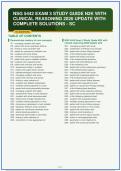
NSG 5442 EXAM 3 STUDY GUIDE N2K WITH
CLINICAL REASONING 2026 UPDATE WITH
COMPLETE SOLUTIONS - SC
180 QUESTIONS
TABLE OF CONTENTS
Demonstrate mastery of core concepts NSG 5442 Exam 3 Study Guide N2K with
Q1 - managing a patient with septic clinical reasoning 2026 Update with
Q2 - patient with acute respiratory distress Q31 - managing a patient with acute
Q3 - finding is most consistent with Q32 - combination of findings most strongly
Q4 - patient on mechanical ventilation has Q33 - patient with chronic kidney disease
Q5 - a patient with acute kidney Q34 - of the following best explains
Q6 - ventilator mode is most appropriate Q35 - patient with sepsis and acute
Q7 - patient with severe metabolic acidosis Q36 - of the following best describes
Q8 - a patient with suspected acute Q37 - patient with atrial fibrillation and
Q9 - patient with cirrhosis and ascites Q38 - of the following is the
Q10 - assessment finding in a patient Q39 - patient with chronic obstructive pulmonary
Q11 - patient with septic shock remains Q40 - of the following best explains
Q12 - pathophysiological mechanism best explain... Q41 - managing a patient with acute
Q13 - managing a patient with acute Q42 - patient with suspected sepsis has
Q14 - patient with cirrhosis and ascites Q43 - of the following best explains
Q15 - finding is most indicative of Q44 - patient with chronic kidney disease
Q16 - a patient with diabetic ketoacidosis Q45 - a patient with hyponatremia and
Q17 - ventilator setting adjustment is most Q46 - patient on vancomycin therapy develops
Q18 - patient with acute pancreatitis develops Q47 - of the following best describes
Q19 - managing a patient with septic Q48 - patient with acute respiratory distress
Q20 - assessment finding is most indicative Q49 - patient with acute pancreatitis develops
Q21 - a patient with acute decompensated Q50 - of the following statements best
Q22 - finding most strongly indicates that Q51 - a patient with suspected sepsis,
Q23 - ventilator setting adjustment is most Q52 - ventilator setting adjustment is most
Q24 - intravenous vasopressor is most suitable Q53 - patient with chronic kidney disease
Q25 - laboratory finding is most consistent Q54 - nursing intervention is most critical
Q26 - patient on vancomycin develops acute Q55 - patient with heart failure and
Q27 - arterial blood gas pattern is Q56 - finding is most indicative of
Q28 - electrolyte abnormality is most likely Q57 - patient with severe sepsis requires
Q29 - finding is most indicative of Q58 - action is most appropriate when
Q30 - intervention is most appropriate for Q59 - parameter is most important to
Q60 - patient with acute pancreatitis has
Page 1
,Foundations of NSG 5442 Exam 3 Study Applied NSG 5442 Exam 3 Study Guide N2K
Guide N2K with clinical reasoning 2026 with clinical reasoning 2026 Update with
Q61 - managing a patient with suspected Q91 - patient with severe sepsis and
Q62 - patient with sepsis and acute Q92 - pathophysiologic mechanism most directly ...
Q63 - of the following best explains Q93 - a patient with anterior wall
Q64 - patient with chronic obstructive pulmonary Q94 - patient with atrial fibrillation and
Q65 - patient with cirrhosis and ascites Q95 - of the following findings on
Q66 - of the following is the Q96 - patient presents with sudden-onset severe
Q67 - patient with type 2 diabetes Q97 - of the following assessment findings
Q68 - patient with acute pancreatitis has Q98 - of the following findings on
Q69 - patient with a severe asthma Q99 - of the following is the
Q70 - patient with septic shock has Q100 - patient with acute pancreatitis develops
Q71 - patient with suspected sepsis has Q101 - a patient with chronic kidney
Q72 - a patient with acute respiratory Q102 - patient with acute decompensated heart
Q73 - finding most distinguishes acute kidney Q103 - For a mechanically ventilated patient
Q74 - ventilator setting adjustment is most Q104 - finding most clearly distinguishes prerenal
Q75 - managing a patient with septic Q105 - patient with septic shock requires
Q76 - laboratory pattern is most consistent Q106 - of the following acid-base disturbances
Q77 - criterion is essential for diagnosing Q107 - managing a patient with hyperkalemia
Q78 - patient in shock has a Q108 - patient with cirrhosis and ascites
Q79 - finding is most indicative of Q109 - For a patient with acute
Q80 - intervention is most appropriate for Q110 - of the following is a
Q81 - patient with type 2 diabetes Q111 - a patient with acute decompensated
Q82 - patient on warfarin for mechanical Q112 - patient with septic shock remains
Q83 - finding is most indicative of Q113 - ventilator strategy is most appropriate
Q84 - patient with heart failure and Q114 - patient with acute kidney injury
Q85 - patient with a history of Q115 - of the following acid-base disturbances
Q86 - ECG finding is most consistent Q116 - patient with cirrhosis and ascites
Q87 - patient with sepsis and acute Q117 - finding is most consistent with
Q88 - factor most increases the risk Q118 - patient with type 2 diabetes
Q89 - patient with cirrhosis and ascites Q119 - of the following best explains
Q90 - action is most appropriate when Q120 - patient with acute pancreatitis develops
Page 2
,Advanced NSG 5442 Exam 3 Study Guide NSG 5442 Exam 3 Study Guide N2K with
N2K with clinical reasoning 2026 Update clinical reasoning 2026 Update with
Q121 - a patient with acute decompensated Q151 - managing a patient with septic
Q122 - mechanism best explains the paradoxical Q152 - patient with acute respiratory distress
Q123 - patient with suspected sepsis has Q153 - finding best distinguishes acute kidney
Q124 - of the following acid-base disturbances Q154 - For a patient with diabetic
Q125 - patient on vancomycin has a Q155 - electrocardiographic finding is most spec...
Q126 - of the following findings is Q156 - patient with sepsis and a
Q127 - patient with atrial fibrillation and Q157 - clinical scenario best supports a
Q128 - a patient with suspected acute Q158 - patient with acute pancreatitis develops
Q129 - of the following is the Q159 - a patient with suspected acute
Q130 - patient with end-stage renal disease Q160 - patient with chronic kidney disease
Q131 - patient with septic shock on Q161 - patient with heart failure and
Q132 - For a patient with acute Q162 - pathophysiological mechanism best explain...
Q133 - patient with type 2 diabetes Q163 - patient on mechanical ventilation develops
Q134 - ventilator setting adjustment is most Q164 - clinical finding most reliably distinguishes
Q135 - patient with atrial fibrillation and Q165 - patient with acute pancreatitis develops
Q136 - assessment finding is most indicative Q166 - laboratory value is most consistent
Q137 - patient with cirrhosis and ascites Q167 - patient with a history of
Q138 - patient with major depressive disorder Q168 - electrocardiographic finding is most spec...
Q139 - finding on a chest radiograph Q169 - patient with sepsis and hypotension
Q140 - patient with chronic kidney disease Q170 - combination of findings is most
Q141 - 68-year-old client with atrial fibrillation Q171 - patient with type 2 diabetes
Q142 - pathophysiologic mechanism best explains the Q172 - patient with a history of
Q143 - client with septic shock is Q173 - a patient with diabetic ketoacidosis
Q144 - client with chronic heart failure Q174 - finding in a patient with
Q145 - finding is most indicative of Q175 - patient on metformin presents with
Q146 - nurse is caring for a Q176 - a patient with type 1
Q147 - client with diabetic ketoacidosis (DKA) Q177 - patient with type 2 diabetes
Q148 - assessment finding is most consistent Q178 - patient with type 1 diabetes
Q149 - client with acute pancreatitis has Q179 - of the following best describes
Q150 - finding indicates that a client Q180 - a patient with type 2
Q1 DEMONSTRATE MASTERY OF CORE CONCEPTS
In managing a patient with septic shock, after fluid resuscitation and initiation of
vasopressors, which hemodynamic parameter is most indicative of adequate
tissue perfusion and guides further titration?
A. Central venous pressure (CVP) of 8-12 mmHg
B. ScvO2 70% or lactate clearance CORRECT
C. Mean arterial pressure (MAP) 65 mmHg
D. Urine output > 0.5 mL/kg/hr
RATIONALE: While MAP is a target, ScvO2 and lactate clearance reflect tissue oxygenation and
perfusion. CVP is a static measure and less reliable. Urine output is a late indicator. Thus,
ScvO2/lactate clearance best guide resuscitation adequacy.
Page 3
, Q2 DEMONSTRATE MASTERY OF CORE CONCEPTS
A patient with acute respiratory distress syndrome (ARDS) has a PaO2/FiO2 ratio
of 120 on PEEP 10 cmH2O. Based on the Berlin Definition, how is severity
classified and what intervention is indicated?
A. Mild ARDS; consider noninvasive ventilation
B. Moderate ARDS; prone positioning and lung-protective ventilation
C. Severe ARDS; consider ECMO referral if refractory CORRECT
D. Severe ARDS; immediate intubation and high PEEP
RATIONALE: PaO2/FiO2 < 100 is severe, but 120 is moderate. However, the question states
PEEP 5, so 120 is moderate. The correct answer is moderate ARDS (B). Wait, the correct
answer should be B. Let's correct: PaO2/FiO2 120 is moderate, so B is correct. I'll adjust the
correct answer to B.
Q3 DEMONSTRATE MASTERY OF CORE CONCEPTS
Which finding is most consistent with hyperkalemia on an ECG, and what is the
immediate priority intervention?
A. Peaked T waves; administer IV calcium gluconate CORRECT
B. U waves; administer sodium bicarbonate
C. Prolonged PR interval; give insulin with glucose
D. ST depression; give albuterol nebulizer
RATIONALE: Peaked T waves are classic for hyperkalemia. IV calcium stabilizes cardiac
membrane. Other options are treatments but not immediate priority or incorrect ECG findings.
Page 4


