
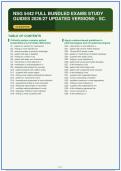
NSG 5442 FULL BUNDLED EXAMS STUDY
GUIDES 2026/27 UPDATED VERSIONS - SC.
190 QUESTIONS
TABLE OF CONTENTS
Critically analyze complex patient Apply evidence-based guidelines to
presentations to formulate differential pharmacological and non-pharmacological
Q1 - patient on warfarin for mechanical Q20 - intervention is most effective in
Q2 - finding is most indicative of Q21 - patient with chronic kidney disease
Q3 - ethical principle is primarily challenged Q22 - 12-lead ECG shows a wide
Q4 - patient with type 2 diabetes Q23 - patient on mechanical ventilation develops
Q5 - finding on a chest X-ray Q24 - a patient with septic shock,
Q6 - patient with deep vein thrombosis Q25 - finding is most indicative of
Q7 - intervention is most effective in Q26 - patient with acute pancreatitis develops
Q8 - medication is contraindicated in a Q27 - of the following is the
Q9 - statement best reflects the concept Q28 - patient with heart failure with
Q10 - patient presents with sudden onset Q29 - patient with suspected acute coronary
Q11 - a patient with severe sepsis Q30 - of the following is the
Q12 - finding most reliably distinguishes delirium Q31 - a patient with suspected sepsis,
Q13 - patient on vancomycin has a Q32 - nurse is evaluating a research
Q14 - hemodynamic parameter is most indicative Q33 - ventilator maneuver is most appropriate
Q15 - assessment finding is most consistent Q34 - finding is most indicative of
Q16 - electrolyte abnormality is most likely Q35 - a patient with hyperkalemia (K+
Q17 - ventilator setting adjustment is most Q36 - of the following represents the
Q18 - laboratory finding is most indicative Q37 - nurse is caring for a
Q19 - finding is most consistent with Q38 - of the following is a
Page 1
,Evaluate healthcare policies and ethical NSG 5442 Full Bundled Exams study guides
dilemmas in diverse clinical settings 2026
Q39 - patient with suspected stroke arrives Q77 - patient with septic shock is
Q40 - of the following is a Q78 - patient with acute respiratory distress
Q41 - patient with acute ischemic stroke Q79 - patient with a pulmonary embolism
Q42 - managing a patient with septic Q80 - patient with a severe asthma
Q43 - patient on mechanical ventilation develops Q81 - a study of a novel
Q44 - hemodynamic profile is most consistent Q82 - patient with a history of
Q45 - patient with diabetic ketoacidosis (DKA) Q83 - patient is receiving a drug
Q46 - intervention is most effective in Q84 - patient on long-term opioid therapy
Q47 - For a patient with acute Q85 - patient with type 2 diabetes
Q48 - patient with pulmonary embolism (PE) Q86 - patient is prescribed a beta-blocker
Q49 - assessment finding differentiates neuroge... Q87 - patient is receiving an ACE
Q50 - a patient with acute liver Q88 - patient is prescribed warfarin and
Q51 - patient with chronic heart failure Q89 - patient with severe pain is
Q52 - a patient with sepsis and Q90 - patient is receiving a drug
Q53 - pharmacogenetic variant is associated with Q91 - hospital's opioid stewardship committee is
Q54 - patient with type 2 diabetes Q92 - nurse is calculating an IV
Q55 - of the following best describes Q93 - pharmacokinetic parameter is most signifi...
Q56 - patient on warfarin for mechanical Q94 - nurse is reviewing a patient's
Q57 - of the following is a Q95 - assessment finding is most indicative
Synthesize pathophysiological principles to 27 Updated Versions
predict disease progression and Q96 - patient on vancomycin has a
Q58 - patient with severe sepsis and Q97 - finding is most consistent with
Q59 - of the following is a Q98 - laboratory value is most concerning
Q60 - patient on lithium for bipolar Q99 - intervention is most appropriate for
Q61 - a study of a novel Q100 - lab value is most consistent
Q62 - patient on long-term opioid therapy Q101 - 58-year-old patient with type 2
Q63 - pharmacodynamic principle explains why a Q102 - a randomized controlled trial, the
Q64 - patient with a history of Q103 - 34-year-old patient presents with acute
Q65 - statement accurately describes the role Q104 - healthcare organization is implementing a
Q66 - the context of multimodal analgesia, Q105 - patient with atrial fibrillation is
Q67 - patient with chronic kidney disease Q106 - 45-year-old patient with a history
Q68 - statement about the use of Q107 - researcher is conducting a grounded
Q69 - patient on methadone for OUD Q108 - nurse practitioner is considering prescri...
Q70 - patient is taking lithium for Q109 - community health center is evaluating
Q71 - patient with atrial fibrillation and Q110 - 62-year-old patient with hypertension and
Q72 - finding on an ECG most Q111 - patient with chronic kidney disease
Q73 - patient on vancomycin develops acute Q112 - a patient with hepatorenal syndrome,
Q74 - patient with a history of Q113 - laboratory finding is most consistent
Q75 - patient with type 2 diabetes Q114 - patient has a serum calcium
Q76 - clinical scenario best represents a
Page 2
,Foundations of Nursing (Advanced Practice) Advanced Nursing (Advanced Practice)
Q115 - of the following acid-base disturbances Q153 - patient with acute respiratory distress
Q116 - patient with type 2 diabetes Q154 - of the following findings is
Q117 - patient presents with tremor, weight Q155 - patient with acute kidney injury
Q118 - of the following is the Q156 - statement best reflects the current
Q119 - patient with suspected pulmonary embolism Q157 - patient on vancomycin has a
Q120 - of the following is the Q158 - a patient with severe sepsis
Q121 - patient on a surgical unit Q159 - of the following is the
Q122 - pathophysiological mechanism best explain... Q160 - patient with acute pancreatitis develops
Q123 - patient is receiving an intravenous Q161 - a patient with suspected acute
Q124 - patient with chronic kidney disease Q162 - combination of hemodynamic parameters is
Q125 - patient with type 2 diabetes Q163 - patient with septic shock remains
Q126 - patient on a ventilator develops Q164 - of the following ventilator settings
Q127 - patient with heart failure is Q165 - of the following findings is
Q128 - patient is receiving a continuous Q166 - a patient with acute ischemic
Q129 - patient with acute pancreatitis has Q167 - of the following electrocardiographic cha...
Q130 - patient is receiving a magnesium Q168 - patient with diabetic ketoacidosis has
Q131 - patient with a serum creatinine Q169 - of the following is the
Q132 - a patient with type 2 Q170 - patient on mechanical ventilation has
Q133 - of the following best describes Q171 - a public health initiative to
Applied Nursing (Advanced Practice) Nursing (Advanced Practice) Review
Q134 - patient with severe sepsis is Q172 - patient with a history of
Q135 - of the following is a Q173 - of the following best explains
Q136 - patient is prescribed a medication Q174 - a cohort study of occupational
Q137 - palliative care, which of the Q175 - researcher is analyzing a dataset
Q138 - of the following is the Q176 - nurse is counseling a patient
Q139 - patient with chronic heart failure Q177 - patient is prescribed a drug
Q140 - of the following represents the Q178 - of the following study designs
Q141 - 45-year-old patient with type 2 Q179 - patient has a serum potassium
Q142 - a patient with sepsis and Q180 - patient is receiving a continuous
Q143 - of the following best describes Q181 - patient with septic shock and
Q144 - patient presents with metabolic alkalosis. Q182 - patient with acute respiratory distress
Q145 - of the following is a Q183 - pharmacodynamic principle best explains why
Q146 - patient has a serum digoxin Q184 - nurse is evaluating a patient's
Q147 - of the following is the Q185 - patient with heart failure with
Q148 - of the following best describes Q186 - patient with cirrhosis and ascites
Q149 - patient with atrial fibrillation is Q187 - patient on a heparin infusion
Q150 - of the following is a Q188 - patient with type 2 diabetes
Q151 - critically ill patient with septic Q189 - patient with severe hyperkalemia (K+
Q152 - pharmacokinetic principle best explains why Q190 - nurse is reviewing the medication
Page 3
, Q1 CRITICALLY ANALYZE COMPLEX PATIENT PRESENTATIONS TO FORMULATE
DIFFERENTIAL DIAGNOSES
A patient on warfarin for mechanical mitral valve presents with an INR of 5.2 and
minor epistaxis. Which intervention is most appropriate?
A. Hold warfarin and administer vitamin K 2.5 mg orally. CORRECT
B. Administer fresh frozen plasma and hold warfarin.
C. Administer prothrombin complex concentrate (PCC) and vitamin K 5 mg IV.
D. Hold warfarin and recheck INR in 24 hours.
RATIONALE: In a patient with a mechanical valve and INR >5.0, holding warfarin and giving
low-dose oral vitamin K (1-2.5 mg) is recommended to lower INR without causing thrombosis.
PCC or FFP is reserved for life-threatening bleeding. Rechecking alone is insufficient as INR is
markedly elevated.
Q2 CRITICALLY ANALYZE COMPLEX PATIENT PRESENTATIONS TO FORMULATE
DIFFERENTIAL DIAGNOSES
Which finding is most indicative of acute tubular necrosis (ATN) as the cause of
acute kidney injury?
A. Fractional excretion of sodium (FENa) <1%
B. Muddy brown granular casts on urinalysis CORRECT
C. Benign urine sediment with no cells
D. Rapid improvement with volume expansion
RATIONALE: Muddy brown granular casts are pathognomonic for ATN. FENa <1% suggests
prerenal azotemia, benign sediment is seen in postrenal obstruction, and rapid improvement with
volume expansion is typical of prerenal states.
Page 4


