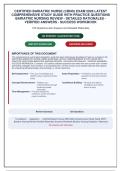
CERTIFIED BARIATRIC NURSE (CBN®) EXAM 2026 LATEST
COMPREHENSIVE STUDY GUIDE WITH PRACTICE QUESTIONS
BARIATRIC NURSING REVIEW - DETAILED RATIONALES -
VERIFIED ANSWERS - SUCCESS WORKBOOK
120 Questions with Answers and Detailed Rationales
100 PERCENT GUARANTEED PASS
INSTANT DOWNLOAD ANSWERS INCLUDED
IMPORTANCE OF THIS DOCUMENT
This comprehensive examination preparation guide has been meticulously developed to help you succeed in the
CERTIFIED BARIATRIC NURSE (CBN®) EXAM 2026 LATEST COMPREHENSIVE STUDY GUIDE WITH
PRACTICE QUESTIONS BARIATRIC NURSING REVIEW - DETAILED RATIONALES - VERIFIED ANSWERS -
SUCCESS WORKBOOK. It contains 120 carefully selected questions that reflect the most current exam content
and testing strategies. Each question is accompanied by a correct answer and a detailed rationale that explains
the underlying pathophysiology, pharmacology, or clinical reasoning.
Self-Assessment – Test your knowledge and Exam Preparation – Familiarize yourself with the
identify areas requiring further question format and content
study areas
Concept Reinforcement – Deepen your Confidence Building – Develop test-taking
understanding through strategies and reduce
evidence-based exam anxiety
rationales
Time Management – Practice answering
questions under simulated
exam conditions
Review Summary 120 Questions
Foundations - Application - Certified Bariatric Nurse CBN 2026 Comprehensive Study Guide WITH
Bariatric Nursing Review Detailed Rationales Success Workbook Bariatric Nursing Graduate / Advanced
All answers with rationales
,Table of Contents
Content Area Questions Key Topics
Bariatric Nursing Scope AND 1-20 Gastric, Bypass, Bariatric, Surgery, Roux-en-y
Standards OF
Obesity Pathophysiology 21-40 Surgery, Bariatric, Gastric, Bypass, Roux-en-y
AND Comorbidities
Preoperative Assessment 41-60 Gastric Bypass, Bariatric Surgery, Roux-en-y Gastric, Finding,
AND Patient Selection Diabetes
Bariatric Surgical Procedures 61-80 Gastric Bypass, Bariatric Surgery, Roux-en-y Gastric, Weight,
AND Mechanisms OF Action Finding
Perioperative Nursing CARE 81-100 Surgery, Gastric, Weight, Bariatric, Roux-en-y
Postoperative Complications 101-120 Surgery, Bariatric, Gastric, Bypass, Roux-en-y
AND Management
TOTAL 120 All questions include answers and detailed rationales
,Section A - Bariatric Nursing Scope AND Standards OF
Q1.
A patient with a history of Roux-en-Y gastric bypass presents with new-onset
neuropsychiatric symptoms and ataxia. Which laboratory finding is most consistent with a
deficiency that is a known long-term complication of this procedure?
A. Elevated serum homocysteine B. Decreased serum vitamin B12
C. Elevated serum methylmalonic acid D. Decreased serum folate
Correct: C - Elevated serum methylmalonic acid
Rationale:Neuropsychiatric symptoms and ataxia after gastric bypass suggest vitamin B12
deficiency, but serum B12 may be falsely normal. Elevated methylmalonic acid (MMA) is a
more sensitive marker of functional B12 deficiency. Homocysteine is less specific. Decreased
B12 may be present but is not the most definitive finding. Folate deficiency is less likely and
does not present with ataxia as a primary symptom.
Why the other answers are wrong:
A. Elevated homocysteine is a marker of both B12 and folate deficiency, but is less specific
than MMA for B12 deficiency.
B. Decreased serum B12 may be seen but can be falsely normal; functional deficiency is better
detected by MMA.
D. Folate deficiency causes megaloblastic anemia but not the classic neuropsychiatric
syndrome described; B12 is the key deficiency.
Reference: Mechanick, J.I., et al. (2020). Clinical practice guidelines for the perioperative nutrition,
metabolic, and nonsurgical support of patients undergoing bariatric procedures - 2019
update. Endocrine Practice, 26(Suppl 2), 1-90.
Q2.
Which pulmonary function test finding is most indicative of a contraindication to elective
bariatric surgery in a patient with severe obesity and suspected obesity hypoventilation
syndrome?
A. FEV1/FVC ratio < 0.70 B. Forced vital capacity (FVC) < 50% of
predicted
C. Diffusing capacity of the lungs for carbon D. Arterial partial pressure of carbon dioxide
monoxide (DLCO) < 60% of predicted (PaCO2) > 45 mm Hg on room air
Correct: D - Arterial partial pressure of carbon dioxide (PaCO2) > 45 mm Hg on room air
Page 3
, Section A - Bariatric Nursing Scope AND Standards OF
Rationale: Obesity hypoventilation syndrome is characterized by awake hypercapnia (PaCO2
> 45 mm Hg) in the absence of other causes. Severe hypercapnia indicates significant
respiratory compromise that increases perioperative risk and may require optimization before
surgery. Spirometry and DLCO are less specific for OHS; restrictive patterns are common but
not contraindications per se.
Why the other answers are wrong:
A. A low FEV1/FVC ratio indicates obstructive lung disease, not OHS, and is not a
contraindication.
B. Reduced FVC reflects restriction, often seen in obesity, but is not an absolute
contraindication.
C. Reduced DLCO suggests interstitial lung disease, not OHS, and is not the primary criterion.
Reference: ASMBS (2022). Guidelines for perioperative care in bariatric surgery.
Q3.
Which of the following best explains the mechanism by which GLP-1 receptor agonists
contribute to weight loss in patients with obesity?
A. Delayed gastric emptying and central B. Inhibition of pancreatic lipase in the
satiety enhancement gastrointestinal tract
C. Blockade of cannabinoid CB1 receptors D. Activation of melanocortin-4 receptors in
in the brain the hypothalamus
Correct: A - Delayed gastric emptying and central satiety enhancement
Rationale:GLP-1 receptor agonists (e.g., semaglutide, liraglutide) slow gastric emptying and
act on the brain to increase satiety and reduce food intake. They do not inhibit lipase (orlistat
does), block CB1 receptors (rimonabant did), or directly activate MC4 receptors.
Why the other answers are wrong:
B. Pancreatic lipase inhibition is the mechanism of orlistat, not GLP-1 agonists.
C. CB1 receptor blockade is the mechanism of rimonabant, which is no longer used.
D. MC4 receptor activation is not a direct mechanism of GLP-1 agonists; they act via GLP-1
receptors.
Reference: Semaglutide prescribing information, 2024.
Q4.
A patient who underwent sleeve gastrectomy 3 months ago presents with persistent
vomiting and dysphagia. Upper endoscopy reveals a stricture at the incisura angularis.
Which management approach is the most appropriate initial intervention?
A. Surgical revision to Roux-en-Y gastric B. Endoscopic balloon dilation
bypass
C. Total parenteral nutrition for 4 weeks D. Oral corticosteroid therapy
Page 4
COMPREHENSIVE STUDY GUIDE WITH PRACTICE QUESTIONS
BARIATRIC NURSING REVIEW - DETAILED RATIONALES -
VERIFIED ANSWERS - SUCCESS WORKBOOK
120 Questions with Answers and Detailed Rationales
100 PERCENT GUARANTEED PASS
INSTANT DOWNLOAD ANSWERS INCLUDED
IMPORTANCE OF THIS DOCUMENT
This comprehensive examination preparation guide has been meticulously developed to help you succeed in the
CERTIFIED BARIATRIC NURSE (CBN®) EXAM 2026 LATEST COMPREHENSIVE STUDY GUIDE WITH
PRACTICE QUESTIONS BARIATRIC NURSING REVIEW - DETAILED RATIONALES - VERIFIED ANSWERS -
SUCCESS WORKBOOK. It contains 120 carefully selected questions that reflect the most current exam content
and testing strategies. Each question is accompanied by a correct answer and a detailed rationale that explains
the underlying pathophysiology, pharmacology, or clinical reasoning.
Self-Assessment – Test your knowledge and Exam Preparation – Familiarize yourself with the
identify areas requiring further question format and content
study areas
Concept Reinforcement – Deepen your Confidence Building – Develop test-taking
understanding through strategies and reduce
evidence-based exam anxiety
rationales
Time Management – Practice answering
questions under simulated
exam conditions
Review Summary 120 Questions
Foundations - Application - Certified Bariatric Nurse CBN 2026 Comprehensive Study Guide WITH
Bariatric Nursing Review Detailed Rationales Success Workbook Bariatric Nursing Graduate / Advanced
All answers with rationales
,Table of Contents
Content Area Questions Key Topics
Bariatric Nursing Scope AND 1-20 Gastric, Bypass, Bariatric, Surgery, Roux-en-y
Standards OF
Obesity Pathophysiology 21-40 Surgery, Bariatric, Gastric, Bypass, Roux-en-y
AND Comorbidities
Preoperative Assessment 41-60 Gastric Bypass, Bariatric Surgery, Roux-en-y Gastric, Finding,
AND Patient Selection Diabetes
Bariatric Surgical Procedures 61-80 Gastric Bypass, Bariatric Surgery, Roux-en-y Gastric, Weight,
AND Mechanisms OF Action Finding
Perioperative Nursing CARE 81-100 Surgery, Gastric, Weight, Bariatric, Roux-en-y
Postoperative Complications 101-120 Surgery, Bariatric, Gastric, Bypass, Roux-en-y
AND Management
TOTAL 120 All questions include answers and detailed rationales
,Section A - Bariatric Nursing Scope AND Standards OF
Q1.
A patient with a history of Roux-en-Y gastric bypass presents with new-onset
neuropsychiatric symptoms and ataxia. Which laboratory finding is most consistent with a
deficiency that is a known long-term complication of this procedure?
A. Elevated serum homocysteine B. Decreased serum vitamin B12
C. Elevated serum methylmalonic acid D. Decreased serum folate
Correct: C - Elevated serum methylmalonic acid
Rationale:Neuropsychiatric symptoms and ataxia after gastric bypass suggest vitamin B12
deficiency, but serum B12 may be falsely normal. Elevated methylmalonic acid (MMA) is a
more sensitive marker of functional B12 deficiency. Homocysteine is less specific. Decreased
B12 may be present but is not the most definitive finding. Folate deficiency is less likely and
does not present with ataxia as a primary symptom.
Why the other answers are wrong:
A. Elevated homocysteine is a marker of both B12 and folate deficiency, but is less specific
than MMA for B12 deficiency.
B. Decreased serum B12 may be seen but can be falsely normal; functional deficiency is better
detected by MMA.
D. Folate deficiency causes megaloblastic anemia but not the classic neuropsychiatric
syndrome described; B12 is the key deficiency.
Reference: Mechanick, J.I., et al. (2020). Clinical practice guidelines for the perioperative nutrition,
metabolic, and nonsurgical support of patients undergoing bariatric procedures - 2019
update. Endocrine Practice, 26(Suppl 2), 1-90.
Q2.
Which pulmonary function test finding is most indicative of a contraindication to elective
bariatric surgery in a patient with severe obesity and suspected obesity hypoventilation
syndrome?
A. FEV1/FVC ratio < 0.70 B. Forced vital capacity (FVC) < 50% of
predicted
C. Diffusing capacity of the lungs for carbon D. Arterial partial pressure of carbon dioxide
monoxide (DLCO) < 60% of predicted (PaCO2) > 45 mm Hg on room air
Correct: D - Arterial partial pressure of carbon dioxide (PaCO2) > 45 mm Hg on room air
Page 3
, Section A - Bariatric Nursing Scope AND Standards OF
Rationale: Obesity hypoventilation syndrome is characterized by awake hypercapnia (PaCO2
> 45 mm Hg) in the absence of other causes. Severe hypercapnia indicates significant
respiratory compromise that increases perioperative risk and may require optimization before
surgery. Spirometry and DLCO are less specific for OHS; restrictive patterns are common but
not contraindications per se.
Why the other answers are wrong:
A. A low FEV1/FVC ratio indicates obstructive lung disease, not OHS, and is not a
contraindication.
B. Reduced FVC reflects restriction, often seen in obesity, but is not an absolute
contraindication.
C. Reduced DLCO suggests interstitial lung disease, not OHS, and is not the primary criterion.
Reference: ASMBS (2022). Guidelines for perioperative care in bariatric surgery.
Q3.
Which of the following best explains the mechanism by which GLP-1 receptor agonists
contribute to weight loss in patients with obesity?
A. Delayed gastric emptying and central B. Inhibition of pancreatic lipase in the
satiety enhancement gastrointestinal tract
C. Blockade of cannabinoid CB1 receptors D. Activation of melanocortin-4 receptors in
in the brain the hypothalamus
Correct: A - Delayed gastric emptying and central satiety enhancement
Rationale:GLP-1 receptor agonists (e.g., semaglutide, liraglutide) slow gastric emptying and
act on the brain to increase satiety and reduce food intake. They do not inhibit lipase (orlistat
does), block CB1 receptors (rimonabant did), or directly activate MC4 receptors.
Why the other answers are wrong:
B. Pancreatic lipase inhibition is the mechanism of orlistat, not GLP-1 agonists.
C. CB1 receptor blockade is the mechanism of rimonabant, which is no longer used.
D. MC4 receptor activation is not a direct mechanism of GLP-1 agonists; they act via GLP-1
receptors.
Reference: Semaglutide prescribing information, 2024.
Q4.
A patient who underwent sleeve gastrectomy 3 months ago presents with persistent
vomiting and dysphagia. Upper endoscopy reveals a stricture at the incisura angularis.
Which management approach is the most appropriate initial intervention?
A. Surgical revision to Roux-en-Y gastric B. Endoscopic balloon dilation
bypass
C. Total parenteral nutrition for 4 weeks D. Oral corticosteroid therapy
Page 4