Section 7 Lesson 2
Gene Expression Study Questions
Learning Objectives
• Describe the flow of information from DNA to RNA and from RNA to
protein.
• Identify the molecular requirements, cellular location, and product of
transcription.
• Identify the molecular requirements, cellular location, and product of
translation.
• Identify how a change in the DNA code may affect phenotype.
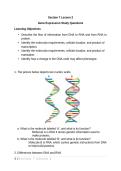
1. The picture below depicts two nucleic acids.
a. What is the molecule labeled ‘A’, and what is its function?
Molecule A is DNA it stores genetic information used to
make proteins.
b. What is the molecule labeled ‘B’, and what is its function?
Molecule B is RNA, which carries genetic instructions from DNA
to help build proteins.
2. Differences between DNA and RNA
1 | Section 7 Lesson 2
, a. What is the difference between the sugars in DNA and RNA?
DNA contains deoxyribose sugar while RNA contains ribose sugar.
b. What is the difference between the nitrogenous bases in DNA and
RNA? DNA uses thymine while RNA uses uracil instead of thymine.
3. Answer the following questions regarding transcription.
a. What macromolecule is used as a template for this process?
DNA is the macromolecule used as a template for transcription.
b. Where in the cell does this process take place?
Transcription takes place in the nucleus.
c. What enzyme catalyzes transcription?
RNA polymerase is the enzyme that catalyzes transcription.
d. What is produced during transcription?
mRNA.
e. Given the DNA template sequence, TAC AGC TAA GCT, what is the
nucleotide sequence for the mRNA product?
AUG UCG AUU CGA.
4. Answer the following questions regarding translation.
a. What are three different types of RNA and what is their role during
translation?
mRNA carries the code, tRNA brings amino acids, and rRNA forms part of
the ribosome.
b. Where in the cell does translation take place?
Translation takes place in the cytoplasm at the ribosome.
c. What is produced during translation?
Translation produces a protein (polypeptide).
d. What is a codon?
A three-nucleotide sequence on mRNA that codes for an amino
acid.
e. Given the mRNA sequence, AUG CGA AAG CUA, what are the first
two codons?
AUG and CGA.
f. Given the mRNA sequence, AUG CGA AAG CUA, what is the
2 | Section 7 Lesson 2
Gene Expression Study Questions
Learning Objectives
• Describe the flow of information from DNA to RNA and from RNA to
protein.
• Identify the molecular requirements, cellular location, and product of
transcription.
• Identify the molecular requirements, cellular location, and product of
translation.
• Identify how a change in the DNA code may affect phenotype.
1. The picture below depicts two nucleic acids.
a. What is the molecule labeled ‘A’, and what is its function?
Molecule A is DNA it stores genetic information used to
make proteins.
b. What is the molecule labeled ‘B’, and what is its function?
Molecule B is RNA, which carries genetic instructions from DNA
to help build proteins.
2. Differences between DNA and RNA
1 | Section 7 Lesson 2
, a. What is the difference between the sugars in DNA and RNA?
DNA contains deoxyribose sugar while RNA contains ribose sugar.
b. What is the difference between the nitrogenous bases in DNA and
RNA? DNA uses thymine while RNA uses uracil instead of thymine.
3. Answer the following questions regarding transcription.
a. What macromolecule is used as a template for this process?
DNA is the macromolecule used as a template for transcription.
b. Where in the cell does this process take place?
Transcription takes place in the nucleus.
c. What enzyme catalyzes transcription?
RNA polymerase is the enzyme that catalyzes transcription.
d. What is produced during transcription?
mRNA.
e. Given the DNA template sequence, TAC AGC TAA GCT, what is the
nucleotide sequence for the mRNA product?
AUG UCG AUU CGA.
4. Answer the following questions regarding translation.
a. What are three different types of RNA and what is their role during
translation?
mRNA carries the code, tRNA brings amino acids, and rRNA forms part of
the ribosome.
b. Where in the cell does translation take place?
Translation takes place in the cytoplasm at the ribosome.
c. What is produced during translation?
Translation produces a protein (polypeptide).
d. What is a codon?
A three-nucleotide sequence on mRNA that codes for an amino
acid.
e. Given the mRNA sequence, AUG CGA AAG CUA, what are the first
two codons?
AUG and CGA.
f. Given the mRNA sequence, AUG CGA AAG CUA, what is the
2 | Section 7 Lesson 2