

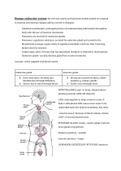
Human endocrine system-the nervous system and hormones enable animal sto respond
to external and internal changes (allows control to changes)
- Chemical coordination: prolonged process of communicating information throughout
body with the use of chemical (hormones)
- Hormones are secreted by endocrine glands
- Hormones: regulatory substance, secreted by endocrine gland and carried in the
bloodstream to target organs where it regulates metabolic reactions. Don’t last long,
broken down by enzymes
- Target organ: piece of tissue that has specialised receptors to respond to that hormone
- Endocrine gland: vascular,ductless gland that secretes hormones
vascular= richly supplied with blood vessels
Endocrine gland Exocrine gland
● Don't have ducts, secreted into ● Secretions carried into ducts, where
bloodstream (through diffusion) needed e.g. salivary glands
● Slower, has to travel through blood ● Faster, travel through ducts
HYPOTHALAMUS: part of brain, situated above
pituitary(secretes ADH anti-diuretic)
ADH: osmoregulation, helps conserve water. If
body is dehydrated ADH causes more water to be
reabsorbed back into body from kidneys, less urine
-exercise/sweat= decrease in blood volume, release
ADH = less/concentrated urine
PITUITARY GLAND: i brain,, master gland. Controls
most glands (hypophysis)
Posterior pituitary = smaller
Anterior pituitary = larger
HORMONES SECRETED BY PITUITARY (anterior)
, ● Thyroid stimulating hormone (TSH): stimulates thyroid to secrete thyroxin
● Follicle stimulating hormone (FSH): stimulates oogenesis and spermatogenesis
● Luteinizing hormone (LH): stimulates ovulation and formation of corpus luteum
● Prolactin: production of milk in mammary glands (continues as long as baby suckles)
● Adrenocorticotropic hormone (ACTH): stimulates adrenal cortex to secrete cortisone
and aldosterone
● Interstitial cell stimulating hormone(ICSH): stimulates testes to secrete testosterone
● Growth hormone somatotropic hormone (GH/STH):promotes skeletal and muscular
growth (stimulates synthesis of proteins
HORMONES SECRETED BY PITUITARY (posterior): ADH oxytocin,vasopressin
Growth disorders: too much or too little growth hormone
-hypersecretion = over secretion , hyposecretion = under secretion
- hypersecretion in prepubertal children can lead to gigantism (caused by tumor in pituitary)
- hyposecretion in prepubertal children results in pituitary dwarfism, sexually immature (other
dwarfism is caused by defective gene and body is out of proportion)
Can be treated with synthetic growth hormone (STH) produced by genetically engineered
bacteria
- Hyposecretion in adults leads to acromegaly: feet, hands and face bones thicken
THYROID GLAND- found on either side of trachea just below larynx
- Secretes thyroxin (iodine is essential for secretion of thyroxin) - goitre may develop if
iodine is low
Functions of thyroxin: increases basal metabolic rate (how fast calories are burnt) and body
heat.
Basal metabolic rate = amount of energy the body needs to keep functioning while at rest
- Promotes normal functioning of heart and nervous system by increasing nervous
activity
- Hypothyroidism: too little thyroxin produced can cause myxoedema (adults) anad
cretinism (children)
to external and internal changes (allows control to changes)
- Chemical coordination: prolonged process of communicating information throughout
body with the use of chemical (hormones)
- Hormones are secreted by endocrine glands
- Hormones: regulatory substance, secreted by endocrine gland and carried in the
bloodstream to target organs where it regulates metabolic reactions. Don’t last long,
broken down by enzymes
- Target organ: piece of tissue that has specialised receptors to respond to that hormone
- Endocrine gland: vascular,ductless gland that secretes hormones
vascular= richly supplied with blood vessels
Endocrine gland Exocrine gland
● Don't have ducts, secreted into ● Secretions carried into ducts, where
bloodstream (through diffusion) needed e.g. salivary glands
● Slower, has to travel through blood ● Faster, travel through ducts
HYPOTHALAMUS: part of brain, situated above
pituitary(secretes ADH anti-diuretic)
ADH: osmoregulation, helps conserve water. If
body is dehydrated ADH causes more water to be
reabsorbed back into body from kidneys, less urine
-exercise/sweat= decrease in blood volume, release
ADH = less/concentrated urine
PITUITARY GLAND: i brain,, master gland. Controls
most glands (hypophysis)
Posterior pituitary = smaller
Anterior pituitary = larger
HORMONES SECRETED BY PITUITARY (anterior)
, ● Thyroid stimulating hormone (TSH): stimulates thyroid to secrete thyroxin
● Follicle stimulating hormone (FSH): stimulates oogenesis and spermatogenesis
● Luteinizing hormone (LH): stimulates ovulation and formation of corpus luteum
● Prolactin: production of milk in mammary glands (continues as long as baby suckles)
● Adrenocorticotropic hormone (ACTH): stimulates adrenal cortex to secrete cortisone
and aldosterone
● Interstitial cell stimulating hormone(ICSH): stimulates testes to secrete testosterone
● Growth hormone somatotropic hormone (GH/STH):promotes skeletal and muscular
growth (stimulates synthesis of proteins
HORMONES SECRETED BY PITUITARY (posterior): ADH oxytocin,vasopressin
Growth disorders: too much or too little growth hormone
-hypersecretion = over secretion , hyposecretion = under secretion
- hypersecretion in prepubertal children can lead to gigantism (caused by tumor in pituitary)
- hyposecretion in prepubertal children results in pituitary dwarfism, sexually immature (other
dwarfism is caused by defective gene and body is out of proportion)
Can be treated with synthetic growth hormone (STH) produced by genetically engineered
bacteria
- Hyposecretion in adults leads to acromegaly: feet, hands and face bones thicken
THYROID GLAND- found on either side of trachea just below larynx
- Secretes thyroxin (iodine is essential for secretion of thyroxin) - goitre may develop if
iodine is low
Functions of thyroxin: increases basal metabolic rate (how fast calories are burnt) and body
heat.
Basal metabolic rate = amount of energy the body needs to keep functioning while at rest
- Promotes normal functioning of heart and nervous system by increasing nervous
activity
- Hypothyroidism: too little thyroxin produced can cause myxoedema (adults) anad
cretinism (children)



