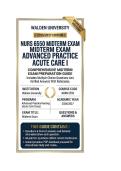
,NURS 6550 midterm exam Advanced Practice Acute Care I
Questions And Answers 2026/2027 Walden University
Course: NURS 6550
University: Walden University
Assessment: Midterm Exam
Area: Advanced Practice Care of Adults in Acute Care Settings I
1.
Which role most directly distinguishes the acute care nurse practitioner from
a primary care NP?
A) Management of complex, acute, and unstable conditions
B) Provision of only preventive services
C) Care limited to healthy adults
D) Avoidance of diagnostic procedures
Answer: A) Management of complex, acute, and unstable conditions
Rationale: The acute care NP is educated to manage patients with complex,
acute, critical, and chronic conditions with acute exacerbations.
2.
Which clinical setting is most appropriate for an adult-gerontology acute care
NP?
A) Intensive care unit
B) Well-child clinic
C) Routine pediatric office
D) Prenatal clinic
Answer: A) Intensive care unit
Rationale: Acute care NPs commonly practice in emergency, inpatient,
intensive care, specialty, and other settings involving acutely ill adults.
3.
Which activity is within the scope of an acute care NP?
A) Performing advanced assessment, diagnosis, and management of acutely
ill adults
B) Providing care only after a physician establishes the diagnosis
C) Performing only routine physical examinations
D) Restricting practice to health education
,Answer: A) Performing advanced assessment, diagnosis, and
management of acutely ill adults
Rationale: Acute care NPs independently or collaboratively assess,
diagnose, treat, and manage complex adult patients within applicable scope-
of-practice laws.
4.
Which three major components are considered when selecting an evaluation
and management code?
A) History, examination, and medical decision-making
B) Diagnosis, insurance, and discharge location
C) Medication, laboratory testing, and imaging only
D) Vital signs, age, and room number
Answer: A) History, examination, and medical decision-making
Rationale: Evaluation and management coding is based on required
elements and current coding rules; medical decision-making is a major
component.
5.
Which coding system is primarily used to identify diagnoses?
A) ICD-10-CM
B) CPT
C) HCPCS Level II only
D) DRG
Answer: A) ICD-10-CM
Rationale: ICD-10-CM codes describe diagnoses and health conditions.
6.
Which coding system is primarily associated with reporting medical
procedures and services?
A) CPT
B) ICD-10-CM
C) DSM-5-TR
D) NDC
Answer: A) CPT
, Rationale: Current Procedural Terminology codes identify many medical
procedures and professional services.
7.
A provider documents a diagnosis but does not adequately support the billed
level of service. What is the major concern?
A) Coding compliance and potential inaccurate billing
B) Increased patient satisfaction
C) Better interoperability
D) Improved medication adherence
Answer: A) Coding compliance and potential inaccurate billing
Rationale: Documentation must support the services billed.
8.
Which ethical principle requires a patient to understand relevant risks,
benefits, and alternatives before consenting to a procedure?
A) Autonomy
B) Justice
C) Beneficence
D) Nonmaleficence
Answer: A) Autonomy
Rationale: Informed consent supports the patient's autonomy and right to
make informed healthcare decisions.
9.
Which situation can invalidate informed consent?
A) The patient lacks decision-making capacity and no appropriate surrogate
is involved
B) The clinician explains risks and alternatives
C) The patient asks questions
D) The patient voluntarily agrees after receiving appropriate information
Answer: A) The patient lacks decision-making capacity and no
appropriate surrogate is involved
Rationale: Valid consent requires appropriate decision-making capacity or
involvement of an authorized surrogate when necessary.
Questions And Answers 2026/2027 Walden University
Course: NURS 6550
University: Walden University
Assessment: Midterm Exam
Area: Advanced Practice Care of Adults in Acute Care Settings I
1.
Which role most directly distinguishes the acute care nurse practitioner from
a primary care NP?
A) Management of complex, acute, and unstable conditions
B) Provision of only preventive services
C) Care limited to healthy adults
D) Avoidance of diagnostic procedures
Answer: A) Management of complex, acute, and unstable conditions
Rationale: The acute care NP is educated to manage patients with complex,
acute, critical, and chronic conditions with acute exacerbations.
2.
Which clinical setting is most appropriate for an adult-gerontology acute care
NP?
A) Intensive care unit
B) Well-child clinic
C) Routine pediatric office
D) Prenatal clinic
Answer: A) Intensive care unit
Rationale: Acute care NPs commonly practice in emergency, inpatient,
intensive care, specialty, and other settings involving acutely ill adults.
3.
Which activity is within the scope of an acute care NP?
A) Performing advanced assessment, diagnosis, and management of acutely
ill adults
B) Providing care only after a physician establishes the diagnosis
C) Performing only routine physical examinations
D) Restricting practice to health education
,Answer: A) Performing advanced assessment, diagnosis, and
management of acutely ill adults
Rationale: Acute care NPs independently or collaboratively assess,
diagnose, treat, and manage complex adult patients within applicable scope-
of-practice laws.
4.
Which three major components are considered when selecting an evaluation
and management code?
A) History, examination, and medical decision-making
B) Diagnosis, insurance, and discharge location
C) Medication, laboratory testing, and imaging only
D) Vital signs, age, and room number
Answer: A) History, examination, and medical decision-making
Rationale: Evaluation and management coding is based on required
elements and current coding rules; medical decision-making is a major
component.
5.
Which coding system is primarily used to identify diagnoses?
A) ICD-10-CM
B) CPT
C) HCPCS Level II only
D) DRG
Answer: A) ICD-10-CM
Rationale: ICD-10-CM codes describe diagnoses and health conditions.
6.
Which coding system is primarily associated with reporting medical
procedures and services?
A) CPT
B) ICD-10-CM
C) DSM-5-TR
D) NDC
Answer: A) CPT
, Rationale: Current Procedural Terminology codes identify many medical
procedures and professional services.
7.
A provider documents a diagnosis but does not adequately support the billed
level of service. What is the major concern?
A) Coding compliance and potential inaccurate billing
B) Increased patient satisfaction
C) Better interoperability
D) Improved medication adherence
Answer: A) Coding compliance and potential inaccurate billing
Rationale: Documentation must support the services billed.
8.
Which ethical principle requires a patient to understand relevant risks,
benefits, and alternatives before consenting to a procedure?
A) Autonomy
B) Justice
C) Beneficence
D) Nonmaleficence
Answer: A) Autonomy
Rationale: Informed consent supports the patient's autonomy and right to
make informed healthcare decisions.
9.
Which situation can invalidate informed consent?
A) The patient lacks decision-making capacity and no appropriate surrogate
is involved
B) The clinician explains risks and alternatives
C) The patient asks questions
D) The patient voluntarily agrees after receiving appropriate information
Answer: A) The patient lacks decision-making capacity and no
appropriate surrogate is involved
Rationale: Valid consent requires appropriate decision-making capacity or
involvement of an authorized surrogate when necessary.