

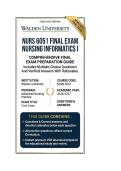
,NURS 6051 Final exam Nursing Informatics I Questions And
Answers 2026/2027 Walden University
Course: NURS 6051
University: Walden University
Assessment: Final Exam
Area: Nursing Informatics
1.
A nurse uses a personal smartphone to photograph a patient's wound and
uploads the image to a personal cloud-storage account. What is the primary
concern?
A) Battery consumption
B) Patient privacy and security of protected health information
C) Image resolution
D) Documentation length
Answer: B) Patient privacy and security of protected health
information
Rationale: Clinical photographs may contain identifiable health information
and must be handled using authorized systems and appropriate privacy and
security safeguards.
2.
Which federal law is most directly associated with protecting individually
identifiable health information?
A) HIPAA
B) EMTALA
C) OSHA
D) COBRA
Answer: A) HIPAA
Rationale: HIPAA establishes important privacy and security requirements
concerning protected health information.
3.
A nurse leaves an EHR workstation unlocked while stepping away to answer
a call. What is the major risk?
,A) Unauthorized access to patient information
B) Increased database storage
C) Loss of internet speed
D) Duplicate medications automatically
Answer: A) Unauthorized access to patient information
Rationale: An unattended authenticated workstation can permit
unauthorized individuals to access protected health information.
4.
Which action best protects patient confidentiality when using an EHR?
A) Log out or lock the workstation when leaving it unattended
B) Share passwords with trusted coworkers
C) Write passwords on the monitor
D) Use another employee's login when necessary
Answer: A) Log out or lock the workstation when leaving it
unattended
Rationale: Authentication credentials and active sessions must be protected
to prevent unauthorized access.
5.
Which action violates appropriate EHR access practices?
A) Accessing the chart of a celebrity patient out of curiosity
B) Reviewing the chart of an assigned patient
C) Documenting care provided
D) Reviewing relevant medication information
Answer: A) Accessing the chart of a celebrity patient out of curiosity
Rationale: Access to health information must be based on an appropriate
role and legitimate need, not curiosity.
6.
A nurse receives an email requesting a patient's health information from an
unknown sender. What should the nurse do first?
A) Verify the request and authorization before disclosing any information
B) Send the information immediately
C) Forward the message to personal email
D) Post the request on social media
, Answer: A) Verify the request and authorization before disclosing
any information
Rationale: Patient information should not be disclosed until the identity,
purpose, authorization, and applicable policies are verified.
7.
Which practice creates the greatest cybersecurity risk?
A) Sharing login credentials
B) Using multifactor authentication
C) Locking the workstation
D) Reporting suspicious messages
Answer: A) Sharing login credentials
Rationale: Credential sharing undermines accountability and increases the
risk of unauthorized access.
8.
A nurse receives an unexpected email asking the nurse to click a link and
enter EHR credentials. What should the nurse suspect?
A) Phishing
B) Interoperability
C) Data normalization
D) Clinical decision support
Answer: A) Phishing
Rationale: Phishing attempts commonly use deceptive messages to obtain
credentials or other sensitive information.
9.
Which response is most appropriate when a suspicious phishing email is
received?
A) Report it using the organization's security process
B) Click the link to determine whether it is legitimate
C) Forward it to all coworkers
D) Reply with the password
Answer: A) Report it using the organization's security process
Rationale: Reporting suspicious activity allows security teams to investigate
and protect other users.
Answers 2026/2027 Walden University
Course: NURS 6051
University: Walden University
Assessment: Final Exam
Area: Nursing Informatics
1.
A nurse uses a personal smartphone to photograph a patient's wound and
uploads the image to a personal cloud-storage account. What is the primary
concern?
A) Battery consumption
B) Patient privacy and security of protected health information
C) Image resolution
D) Documentation length
Answer: B) Patient privacy and security of protected health
information
Rationale: Clinical photographs may contain identifiable health information
and must be handled using authorized systems and appropriate privacy and
security safeguards.
2.
Which federal law is most directly associated with protecting individually
identifiable health information?
A) HIPAA
B) EMTALA
C) OSHA
D) COBRA
Answer: A) HIPAA
Rationale: HIPAA establishes important privacy and security requirements
concerning protected health information.
3.
A nurse leaves an EHR workstation unlocked while stepping away to answer
a call. What is the major risk?
,A) Unauthorized access to patient information
B) Increased database storage
C) Loss of internet speed
D) Duplicate medications automatically
Answer: A) Unauthorized access to patient information
Rationale: An unattended authenticated workstation can permit
unauthorized individuals to access protected health information.
4.
Which action best protects patient confidentiality when using an EHR?
A) Log out or lock the workstation when leaving it unattended
B) Share passwords with trusted coworkers
C) Write passwords on the monitor
D) Use another employee's login when necessary
Answer: A) Log out or lock the workstation when leaving it
unattended
Rationale: Authentication credentials and active sessions must be protected
to prevent unauthorized access.
5.
Which action violates appropriate EHR access practices?
A) Accessing the chart of a celebrity patient out of curiosity
B) Reviewing the chart of an assigned patient
C) Documenting care provided
D) Reviewing relevant medication information
Answer: A) Accessing the chart of a celebrity patient out of curiosity
Rationale: Access to health information must be based on an appropriate
role and legitimate need, not curiosity.
6.
A nurse receives an email requesting a patient's health information from an
unknown sender. What should the nurse do first?
A) Verify the request and authorization before disclosing any information
B) Send the information immediately
C) Forward the message to personal email
D) Post the request on social media
, Answer: A) Verify the request and authorization before disclosing
any information
Rationale: Patient information should not be disclosed until the identity,
purpose, authorization, and applicable policies are verified.
7.
Which practice creates the greatest cybersecurity risk?
A) Sharing login credentials
B) Using multifactor authentication
C) Locking the workstation
D) Reporting suspicious messages
Answer: A) Sharing login credentials
Rationale: Credential sharing undermines accountability and increases the
risk of unauthorized access.
8.
A nurse receives an unexpected email asking the nurse to click a link and
enter EHR credentials. What should the nurse suspect?
A) Phishing
B) Interoperability
C) Data normalization
D) Clinical decision support
Answer: A) Phishing
Rationale: Phishing attempts commonly use deceptive messages to obtain
credentials or other sensitive information.
9.
Which response is most appropriate when a suspicious phishing email is
received?
A) Report it using the organization's security process
B) Click the link to determine whether it is legitimate
C) Forward it to all coworkers
D) Reply with the password
Answer: A) Report it using the organization's security process
Rationale: Reporting suspicious activity allows security teams to investigate
and protect other users.


