

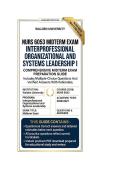
,NURS 6053 midterm exam Interprofessional Organizational and
Systems Leadership I Questions And Answers 2026/2027 Walden
University
NURS 6053 Midterm Exam — Interprofessional Organizational and
Systems Leadership
Course: NURS 6053
University: Walden University
Assessment: Midterm Exam
Area: Interprofessional Organizational and Systems Leadership
1.
Which statement best describes systems leadership in healthcare?
A) Focusing only on individual employee performance
B) Coordinating people, processes, resources, and organizational goals
across interconnected parts of the healthcare system
C) Managing only the nursing budget
D) Directing only bedside clinical activities
Answer: B) Coordinating people, processes, resources, and
organizational goals across interconnected parts of the healthcare
system
Rationale: Systems leadership considers how multiple people, departments,
processes, and external influences interact to achieve organizational and
patient outcomes.
2.
Which issue is an example of a national healthcare stressor that can affect
healthcare organizations?
A) Workforce shortages
B) A nurse's preferred lunch time
C) A patient's favorite television program
D) The color of hospital uniforms
Answer: A) Workforce shortages
Rationale: Workforce shortages can affect staffing, workload, access to
care, quality, organizational costs, and patient outcomes.
,3.
Which outcome is most directly associated with excessive healthcare-worker
burnout?
A) Improved patient safety
B) Increased turnover and reduced quality of care
C) Lower workload
D) Increased employee engagement
Answer: B) Increased turnover and reduced quality of care
Rationale: Burnout can contribute to disengagement, absenteeism,
turnover, reduced productivity, and risks to quality and patient safety.
4.
The original Triple Aim emphasizes:
A) Better population health, improved patient experience, and lower per-
capita cost
B) Nurse retention, hospital construction, and increased revenue
C) Higher salaries, more technology, and more admissions
D) Greater documentation, more staffing, and longer hospital stays
Answer: A) Better population health, improved patient experience,
and lower per-capita cost
Rationale: The Triple Aim focuses on improving population health,
improving the patient experience of care, and reducing per-capita healthcare
costs.
5.
The Quadruple Aim adds which element to the Triple Aim?
A) Healthcare-worker well-being
B) Hospital expansion
C) Increased documentation
D) More specialty referrals
Answer: A) Healthcare-worker well-being
Rationale: The Quadruple Aim recognizes that clinician and staff well-being
is essential to sustainable improvements in healthcare.
6.
A hospital introduces a program designed to reduce clinician burnout while
improving patient outcomes. Which framework is most directly represented?
, A) Quadruple Aim
B) Maslow's hierarchy
C) SWOT only
D) Chain of command
Answer: A) Quadruple Aim
Rationale: The program addresses both workforce well-being and patient
outcomes, which are central to the Quadruple Aim.
7.
Why is healthcare increasingly described as a complex adaptive system?
A) Healthcare organizations consist of interconnected individuals and groups
whose actions influence one another
B) Healthcare organizations operate independently of their environments
C) Each department functions without affecting another
D) Healthcare outcomes depend solely on physician decisions
Answer: A) Healthcare organizations consist of interconnected
individuals and groups whose actions influence one another
Rationale: Complex healthcare systems contain multiple interacting parts,
and changes in one area can produce effects elsewhere in the system.
8.
Which organizational response is most appropriate when a national nursing
shortage affects staffing?
A) Assess workload, staffing needs, retention strategies, care models, and
workforce development
B) Ignore the issue because it is national
C) Increase workloads without assessment
D) Eliminate quality monitoring
Answer: A) Assess workload, staffing needs, retention strategies,
care models, and workforce development
Rationale: Organizational leaders must translate external stressors into
practical strategies that protect workforce stability and patient outcomes.
9.
Which factor may contribute to healthcare-worker burnout?
A) Excessive workload and inadequate resources
B) Adequate staffing
Systems Leadership I Questions And Answers 2026/2027 Walden
University
NURS 6053 Midterm Exam — Interprofessional Organizational and
Systems Leadership
Course: NURS 6053
University: Walden University
Assessment: Midterm Exam
Area: Interprofessional Organizational and Systems Leadership
1.
Which statement best describes systems leadership in healthcare?
A) Focusing only on individual employee performance
B) Coordinating people, processes, resources, and organizational goals
across interconnected parts of the healthcare system
C) Managing only the nursing budget
D) Directing only bedside clinical activities
Answer: B) Coordinating people, processes, resources, and
organizational goals across interconnected parts of the healthcare
system
Rationale: Systems leadership considers how multiple people, departments,
processes, and external influences interact to achieve organizational and
patient outcomes.
2.
Which issue is an example of a national healthcare stressor that can affect
healthcare organizations?
A) Workforce shortages
B) A nurse's preferred lunch time
C) A patient's favorite television program
D) The color of hospital uniforms
Answer: A) Workforce shortages
Rationale: Workforce shortages can affect staffing, workload, access to
care, quality, organizational costs, and patient outcomes.
,3.
Which outcome is most directly associated with excessive healthcare-worker
burnout?
A) Improved patient safety
B) Increased turnover and reduced quality of care
C) Lower workload
D) Increased employee engagement
Answer: B) Increased turnover and reduced quality of care
Rationale: Burnout can contribute to disengagement, absenteeism,
turnover, reduced productivity, and risks to quality and patient safety.
4.
The original Triple Aim emphasizes:
A) Better population health, improved patient experience, and lower per-
capita cost
B) Nurse retention, hospital construction, and increased revenue
C) Higher salaries, more technology, and more admissions
D) Greater documentation, more staffing, and longer hospital stays
Answer: A) Better population health, improved patient experience,
and lower per-capita cost
Rationale: The Triple Aim focuses on improving population health,
improving the patient experience of care, and reducing per-capita healthcare
costs.
5.
The Quadruple Aim adds which element to the Triple Aim?
A) Healthcare-worker well-being
B) Hospital expansion
C) Increased documentation
D) More specialty referrals
Answer: A) Healthcare-worker well-being
Rationale: The Quadruple Aim recognizes that clinician and staff well-being
is essential to sustainable improvements in healthcare.
6.
A hospital introduces a program designed to reduce clinician burnout while
improving patient outcomes. Which framework is most directly represented?
, A) Quadruple Aim
B) Maslow's hierarchy
C) SWOT only
D) Chain of command
Answer: A) Quadruple Aim
Rationale: The program addresses both workforce well-being and patient
outcomes, which are central to the Quadruple Aim.
7.
Why is healthcare increasingly described as a complex adaptive system?
A) Healthcare organizations consist of interconnected individuals and groups
whose actions influence one another
B) Healthcare organizations operate independently of their environments
C) Each department functions without affecting another
D) Healthcare outcomes depend solely on physician decisions
Answer: A) Healthcare organizations consist of interconnected
individuals and groups whose actions influence one another
Rationale: Complex healthcare systems contain multiple interacting parts,
and changes in one area can produce effects elsewhere in the system.
8.
Which organizational response is most appropriate when a national nursing
shortage affects staffing?
A) Assess workload, staffing needs, retention strategies, care models, and
workforce development
B) Ignore the issue because it is national
C) Increase workloads without assessment
D) Eliminate quality monitoring
Answer: A) Assess workload, staffing needs, retention strategies,
care models, and workforce development
Rationale: Organizational leaders must translate external stressors into
practical strategies that protect workforce stability and patient outcomes.
9.
Which factor may contribute to healthcare-worker burnout?
A) Excessive workload and inadequate resources
B) Adequate staffing


