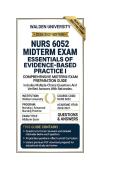
,NURS 6052 midterm exam Essentials of Evidence-Based Practice I
Questions And
Answers 2026/2027 Walden University
Course: NURS 6052
University: Walden University
Assessment: Midterm Exam
Area: Essentials of Evidence-Based Practice
1.
Which statement best defines evidence-based practice (EBP)?
A) Using only published research findings to make clinical decisions
B) Integrating best available evidence with clinical expertise and patient
preferences
C) Following institutional policies regardless of current evidence
D) Using personal experience as the primary basis for care
Answer: B) Integrating best available evidence with clinical expertise and
patient preferences
Rationale: EBP integrates the best available research evidence with clinical
expertise and the patient's values, preferences, and circumstances.
2.
What is the primary purpose of evidence-based practice?
A) Eliminate clinical judgment
B) Improve patient outcomes and healthcare quality through informed
decisions
C) Replace nursing knowledge with research
D) Reduce the number of healthcare professionals
Answer: B) Improve patient outcomes and healthcare quality through
informed decisions
Rationale: EBP supports safer, higher-quality, more effective care by
combining evidence with clinical expertise and patient needs.
3.
Which three elements form the traditional core of evidence-based practice?
,A) Research evidence, clinical expertise, and patient preferences
B) Policy, cost, and staffing
C) Technology, documentation, and reimbursement
D) Tradition, experience, and intuition
Answer: A) Research evidence, clinical expertise, and patient preferences
Rationale: These three elements are integrated when applying evidence to
individual clinical decisions.
4.
Which statement best describes the relationship between nursing research
and evidence-based practice?
A) Research generates evidence that may be incorporated into EBP
B) EBP eliminates the need for research
C) Research and EBP are identical
D) Research is relevant only to academic nurses
Answer: A) Research generates evidence that may be incorporated into EBP
Rationale: Research is a major source of evidence, while EBP is the broader
process of integrating evidence into clinical decision-making.
5.
A nurse continues using a dressing technique solely because "this is how we
have always done it." Which concern does this illustrate?
A) Tradition without evaluation of current evidence
B) Evidence-based practice
C) Critical appraisal
D) Clinical inquiry
Answer: A) Tradition without evaluation of current evidence
Rationale: EBP requires questioning established practices and determining
whether current evidence supports them.
6.
Which behavior best demonstrates a spirit of inquiry?
A) Asking whether an established practice is supported by current evidence
B) Assuming existing policies are always correct
C) Avoiding research literature
D) Rejecting changes to clinical practice
, Answer: A) Asking whether an established practice is supported by current
evidence
Rationale: A spirit of inquiry encourages nurses to question practice
assumptions and seek evidence for improvement.
7.
Which statement about EBP is most accurate?
A) EBP requires the strongest research design for every clinical question
B) The appropriate type of evidence depends on the clinical question being
asked
C) Expert opinion is always superior to research
D) Randomized trials answer every clinical question
Answer: B) The appropriate type of evidence depends on the clinical question
being asked
Rationale: Different questions—such as treatment, prognosis, diagnosis, or
patient experience—require different types of evidence.
8.
Which is an example of a clinical inquiry?
A) Asking whether hourly rounding reduces inpatient falls
B) Asking how many nurses are on a unit
C) Selecting a nurse's vacation schedule
D) Calculating annual payroll
Answer: A) Asking whether hourly rounding reduces inpatient falls
Rationale: Clinical inquiry begins with a focused question about improving
patient care or outcomes.
9.
Which statement best distinguishes research from EBP?
A) Research generates new knowledge; EBP uses existing evidence to inform
practice
B) Research is always qualitative; EBP is always quantitative
C) Research is clinical care; EBP is laboratory work
D) Research and EBP are identical processes
Answer: A) Research generates new knowledge; EBP uses existing evidence
to inform practice
Questions And
Answers 2026/2027 Walden University
Course: NURS 6052
University: Walden University
Assessment: Midterm Exam
Area: Essentials of Evidence-Based Practice
1.
Which statement best defines evidence-based practice (EBP)?
A) Using only published research findings to make clinical decisions
B) Integrating best available evidence with clinical expertise and patient
preferences
C) Following institutional policies regardless of current evidence
D) Using personal experience as the primary basis for care
Answer: B) Integrating best available evidence with clinical expertise and
patient preferences
Rationale: EBP integrates the best available research evidence with clinical
expertise and the patient's values, preferences, and circumstances.
2.
What is the primary purpose of evidence-based practice?
A) Eliminate clinical judgment
B) Improve patient outcomes and healthcare quality through informed
decisions
C) Replace nursing knowledge with research
D) Reduce the number of healthcare professionals
Answer: B) Improve patient outcomes and healthcare quality through
informed decisions
Rationale: EBP supports safer, higher-quality, more effective care by
combining evidence with clinical expertise and patient needs.
3.
Which three elements form the traditional core of evidence-based practice?
,A) Research evidence, clinical expertise, and patient preferences
B) Policy, cost, and staffing
C) Technology, documentation, and reimbursement
D) Tradition, experience, and intuition
Answer: A) Research evidence, clinical expertise, and patient preferences
Rationale: These three elements are integrated when applying evidence to
individual clinical decisions.
4.
Which statement best describes the relationship between nursing research
and evidence-based practice?
A) Research generates evidence that may be incorporated into EBP
B) EBP eliminates the need for research
C) Research and EBP are identical
D) Research is relevant only to academic nurses
Answer: A) Research generates evidence that may be incorporated into EBP
Rationale: Research is a major source of evidence, while EBP is the broader
process of integrating evidence into clinical decision-making.
5.
A nurse continues using a dressing technique solely because "this is how we
have always done it." Which concern does this illustrate?
A) Tradition without evaluation of current evidence
B) Evidence-based practice
C) Critical appraisal
D) Clinical inquiry
Answer: A) Tradition without evaluation of current evidence
Rationale: EBP requires questioning established practices and determining
whether current evidence supports them.
6.
Which behavior best demonstrates a spirit of inquiry?
A) Asking whether an established practice is supported by current evidence
B) Assuming existing policies are always correct
C) Avoiding research literature
D) Rejecting changes to clinical practice
, Answer: A) Asking whether an established practice is supported by current
evidence
Rationale: A spirit of inquiry encourages nurses to question practice
assumptions and seek evidence for improvement.
7.
Which statement about EBP is most accurate?
A) EBP requires the strongest research design for every clinical question
B) The appropriate type of evidence depends on the clinical question being
asked
C) Expert opinion is always superior to research
D) Randomized trials answer every clinical question
Answer: B) The appropriate type of evidence depends on the clinical question
being asked
Rationale: Different questions—such as treatment, prognosis, diagnosis, or
patient experience—require different types of evidence.
8.
Which is an example of a clinical inquiry?
A) Asking whether hourly rounding reduces inpatient falls
B) Asking how many nurses are on a unit
C) Selecting a nurse's vacation schedule
D) Calculating annual payroll
Answer: A) Asking whether hourly rounding reduces inpatient falls
Rationale: Clinical inquiry begins with a focused question about improving
patient care or outcomes.
9.
Which statement best distinguishes research from EBP?
A) Research generates new knowledge; EBP uses existing evidence to inform
practice
B) Research is always qualitative; EBP is always quantitative
C) Research is clinical care; EBP is laboratory work
D) Research and EBP are identical processes
Answer: A) Research generates new knowledge; EBP uses existing evidence
to inform practice