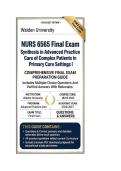
,NURS 6565 Final Exam | Synthesis in Advanced Practice Care of
Complex Patients in Primary Care Settings I Questions And Answers
2026/2027 Walden University
NURS 6565 Final Exam Practice Bank
Course: NURS 6565
University: Walden University
Assessment: Final Exam
Area: Synthesis in Advanced Practice Care of Complex Patients in Primary
Care Settings I
1.
A 72-year-old patient presents with a unilateral vesicular rash along the right
thoracic dermatome. The patient reports severe burning pain that began 2
days before the rash appeared. Which diagnosis is most likely?
A) Impetigo
B) Herpes zoster
C) Contact dermatitis
D) Tinea corporis
Answer: B) Herpes zoster
Rationale: Herpes zoster results from reactivation of varicella-zoster virus
and typically presents as a painful, unilateral vesicular eruption following a
dermatome.
2.
A patient with suspected herpes zoster presents within 48 hours of the onset
of the rash. Which intervention is most appropriate?
A) Begin antiviral therapy
B) Apply topical corticosteroids only
C) Prescribe oral antibiotics
D) Reassure the patient that treatment is unnecessary
Answer: A) Begin antiviral therapy
Rationale: Antiviral therapy is most effective when initiated early, ideally
within 72 hours of rash onset, and can reduce complications and duration of
symptoms.
,3.
A patient develops an intensely pruritic rash after beginning a new
medication. Which finding would most strongly suggest Stevens-Johnson
syndrome rather than a simple drug eruption?
A) Mild localized erythema
B) Dry scaling of the elbows
C) Mucosal involvement with blistering and epidermal detachment
D) Isolated itching without skin lesions
Answer: C) Mucosal involvement with blistering and epidermal
detachment
Rationale: Stevens-Johnson syndrome is a severe mucocutaneous reaction
characterized by painful skin lesions, mucosal involvement, blistering, and
epidermal detachment.
4.
Which lesion is most concerning for possible melanoma?
A) Symmetric tan macule with uniform borders
B) Stable seborrheic keratosis
C) Dark lesion with asymmetry, irregular borders, color variation, and recent
enlargement
D) Small skin tag
Answer: C) Dark lesion with asymmetry, irregular borders, color
variation, and recent enlargement
Rationale: The ABCDE characteristics—Asymmetry, Border irregularity,
Color variation, Diameter enlargement, and Evolution—raise concern for
melanoma.
5.
A patient presents with honey-colored crusted lesions around the nose and
mouth. Which diagnosis is most likely?
A) Impetigo
B) Psoriasis
C) Herpes zoster
D) Vitiligo
Answer: A) Impetigo
, Rationale: Impetigo is a superficial bacterial skin infection classically
associated with honey-colored crusting.
6.
Which finding is most characteristic of psoriasis?
A) Silvery scale over well-demarcated erythematous plaques
B) Honey-colored crust
C) Grouped vesicles following a dermatome
D) Burrows between the fingers
Answer: A) Silvery scale over well-demarcated erythematous
plaques
Rationale: Plaque psoriasis commonly presents with sharply demarcated
erythematous plaques covered by silvery scales.
7.
An adult suddenly develops facial drooping, right arm weakness, and
expressive aphasia. What should the NP do first?
A) Schedule a follow-up appointment
B) Determine the patient's last known well time and activate emergency
stroke evaluation
C) Administer an oral anxiolytic
D) Obtain a routine outpatient MRI appointment
Answer: B) Determine the patient's last known well time and
activate emergency stroke evaluation
Rationale: Sudden focal neurologic deficits suggest acute ischemic stroke.
Time of symptom onset or last known well is critical for determining eligibility
for reperfusion therapy.
8.
Which symptom is most characteristic of Parkinson disease?
A) Resting tremor
B) Sudden complete paralysis
C) Hyperreflexia alone
D) Intention tremor as the only finding
Answer: A) Resting tremor
Rationale: Parkinson disease commonly presents with bradykinesia, rigidity,
resting tremor, and postural instability.
Complex Patients in Primary Care Settings I Questions And Answers
2026/2027 Walden University
NURS 6565 Final Exam Practice Bank
Course: NURS 6565
University: Walden University
Assessment: Final Exam
Area: Synthesis in Advanced Practice Care of Complex Patients in Primary
Care Settings I
1.
A 72-year-old patient presents with a unilateral vesicular rash along the right
thoracic dermatome. The patient reports severe burning pain that began 2
days before the rash appeared. Which diagnosis is most likely?
A) Impetigo
B) Herpes zoster
C) Contact dermatitis
D) Tinea corporis
Answer: B) Herpes zoster
Rationale: Herpes zoster results from reactivation of varicella-zoster virus
and typically presents as a painful, unilateral vesicular eruption following a
dermatome.
2.
A patient with suspected herpes zoster presents within 48 hours of the onset
of the rash. Which intervention is most appropriate?
A) Begin antiviral therapy
B) Apply topical corticosteroids only
C) Prescribe oral antibiotics
D) Reassure the patient that treatment is unnecessary
Answer: A) Begin antiviral therapy
Rationale: Antiviral therapy is most effective when initiated early, ideally
within 72 hours of rash onset, and can reduce complications and duration of
symptoms.
,3.
A patient develops an intensely pruritic rash after beginning a new
medication. Which finding would most strongly suggest Stevens-Johnson
syndrome rather than a simple drug eruption?
A) Mild localized erythema
B) Dry scaling of the elbows
C) Mucosal involvement with blistering and epidermal detachment
D) Isolated itching without skin lesions
Answer: C) Mucosal involvement with blistering and epidermal
detachment
Rationale: Stevens-Johnson syndrome is a severe mucocutaneous reaction
characterized by painful skin lesions, mucosal involvement, blistering, and
epidermal detachment.
4.
Which lesion is most concerning for possible melanoma?
A) Symmetric tan macule with uniform borders
B) Stable seborrheic keratosis
C) Dark lesion with asymmetry, irregular borders, color variation, and recent
enlargement
D) Small skin tag
Answer: C) Dark lesion with asymmetry, irregular borders, color
variation, and recent enlargement
Rationale: The ABCDE characteristics—Asymmetry, Border irregularity,
Color variation, Diameter enlargement, and Evolution—raise concern for
melanoma.
5.
A patient presents with honey-colored crusted lesions around the nose and
mouth. Which diagnosis is most likely?
A) Impetigo
B) Psoriasis
C) Herpes zoster
D) Vitiligo
Answer: A) Impetigo
, Rationale: Impetigo is a superficial bacterial skin infection classically
associated with honey-colored crusting.
6.
Which finding is most characteristic of psoriasis?
A) Silvery scale over well-demarcated erythematous plaques
B) Honey-colored crust
C) Grouped vesicles following a dermatome
D) Burrows between the fingers
Answer: A) Silvery scale over well-demarcated erythematous
plaques
Rationale: Plaque psoriasis commonly presents with sharply demarcated
erythematous plaques covered by silvery scales.
7.
An adult suddenly develops facial drooping, right arm weakness, and
expressive aphasia. What should the NP do first?
A) Schedule a follow-up appointment
B) Determine the patient's last known well time and activate emergency
stroke evaluation
C) Administer an oral anxiolytic
D) Obtain a routine outpatient MRI appointment
Answer: B) Determine the patient's last known well time and
activate emergency stroke evaluation
Rationale: Sudden focal neurologic deficits suggest acute ischemic stroke.
Time of symptom onset or last known well is critical for determining eligibility
for reperfusion therapy.
8.
Which symptom is most characteristic of Parkinson disease?
A) Resting tremor
B) Sudden complete paralysis
C) Hyperreflexia alone
D) Intention tremor as the only finding
Answer: A) Resting tremor
Rationale: Parkinson disease commonly presents with bradykinesia, rigidity,
resting tremor, and postural instability.