

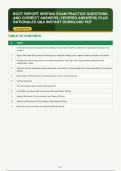
BCOT REPORT WRITING EXAM PRACTICE QUESTIONS
AND CORRECT ANSWERS (VERIFIED ANSWERS) PLUS
RATIONALES Q&A INSTANT DOWNLOAD PDF
150 QUESTIONS
TABLE OF CONTENTS
# TOPIC
1 Critically evaluate the purpose and audience of business reports to determine appropriate structure and
content
2 Apply advanced data analysis techniques to interpret findings and support evidence-based conclusions
3 Design persuasive arguments and recommendations that align with organizational objectives and
stakeholder needs
4 Integrate ethical standards and professional conventions in the development and presentation of business
reports
5 Bcot Report Writing Exam Practice Questions And Correct Answers
6 Verified Answers
7 Plus Rationales Q&A Instant Download Pdf
8 Foundations of Business Communication and Report Writing
9 Applied Business Communication and Report Writing
10 Advanced Business Communication and Report Writing
11 Business Communication and Report Writing Review
Page 1
,Q1 CRITICALLY EVALUATE THE PURPOSE AND AUDIENCE OF BUSINESS REPORTS TO
DETERMINE APPROPRIATE STRUCTURE AND CONTENT
When writing an analytical report for a senior executive who is pressed for time,
what is the most effective approach to structuring the executive summary?
A. Present the findings, then the conclusions, and finally the recommendations in a narrative
format.
B. Lead with the primary recommendation and key supporting evidence, followed by a brief
overview of methods. CORRECT
C. Summarize the entire report in one page, including all data tables and charts.
D. Provide a detailed account of the research methodology and limitations before stating any
conclusions.
RATIONALE: Executives often prefer a 'bottom-line up front' approach. Leading with the
recommendation respects their time and allows them to grasp the essential action quickly.
Options A and D bury the key message, while C is impractical and defeats the purpose of a
summary.
Q2 CRITICALLY EVALUATE THE PURPOSE AND AUDIENCE OF BUSINESS REPORTS TO
DETERMINE APPROPRIATE STRUCTURE AND CONTENT
In a cross-cultural business report, which strategy best mitigates the risk of
misinterpretation due to high-context vs. low-context communication differences?
A. Use extensive metaphors and analogies to convey complex ideas.
B. Ensure that the report is translated into the recipient's native language.
C. Explicitly state all assumptions, data sources, and reasoning behind conclusions. CORRECT
D. Rely on visual aids and graphics to replace all textual explanations.
RATIONALE: High-context cultures rely on implicit communication, while low-context cultures
require explicit detail. By making all assumptions and reasoning explicit, you bridge this gap and
reduce ambiguity. Translation (B) does not address cultural context, and metaphors (A) may
confuse. Visuals (D) cannot replace nuanced explanation.
Page 2
,Q3 CRITICALLY EVALUATE THE PURPOSE AND AUDIENCE OF BUSINESS REPORTS TO
DETERMINE APPROPRIATE STRUCTURE AND CONTENT
You are analyzing survey data for a report. The data shows a statistically
significant correlation between employee satisfaction and productivity, but the
effect size is small. What is the most appropriate interpretation for the report?
A. Emphasize the statistical significance to justify a major policy change.
B. Report the correlation and note that practical significance may be limited despite statistical
significance. CORRECT
C. Dismiss the finding because small effect sizes are not meaningful in business contexts.
D. Recommend further research before acknowledging any relationship exists.
RATIONALE: Statistical significance does not imply practical importance. A small effect size
suggests the relationship is weak, so the report should interpret it cautiously. Overstating (A) is
misleading; dismissing (C) ignores potential value; (D) is overly conservative when data is
already available.
Q4 CRITICALLY EVALUATE THE PURPOSE AND AUDIENCE OF BUSINESS REPORTS TO
DETERMINE APPROPRIATE STRUCTURE AND CONTENT
In a persuasive report, which rhetorical strategy is most effective for overcoming
audience resistance to a recommended change?
A. Present only the benefits and avoid discussing potential drawbacks to maintain a positive
tone.
B. Acknowledge the costs and risks upfront, then provide evidence that the benefits outweigh
them. CORRECT
C. Use emotional appeals to generate enthusiasm for the change.
D. Cite authority figures who endorse the change without providing detailed evidence.
RATIONALE: Acknowledging counterarguments and addressing them directly (two-sided
argument) enhances credibility and persuasiveness, especially with a skeptical audience.
One-sided arguments (A) may be seen as biased; emotional appeals (C) lack substance;
authority alone (D) is not persuasive without evidence.
Page 3
, Q5 CRITICALLY EVALUATE THE PURPOSE AND AUDIENCE OF BUSINESS REPORTS TO
DETERMINE APPROPRIATE STRUCTURE AND CONTENT
When incorporating graphics into a business report, what is the primary guideline
for ensuring they are effective?
A. Use as many graphics as possible to make the report visually appealing.
B. Choose a graphic type that accurately represents the data and is labeled clearly. CORRECT
C. Place all graphics in an appendix to avoid interrupting the narrative flow.
D. Ensure that each graphic includes a three-dimensional effect to enhance visual interest.
RATIONALE: The graphic must be appropriate for the data (e.g., line chart for trends, bar chart
for comparisons) and clearly labeled (titles, axes, legends) for independent comprehension.
Overuse (A) clutters; relegating to appendix (C) reduces impact; 3D effects (D) often distort data.
Q6 CRITICALLY EVALUATE THE PURPOSE AND AUDIENCE OF BUSINESS REPORTS TO
DETERMINE APPROPRIATE STRUCTURE AND CONTENT
Which of the following best describes the purpose of a formal report's 'letter of
transmittal'?
A. To provide a detailed summary of the report's findings and recommendations.
B. To explain the scope and purpose of the report to the reader.
C. To formally present the report to the intended recipient and highlight key points. CORRECT
D. To list all the sources cited in the report in alphabetical order.
RATIONALE: The letter of transmittal serves as a cover note that delivers the report to the
recipient, often mentioning its purpose and key highlights. It is not a summary (A), which is the
executive summary's role; it does not define scope (B) as the introduction does; (D) describes a
bibliography.
Page 4
AND CORRECT ANSWERS (VERIFIED ANSWERS) PLUS
RATIONALES Q&A INSTANT DOWNLOAD PDF
150 QUESTIONS
TABLE OF CONTENTS
# TOPIC
1 Critically evaluate the purpose and audience of business reports to determine appropriate structure and
content
2 Apply advanced data analysis techniques to interpret findings and support evidence-based conclusions
3 Design persuasive arguments and recommendations that align with organizational objectives and
stakeholder needs
4 Integrate ethical standards and professional conventions in the development and presentation of business
reports
5 Bcot Report Writing Exam Practice Questions And Correct Answers
6 Verified Answers
7 Plus Rationales Q&A Instant Download Pdf
8 Foundations of Business Communication and Report Writing
9 Applied Business Communication and Report Writing
10 Advanced Business Communication and Report Writing
11 Business Communication and Report Writing Review
Page 1
,Q1 CRITICALLY EVALUATE THE PURPOSE AND AUDIENCE OF BUSINESS REPORTS TO
DETERMINE APPROPRIATE STRUCTURE AND CONTENT
When writing an analytical report for a senior executive who is pressed for time,
what is the most effective approach to structuring the executive summary?
A. Present the findings, then the conclusions, and finally the recommendations in a narrative
format.
B. Lead with the primary recommendation and key supporting evidence, followed by a brief
overview of methods. CORRECT
C. Summarize the entire report in one page, including all data tables and charts.
D. Provide a detailed account of the research methodology and limitations before stating any
conclusions.
RATIONALE: Executives often prefer a 'bottom-line up front' approach. Leading with the
recommendation respects their time and allows them to grasp the essential action quickly.
Options A and D bury the key message, while C is impractical and defeats the purpose of a
summary.
Q2 CRITICALLY EVALUATE THE PURPOSE AND AUDIENCE OF BUSINESS REPORTS TO
DETERMINE APPROPRIATE STRUCTURE AND CONTENT
In a cross-cultural business report, which strategy best mitigates the risk of
misinterpretation due to high-context vs. low-context communication differences?
A. Use extensive metaphors and analogies to convey complex ideas.
B. Ensure that the report is translated into the recipient's native language.
C. Explicitly state all assumptions, data sources, and reasoning behind conclusions. CORRECT
D. Rely on visual aids and graphics to replace all textual explanations.
RATIONALE: High-context cultures rely on implicit communication, while low-context cultures
require explicit detail. By making all assumptions and reasoning explicit, you bridge this gap and
reduce ambiguity. Translation (B) does not address cultural context, and metaphors (A) may
confuse. Visuals (D) cannot replace nuanced explanation.
Page 2
,Q3 CRITICALLY EVALUATE THE PURPOSE AND AUDIENCE OF BUSINESS REPORTS TO
DETERMINE APPROPRIATE STRUCTURE AND CONTENT
You are analyzing survey data for a report. The data shows a statistically
significant correlation between employee satisfaction and productivity, but the
effect size is small. What is the most appropriate interpretation for the report?
A. Emphasize the statistical significance to justify a major policy change.
B. Report the correlation and note that practical significance may be limited despite statistical
significance. CORRECT
C. Dismiss the finding because small effect sizes are not meaningful in business contexts.
D. Recommend further research before acknowledging any relationship exists.
RATIONALE: Statistical significance does not imply practical importance. A small effect size
suggests the relationship is weak, so the report should interpret it cautiously. Overstating (A) is
misleading; dismissing (C) ignores potential value; (D) is overly conservative when data is
already available.
Q4 CRITICALLY EVALUATE THE PURPOSE AND AUDIENCE OF BUSINESS REPORTS TO
DETERMINE APPROPRIATE STRUCTURE AND CONTENT
In a persuasive report, which rhetorical strategy is most effective for overcoming
audience resistance to a recommended change?
A. Present only the benefits and avoid discussing potential drawbacks to maintain a positive
tone.
B. Acknowledge the costs and risks upfront, then provide evidence that the benefits outweigh
them. CORRECT
C. Use emotional appeals to generate enthusiasm for the change.
D. Cite authority figures who endorse the change without providing detailed evidence.
RATIONALE: Acknowledging counterarguments and addressing them directly (two-sided
argument) enhances credibility and persuasiveness, especially with a skeptical audience.
One-sided arguments (A) may be seen as biased; emotional appeals (C) lack substance;
authority alone (D) is not persuasive without evidence.
Page 3
, Q5 CRITICALLY EVALUATE THE PURPOSE AND AUDIENCE OF BUSINESS REPORTS TO
DETERMINE APPROPRIATE STRUCTURE AND CONTENT
When incorporating graphics into a business report, what is the primary guideline
for ensuring they are effective?
A. Use as many graphics as possible to make the report visually appealing.
B. Choose a graphic type that accurately represents the data and is labeled clearly. CORRECT
C. Place all graphics in an appendix to avoid interrupting the narrative flow.
D. Ensure that each graphic includes a three-dimensional effect to enhance visual interest.
RATIONALE: The graphic must be appropriate for the data (e.g., line chart for trends, bar chart
for comparisons) and clearly labeled (titles, axes, legends) for independent comprehension.
Overuse (A) clutters; relegating to appendix (C) reduces impact; 3D effects (D) often distort data.
Q6 CRITICALLY EVALUATE THE PURPOSE AND AUDIENCE OF BUSINESS REPORTS TO
DETERMINE APPROPRIATE STRUCTURE AND CONTENT
Which of the following best describes the purpose of a formal report's 'letter of
transmittal'?
A. To provide a detailed summary of the report's findings and recommendations.
B. To explain the scope and purpose of the report to the reader.
C. To formally present the report to the intended recipient and highlight key points. CORRECT
D. To list all the sources cited in the report in alphabetical order.
RATIONALE: The letter of transmittal serves as a cover note that delivers the report to the
recipient, often mentioning its purpose and key highlights. It is not a summary (A), which is the
executive summary's role; it does not define scope (B) as the introduction does; (D) describes a
bibliography.
Page 4


