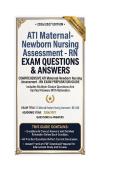
,ATI Maternal-Newborn Nursing Assessment - RN Exam Questions
And Answers
SECTION 1: ANTEPARTUM CARE (20 Questions)
**1.** A nurse is caring for a client at 10 weeks of gestation who reports
nausea and vomiting. Which recommendation is most appropriate?
A) Avoid fluids with meals
B) Eat large, heavy meals
C) Lie down immediately after eating
D) Increase intake of spicy foods
**Correct Answer:** A) Avoid fluids with meals
**Rationale:** Avoiding fluids with meals reduces gastric distension and may
alleviate nausea. Small, frequent, low-fat meals are advised for nausea. Lying
down immediately after eating can worsen reflux; spicy foods may trigger
nausea.
**2.** A nurse is providing teaching to a client about physiological changes in
the first trimester. Which finding should the nurse include as a normal
change?
A) Decreased heart rate
B) Increased blood pressure
C) Frequent urination
D) Decreased respiratory rate
**Correct Answer:** C) Frequent urination
,**Rationale:** Frequent urination occurs due to uterine pressure on the
bladder and increased glomerular filtration rate during pregnancy. Heart rate
typically increases, blood pressure may slightly decrease in the first
trimester, and respiratory rate may increase due to progesterone's effect.
**3.** A nurse is calculating a client's estimated date of delivery using
Naegele's rule. The client's last menstrual period began on May 10. What is
the estimated due date?
A) February 3
B) February 17
C) February 24
D) March 3
**Correct Answer:** B) February 17
**Rationale:** Naegele's rule: subtract 3 months from the first day of the last
menstrual period and add 7 days. May 10 → February 10 + 7 days =
February 17.
**4.** A client at 8 weeks of gestation asks the nurse about the purpose of
folic acid supplementation. Which response is correct?
A) "It prevents maternal anemia."
B) "It prevents neural tube defects in the fetus."
C) "It reduces the risk of gestational diabetes."
D) "It promotes fetal lung development."
, **Correct Answer:** B) "It prevents neural tube defects in the fetus."
**Rationale:** Folic acid supplementation (600 mcg/day) during early
pregnancy significantly reduces the risk of neural tube defects such as spina
bifida and anencephaly.
**5.** A nurse is reviewing laboratory results for a client at 12 weeks of
gestation. Which finding should the nurse report to the provider?
A) Hemoglobin 11.2 g/dL
B) White blood cell count 12,000/mm³
C) Platelet count 140,000/mm³
D) Hematocrit 34%
**Correct Answer:** C) Platelet count 140,000/mm³
**Rationale:** Platelet count below 150,000/mm³ may indicate
thrombocytopenia and should be reported. Mild anemia (Hgb 10.5-11.5 g/dL)
is common in pregnancy due to hemodilution. WBC count of 12,000/mm³ is
within normal range for pregnancy.
**6.** A client at 28 weeks of gestation is scheduled for a glucose tolerance
test (GTT). Which instruction should the nurse provide for the initial
screening test?
A) "Fast for 8-12 hours before the test; nothing to eat or drink."
B) "Eat a high-carbohydrate meal 2 hours before the test."
C) "No special preparation is needed; you can eat and drink normally."
D) "Avoid sugar for 24 hours before the test."
And Answers
SECTION 1: ANTEPARTUM CARE (20 Questions)
**1.** A nurse is caring for a client at 10 weeks of gestation who reports
nausea and vomiting. Which recommendation is most appropriate?
A) Avoid fluids with meals
B) Eat large, heavy meals
C) Lie down immediately after eating
D) Increase intake of spicy foods
**Correct Answer:** A) Avoid fluids with meals
**Rationale:** Avoiding fluids with meals reduces gastric distension and may
alleviate nausea. Small, frequent, low-fat meals are advised for nausea. Lying
down immediately after eating can worsen reflux; spicy foods may trigger
nausea.
**2.** A nurse is providing teaching to a client about physiological changes in
the first trimester. Which finding should the nurse include as a normal
change?
A) Decreased heart rate
B) Increased blood pressure
C) Frequent urination
D) Decreased respiratory rate
**Correct Answer:** C) Frequent urination
,**Rationale:** Frequent urination occurs due to uterine pressure on the
bladder and increased glomerular filtration rate during pregnancy. Heart rate
typically increases, blood pressure may slightly decrease in the first
trimester, and respiratory rate may increase due to progesterone's effect.
**3.** A nurse is calculating a client's estimated date of delivery using
Naegele's rule. The client's last menstrual period began on May 10. What is
the estimated due date?
A) February 3
B) February 17
C) February 24
D) March 3
**Correct Answer:** B) February 17
**Rationale:** Naegele's rule: subtract 3 months from the first day of the last
menstrual period and add 7 days. May 10 → February 10 + 7 days =
February 17.
**4.** A client at 8 weeks of gestation asks the nurse about the purpose of
folic acid supplementation. Which response is correct?
A) "It prevents maternal anemia."
B) "It prevents neural tube defects in the fetus."
C) "It reduces the risk of gestational diabetes."
D) "It promotes fetal lung development."
, **Correct Answer:** B) "It prevents neural tube defects in the fetus."
**Rationale:** Folic acid supplementation (600 mcg/day) during early
pregnancy significantly reduces the risk of neural tube defects such as spina
bifida and anencephaly.
**5.** A nurse is reviewing laboratory results for a client at 12 weeks of
gestation. Which finding should the nurse report to the provider?
A) Hemoglobin 11.2 g/dL
B) White blood cell count 12,000/mm³
C) Platelet count 140,000/mm³
D) Hematocrit 34%
**Correct Answer:** C) Platelet count 140,000/mm³
**Rationale:** Platelet count below 150,000/mm³ may indicate
thrombocytopenia and should be reported. Mild anemia (Hgb 10.5-11.5 g/dL)
is common in pregnancy due to hemodilution. WBC count of 12,000/mm³ is
within normal range for pregnancy.
**6.** A client at 28 weeks of gestation is scheduled for a glucose tolerance
test (GTT). Which instruction should the nurse provide for the initial
screening test?
A) "Fast for 8-12 hours before the test; nothing to eat or drink."
B) "Eat a high-carbohydrate meal 2 hours before the test."
C) "No special preparation is needed; you can eat and drink normally."
D) "Avoid sugar for 24 hours before the test."