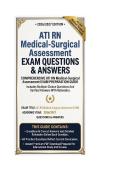
,ATI Medical-Surgical Nursing Assessment - RN Exam Questions And
Answers 2026/2027
SECTION 1: CARDIOVASCULAR & HEMATOLOGIC DISORDERS
**1.** A client with heart failure has crackles in the lung bases, jugular vein
distention, and 3+ pitting edema in the lower extremities. The provider
prescribes furosemide 40 mg IV push. Which outcome indicates that the
medication is having its intended therapeutic effect?
A) Blood pressure increases to 140/90 mm Hg
B) Potassium level rises to 4.5 mEq/L
C) Increased urinary output and decreased edema
D) Heart rate decreases to 60/min
**Correct Answer:** C) Increased urinary output and decreased edema
**Rationale:** Furosemide is a loop diuretic that reduces fluid overload.
Therapeutic response includes increased urine output, decreased edema,
and resolution of crackles. Weight loss is also an expected outcome.
**2.** A 68-year-old client with a history of hypertension and type 2 diabetes
presents with acute onset of substernal chest pressure radiating to the jaw,
associated with diaphoresis and nausea. ECG reveals 3 mm ST-segment
elevation in leads V1-V4. Which intervention should be prioritized?
A) Administer sublingual nitroglycerin and schedule a stress test
B) Initiate immediate reperfusion therapy (PCI or thrombolytics)
C) Obtain a chest X-ray and cardiac enzymes
D) Administer aspirin only and admit for observation
,**Correct Answer:** B) Initiate immediate reperfusion therapy (PCI or
thrombolytics)
**Rationale:** This client is experiencing an acute anterior ST-segment
elevation myocardial infarction (STEMI) based on ST elevation in leads V1-V4.
Immediate reperfusion therapy—percutaneous coronary intervention (PCI)
within 90 minutes or thrombolytics if PCI is unavailable—is the priority.
**3.** A client is prescribed warfarin for atrial fibrillation. The client's INR is
4.8. What is the nurse's priority action?
A) Administer the warfarin as prescribed
B) Hold the warfarin and notify the healthcare provider
C) Increase the warfarin dose
D) Administer vitamin K immediately
**Correct Answer:** B) Hold the warfarin and notify the healthcare provider
**Rationale:** Therapeutic INR for warfarin is typically 2-3. An INR of 4.8
indicates excessive anticoagulation and bleeding risk. The nurse should hold
the dose and notify the provider. Vitamin K may be ordered but requires a
provider prescription.
**4.** A client receiving IV heparin therapy has an aPTT of 120 seconds
(control 30 seconds). Which action should the nurse take?
A) Continue the infusion at the current rate
B) Increase the infusion rate
C) Stop the infusion and notify the healthcare provider
D) Decrease the infusion rate by half
, **Correct Answer:** C) Stop the infusion and notify the healthcare provider
**Rationale:** Therapeutic aPTT for heparin is 1.5-2.5 times control (45-75
seconds). An aPTT of 120 seconds indicates excessive anticoagulation and
risk of hemorrhage. The infusion should be stopped immediately and the
provider notified.
**5.** A client with deep vein thrombosis is prescribed enoxaparin (Lovenox)
subcutaneously. Which technique is correct for administration?
A) Aspirate before injecting
B) Massage the site after injection
C) Administer in the abdomen with a 25-gauge needle
D) Inject into the deltoid muscle
**Correct Answer:** C) Administer in the abdomen with a 25-gauge needle
**Rationale:** Enoxaparin is administered subcutaneously in the abdomen
using a small-gauge needle. Aspiration and massage are not recommended.
The deltoid is not a subcutaneous site.
**6.** A client with heart failure is prescribed digoxin. Which finding indicates
digoxin toxicity?
A) Heart rate 72/min
B) Nausea, vomiting, and visual disturbances
C) Blood pressure 130/80
D) Serum digoxin level 0.9 ng/mL
Answers 2026/2027
SECTION 1: CARDIOVASCULAR & HEMATOLOGIC DISORDERS
**1.** A client with heart failure has crackles in the lung bases, jugular vein
distention, and 3+ pitting edema in the lower extremities. The provider
prescribes furosemide 40 mg IV push. Which outcome indicates that the
medication is having its intended therapeutic effect?
A) Blood pressure increases to 140/90 mm Hg
B) Potassium level rises to 4.5 mEq/L
C) Increased urinary output and decreased edema
D) Heart rate decreases to 60/min
**Correct Answer:** C) Increased urinary output and decreased edema
**Rationale:** Furosemide is a loop diuretic that reduces fluid overload.
Therapeutic response includes increased urine output, decreased edema,
and resolution of crackles. Weight loss is also an expected outcome.
**2.** A 68-year-old client with a history of hypertension and type 2 diabetes
presents with acute onset of substernal chest pressure radiating to the jaw,
associated with diaphoresis and nausea. ECG reveals 3 mm ST-segment
elevation in leads V1-V4. Which intervention should be prioritized?
A) Administer sublingual nitroglycerin and schedule a stress test
B) Initiate immediate reperfusion therapy (PCI or thrombolytics)
C) Obtain a chest X-ray and cardiac enzymes
D) Administer aspirin only and admit for observation
,**Correct Answer:** B) Initiate immediate reperfusion therapy (PCI or
thrombolytics)
**Rationale:** This client is experiencing an acute anterior ST-segment
elevation myocardial infarction (STEMI) based on ST elevation in leads V1-V4.
Immediate reperfusion therapy—percutaneous coronary intervention (PCI)
within 90 minutes or thrombolytics if PCI is unavailable—is the priority.
**3.** A client is prescribed warfarin for atrial fibrillation. The client's INR is
4.8. What is the nurse's priority action?
A) Administer the warfarin as prescribed
B) Hold the warfarin and notify the healthcare provider
C) Increase the warfarin dose
D) Administer vitamin K immediately
**Correct Answer:** B) Hold the warfarin and notify the healthcare provider
**Rationale:** Therapeutic INR for warfarin is typically 2-3. An INR of 4.8
indicates excessive anticoagulation and bleeding risk. The nurse should hold
the dose and notify the provider. Vitamin K may be ordered but requires a
provider prescription.
**4.** A client receiving IV heparin therapy has an aPTT of 120 seconds
(control 30 seconds). Which action should the nurse take?
A) Continue the infusion at the current rate
B) Increase the infusion rate
C) Stop the infusion and notify the healthcare provider
D) Decrease the infusion rate by half
, **Correct Answer:** C) Stop the infusion and notify the healthcare provider
**Rationale:** Therapeutic aPTT for heparin is 1.5-2.5 times control (45-75
seconds). An aPTT of 120 seconds indicates excessive anticoagulation and
risk of hemorrhage. The infusion should be stopped immediately and the
provider notified.
**5.** A client with deep vein thrombosis is prescribed enoxaparin (Lovenox)
subcutaneously. Which technique is correct for administration?
A) Aspirate before injecting
B) Massage the site after injection
C) Administer in the abdomen with a 25-gauge needle
D) Inject into the deltoid muscle
**Correct Answer:** C) Administer in the abdomen with a 25-gauge needle
**Rationale:** Enoxaparin is administered subcutaneously in the abdomen
using a small-gauge needle. Aspiration and massage are not recommended.
The deltoid is not a subcutaneous site.
**6.** A client with heart failure is prescribed digoxin. Which finding indicates
digoxin toxicity?
A) Heart rate 72/min
B) Nausea, vomiting, and visual disturbances
C) Blood pressure 130/80
D) Serum digoxin level 0.9 ng/mL