

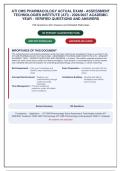
ATI CMS PHARMACOLOGY ACTUAL EXAM - ASSESSMENT
TECHNOLOGIES INSTITUTE (ATI) - 2026/2027 ACADEMIC
YEAR - VERIFIED QUESTIONS AND ANSWERS
159 Questions with Answers and Detailed Rationales
100 PERCENT GUARANTEED PASS
INSTANT DOWNLOAD ANSWERS INCLUDED
IMPORTANCE OF THIS DOCUMENT
This comprehensive examination preparation guide has been meticulously developed to help you succeed in the
ATI CMS PHARMACOLOGY ACTUAL EXAM - ASSESSMENT TECHNOLOGIES INSTITUTE (ATI) - 2026/2027
ACADEMIC YEAR - VERIFIED QUESTIONS AND ANSWERS. It contains 159 carefully selected questions that
reflect the most current exam content and testing strategies. Each question is accompanied by a correct answer
and a detailed rationale that explains the underlying pathophysiology, pharmacology, or clinical reasoning.
Self-Assessment – Test your knowledge and Exam Preparation – Familiarize yourself with the
identify areas requiring further question format and content
study areas
Concept Reinforcement – Deepen your Confidence Building – Develop test-taking
understanding through strategies and reduce
evidence-based exam anxiety
rationales
Time Management – Practice answering
questions under simulated
exam conditions
Review Summary 159 Questions
Foundations - Application - ATI CMS Pharmacology Actual Assessment Technologies Institute ATI
2026/2027 Academic YEAR AND Pharmacology ATI CMS Pharmacology Undergraduate YEAR 3 / Graduate
All answers with rationales
,Table of Contents
Content Area Questions Key Topics
ATI CMS Pharmacology 1-27 Therapeutic, Appropriate, Medication, Therapy, Develops
Actual Assessment
Technologies Institute ATI
2026/2027 Academic YEAR
AND Pharmacology ATI CMS
Pharmacology
Undergraduate YEAR 3 /
Graduate
Prescribed 28-54 Appropriate, Explains, Effect, Requires, Therapy
Therapy 55-81 Phenytoin, Prescribed, Serum, Appropriate, Mechanism
Explains 82-108 Develops, Combination, Therapy, Kidney, Started
Develops 109-135 Appropriate, Prescribed, Receiving, Requires, Therapy
Mechanism 136-159 Explains, Prescribed, Phenytoin, Level, Diabetes
TOTAL 159 All questions include answers and detailed rationales
,Section A - ATI CMS Pharmacology Actual Assessment
Technologies Institute ATI 2026/2027 Academic YEAR AND
Pharmacology ATI CMS Pharmacology Undergraduate
YEAR 3 / Graduate
Q1.
A patient on long-term phenytoin therapy develops nystagmus, ataxia, and confusion.
Plasma albumin is 2.5 g/dL (normal 3.5-5.0). Which pharmacokinetic principle best
explains the toxicity despite a total phenytoin level of 12 mcg/mL (therapeutic 10-20)?
A. Increased hepatic metabolism due to B. Decreased protein binding leading to
enzyme induction higher free drug concentration
C. Altered volume of distribution from D. Competitive inhibition at the active site of
hypoalbuminemia CYP2C9
Correct: B - Decreased protein binding leading to higher free drug concentration
Rationale:Hypoalbuminemia increases the free fraction of phenytoin, increasing
pharmacological effect and toxicity despite normal total levels. The other options do not
explain the paradoxical toxicity with a normal total concentration.
Q2.
Which drug-drug interaction is correctly paired with its mechanism?
A. Warfarin + rifampin -> increased B. Digoxin + verapamil -> decreased digoxin
anticoagulant effect via CYP induction levels via P-glycoprotein induction
C. Clopidogrel + omeprazole -> reduced D. Methotrexate + trimethoprim -> increased
antiplatelet effect via CYP2C19 inhibition methotrexate clearance via renal
competition
Correct: C - Clopidogrel + omeprazole -> reduced antiplatelet effect via CYP2C19 inhibition
Rationale:Omeprazole inhibits CYP2C19, reducing conversion of clopidogrel to its active
metabolite, decreasing antiplatelet effect. The other pairs are incorrect: rifampin induces CYP
and reduces warfarin effect; verapamil inhibits P-glycoprotein and increases digoxin;
trimethoprim inhibits renal tubular secretion of methotrexate, not clearance.
Q3.
A patient receiving intravenous vancomycin develops flushing, pruritus, and hypotension
during the infusion. Which action is most appropriate?
A. Slow the infusion rate and administer B. Stop the infusion and obtain a serum
diphenhydramine vancomycin trough
Page 3
, Section A - ATI CMS Pharmacology Actual Assessment Technologies Institute ATI 2026/2027 Academic YEAR AND Pharmacology ATI CMS
Pharmacology Undergraduate YEAR 3 / Graduate
C. Continue the infusion and monitor vital D. Switch to oral vancomycin to avoid the
signs every 15 minutes reaction
Correct: A - Slow the infusion rate and administer diphenhydramine
Rationale:This is Red Man Syndrome, a non-immunologic histamine release. Management
includes slowing the infusion and premedicating with antihistamines. Stopping is not
necessary unless severe; switching to oral is not appropriate for systemic infections.
Q4.
A patient with type 2 diabetes is prescribed metformin and later develops acute renal
failure (GFR 20 mL/min). Which is the primary reason to discontinue metformin?
A. Increased risk of hypoglycemia due to B. Risk of lactic acidosis due to drug
reduced clearance accumulation
C. Reduced effectiveness because of D. Potential for contrast-induced
altered renal glucose reabsorption nephropathy if imaging is needed
Correct: B - Risk of lactic acidosis due to drug accumulation
Rationale:Metformin is renally excreted; accumulation in renal impairment increases the risk
of lactic acidosis, a life-threatening complication. The other reasons are not the primary
concern.
Q5.
Which medication requires a 30-minute observation period after administration due to risk
of anaphylaxis?
A. IV immune globulin (IVIG) B. Subcutaneous insulin lispro
C. Oral amoxicillin D. Intramuscular vitamin B12
Correct: A - IV immune globulin (IVIG)
Rationale:IVIG can cause anaphylactoid reactions; observation post-infusion is
recommended. Insulin lispro, oral antibiotics, and vitamin B12 do not have this requirement.
Q6.
A patient on lithium therapy has a serum level of 1.8 mEq/L and presents with tremor,
confusion, and vomiting. Which intervention is most appropriate?
A. Administer sodium polystyrene sulfonate B. Increase oral fluids and continue lithium
orally at a reduced dose
C. Hold lithium, administer IV normal saline, D. Administer activated charcoal
and consider hemodialysis immediately
Page 4
TECHNOLOGIES INSTITUTE (ATI) - 2026/2027 ACADEMIC
YEAR - VERIFIED QUESTIONS AND ANSWERS
159 Questions with Answers and Detailed Rationales
100 PERCENT GUARANTEED PASS
INSTANT DOWNLOAD ANSWERS INCLUDED
IMPORTANCE OF THIS DOCUMENT
This comprehensive examination preparation guide has been meticulously developed to help you succeed in the
ATI CMS PHARMACOLOGY ACTUAL EXAM - ASSESSMENT TECHNOLOGIES INSTITUTE (ATI) - 2026/2027
ACADEMIC YEAR - VERIFIED QUESTIONS AND ANSWERS. It contains 159 carefully selected questions that
reflect the most current exam content and testing strategies. Each question is accompanied by a correct answer
and a detailed rationale that explains the underlying pathophysiology, pharmacology, or clinical reasoning.
Self-Assessment – Test your knowledge and Exam Preparation – Familiarize yourself with the
identify areas requiring further question format and content
study areas
Concept Reinforcement – Deepen your Confidence Building – Develop test-taking
understanding through strategies and reduce
evidence-based exam anxiety
rationales
Time Management – Practice answering
questions under simulated
exam conditions
Review Summary 159 Questions
Foundations - Application - ATI CMS Pharmacology Actual Assessment Technologies Institute ATI
2026/2027 Academic YEAR AND Pharmacology ATI CMS Pharmacology Undergraduate YEAR 3 / Graduate
All answers with rationales
,Table of Contents
Content Area Questions Key Topics
ATI CMS Pharmacology 1-27 Therapeutic, Appropriate, Medication, Therapy, Develops
Actual Assessment
Technologies Institute ATI
2026/2027 Academic YEAR
AND Pharmacology ATI CMS
Pharmacology
Undergraduate YEAR 3 /
Graduate
Prescribed 28-54 Appropriate, Explains, Effect, Requires, Therapy
Therapy 55-81 Phenytoin, Prescribed, Serum, Appropriate, Mechanism
Explains 82-108 Develops, Combination, Therapy, Kidney, Started
Develops 109-135 Appropriate, Prescribed, Receiving, Requires, Therapy
Mechanism 136-159 Explains, Prescribed, Phenytoin, Level, Diabetes
TOTAL 159 All questions include answers and detailed rationales
,Section A - ATI CMS Pharmacology Actual Assessment
Technologies Institute ATI 2026/2027 Academic YEAR AND
Pharmacology ATI CMS Pharmacology Undergraduate
YEAR 3 / Graduate
Q1.
A patient on long-term phenytoin therapy develops nystagmus, ataxia, and confusion.
Plasma albumin is 2.5 g/dL (normal 3.5-5.0). Which pharmacokinetic principle best
explains the toxicity despite a total phenytoin level of 12 mcg/mL (therapeutic 10-20)?
A. Increased hepatic metabolism due to B. Decreased protein binding leading to
enzyme induction higher free drug concentration
C. Altered volume of distribution from D. Competitive inhibition at the active site of
hypoalbuminemia CYP2C9
Correct: B - Decreased protein binding leading to higher free drug concentration
Rationale:Hypoalbuminemia increases the free fraction of phenytoin, increasing
pharmacological effect and toxicity despite normal total levels. The other options do not
explain the paradoxical toxicity with a normal total concentration.
Q2.
Which drug-drug interaction is correctly paired with its mechanism?
A. Warfarin + rifampin -> increased B. Digoxin + verapamil -> decreased digoxin
anticoagulant effect via CYP induction levels via P-glycoprotein induction
C. Clopidogrel + omeprazole -> reduced D. Methotrexate + trimethoprim -> increased
antiplatelet effect via CYP2C19 inhibition methotrexate clearance via renal
competition
Correct: C - Clopidogrel + omeprazole -> reduced antiplatelet effect via CYP2C19 inhibition
Rationale:Omeprazole inhibits CYP2C19, reducing conversion of clopidogrel to its active
metabolite, decreasing antiplatelet effect. The other pairs are incorrect: rifampin induces CYP
and reduces warfarin effect; verapamil inhibits P-glycoprotein and increases digoxin;
trimethoprim inhibits renal tubular secretion of methotrexate, not clearance.
Q3.
A patient receiving intravenous vancomycin develops flushing, pruritus, and hypotension
during the infusion. Which action is most appropriate?
A. Slow the infusion rate and administer B. Stop the infusion and obtain a serum
diphenhydramine vancomycin trough
Page 3
, Section A - ATI CMS Pharmacology Actual Assessment Technologies Institute ATI 2026/2027 Academic YEAR AND Pharmacology ATI CMS
Pharmacology Undergraduate YEAR 3 / Graduate
C. Continue the infusion and monitor vital D. Switch to oral vancomycin to avoid the
signs every 15 minutes reaction
Correct: A - Slow the infusion rate and administer diphenhydramine
Rationale:This is Red Man Syndrome, a non-immunologic histamine release. Management
includes slowing the infusion and premedicating with antihistamines. Stopping is not
necessary unless severe; switching to oral is not appropriate for systemic infections.
Q4.
A patient with type 2 diabetes is prescribed metformin and later develops acute renal
failure (GFR 20 mL/min). Which is the primary reason to discontinue metformin?
A. Increased risk of hypoglycemia due to B. Risk of lactic acidosis due to drug
reduced clearance accumulation
C. Reduced effectiveness because of D. Potential for contrast-induced
altered renal glucose reabsorption nephropathy if imaging is needed
Correct: B - Risk of lactic acidosis due to drug accumulation
Rationale:Metformin is renally excreted; accumulation in renal impairment increases the risk
of lactic acidosis, a life-threatening complication. The other reasons are not the primary
concern.
Q5.
Which medication requires a 30-minute observation period after administration due to risk
of anaphylaxis?
A. IV immune globulin (IVIG) B. Subcutaneous insulin lispro
C. Oral amoxicillin D. Intramuscular vitamin B12
Correct: A - IV immune globulin (IVIG)
Rationale:IVIG can cause anaphylactoid reactions; observation post-infusion is
recommended. Insulin lispro, oral antibiotics, and vitamin B12 do not have this requirement.
Q6.
A patient on lithium therapy has a serum level of 1.8 mEq/L and presents with tremor,
confusion, and vomiting. Which intervention is most appropriate?
A. Administer sodium polystyrene sulfonate B. Increase oral fluids and continue lithium
orally at a reduced dose
C. Hold lithium, administer IV normal saline, D. Administer activated charcoal
and consider hemodialysis immediately
Page 4


