

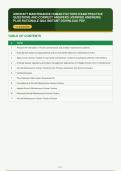
AIRCRAFT MAINTENANCE HUMAN FACTORS EXAM PRACTICE
QUESTIONS AND CORRECT ANSWERS (VERIFIED ANSWERS)
PLUS RATIONALE Q&A INSTANT DOWNLOAD PDF.
140 QUESTIONS
TABLE OF CONTENTS
# TOPIC
1 Analyze the interaction of human performance and aviation maintenance systems
2 Evaluate the impact of organizational and environmental factors on maintenance errors
3 Apply human factors models to real-world maintenance incidents and propose effective interventions
4 Critically assess regulatory and safety management approaches to mitigate human error in maintenance
5 Aircraft Maintenance Human Factors Exam Practice Questions And Correct Answers
6 Verified Answers
7 Plus Rationale Q&A Instant Download Pdf.
8 Foundations of Aircraft Maintenance Human Factors
9 Applied Aircraft Maintenance Human Factors
10 Advanced Aircraft Maintenance Human Factors
11 Aircraft Maintenance Human Factors Review
Page 1
,Q1 ANALYZE THE INTERACTION OF HUMAN PERFORMANCE AND AVIATION MAINTENANCE
SYSTEMS
In a post-incident analysis of a near-miss during landing gear retraction testing,
you discover that the technician misread a pressure gauge due to its placement at
a 30-degree angle and poor lighting. Which human factors model BEST explains
this error as a failure of information transfer?
A. Dirty Dozen: Lack of assertiveness
B. SHELL model: Interface between Liveware and Hardware CORRECT
C. Reason's Swiss Cheese Model: Latent condition
D. Pew's stages of information processing: Response selection
RATIONALE: The SHELL model specifically addresses interfaces between the human (Liveware)
and other system components; a poorly designed gauge and lighting represent a
Liveware-Hardware interface failure. The Dirty Dozen focuses on personal and social factors, not
physical interface design. Reason's model addresses latent conditions but not direct information
transfer. Pew's stage would involve choosing an action, not misreading a display.
Q2 ANALYZE THE INTERACTION OF HUMAN PERFORMANCE AND AVIATION MAINTENANCE
SYSTEMS
During a shift handover, a maintenance team discovers that a critical torque value
was not recorded in the logbook, leading to a rework that delayed departure.
Which communication barrier is MOST directly implicated, and what is the most
effective mitigation?
A. Shift turnover; implement structured handover checklists CORRECT
B. Language differences; provide multilingual documentation
C. Hierarchy gradient; encourage assertiveness training
D. Distraction; enforce no-interruption zones during sign-off
RATIONALE: The scenario describes a failure in shift handover communication, which is a known
barrier to safe maintenance. Structured handover checklists ensure critical information is
transferred systematically. Language differences, hierarchy, and distraction are other barriers but
not the primary issue here, and the proposed mitigations do not address the root cause of
incomplete information transfer.
Page 2
,Q3 ANALYZE THE INTERACTION OF HUMAN PERFORMANCE AND AVIATION MAINTENANCE
SYSTEMS
A maintenance organization is implementing fatigue risk management. Which
approach BEST aligns with current scientific understanding of circadian rhythms
and sleep debt?
A. Mandatory 8-hour rest periods between shifts, regardless of time of day
B. Use of a biomathematical model to schedule shifts, considering individual sleep history
CORRECT
C. Providing caffeine and bright light exposure during night shifts
D. Rotating shifts every 2 days to distribute workload evenly
RATIONALE: Modern fatigue management uses biomathematical models that incorporate
circadian phase and cumulative sleep debt to predict performance. Fixed 8-hour rests are
insufficient because they ignore circadian timing and prior sleep. Caffeine and light are
countermeasures, not primary scheduling solutions. Rapid rotation (every 2 days) disrupts
circadian adaptation and worsens fatigue.
Q4 ANALYZE THE INTERACTION OF HUMAN PERFORMANCE AND AVIATION MAINTENANCE
SYSTEMS
In a root cause analysis of a maintenance error, you find that a technician skipped
a required inspection step because the task card was ambiguous. Which
combination of factors from the 'Dirty Dozen' is MOST likely present?
A. Lack of communication and lack of resources
B. Lack of knowledge and distraction
C. Lack of assertiveness and fatigue
D. Lack of awareness and norms CORRECT
RATIONALE: Ambiguous task cards reflect a lack of awareness (technician not fully mindful of
the step) and norms (a culture where such ambiguity is accepted and not questioned). The
scenario does not indicate poor communication, resource shortage, lack of knowledge,
distraction, assertiveness, or fatigue as primary causes. The 'Dirty Dozen' identifies these two as
the most directly relevant to the situation.
Page 3
, Q5 ANALYZE THE INTERACTION OF HUMAN PERFORMANCE AND AVIATION MAINTENANCE
SYSTEMS
A maintenance control room is redesigned to reduce noise and improve lighting.
According to the SHELL model, which interface is being directly optimized?
A. Liveware-Liveware
B. Liveware-Software
C. Liveware-Hardware
D. Liveware-Environment CORRECT
RATIONALE: The SHELL model includes the Liveware-Environment interface, which covers
physical working conditions such as noise, lighting, temperature, and vibration. Redesigning the
control room's physical environment directly improves this interface. The other interfaces involve
human-human, human-procedures, and human-equipment interactions, which are not the focus
here.
Q6 ANALYZE THE INTERACTION OF HUMAN PERFORMANCE AND AVIATION MAINTENANCE
SYSTEMS
During a shift, a technician uses a smartphone to check personal messages while
performing a repetitive task. This behavior is BEST categorized under which
human error classification?
A. Violation (routine) CORRECT
B. Mistake (rule-based)
C. Slip (attention failure)
D. Lapse (memory failure)
RATIONALE: Using a smartphone for personal messages during work is a deliberate deviation
from established procedures and is classified as a routine violation, especially if it is common
practice. It is not a slip or lapse, which are unintentional errors, nor a rule-based mistake, which
involves misapplying a rule. The behavior is intentional, though not necessarily malicious.
Page 4
QUESTIONS AND CORRECT ANSWERS (VERIFIED ANSWERS)
PLUS RATIONALE Q&A INSTANT DOWNLOAD PDF.
140 QUESTIONS
TABLE OF CONTENTS
# TOPIC
1 Analyze the interaction of human performance and aviation maintenance systems
2 Evaluate the impact of organizational and environmental factors on maintenance errors
3 Apply human factors models to real-world maintenance incidents and propose effective interventions
4 Critically assess regulatory and safety management approaches to mitigate human error in maintenance
5 Aircraft Maintenance Human Factors Exam Practice Questions And Correct Answers
6 Verified Answers
7 Plus Rationale Q&A Instant Download Pdf.
8 Foundations of Aircraft Maintenance Human Factors
9 Applied Aircraft Maintenance Human Factors
10 Advanced Aircraft Maintenance Human Factors
11 Aircraft Maintenance Human Factors Review
Page 1
,Q1 ANALYZE THE INTERACTION OF HUMAN PERFORMANCE AND AVIATION MAINTENANCE
SYSTEMS
In a post-incident analysis of a near-miss during landing gear retraction testing,
you discover that the technician misread a pressure gauge due to its placement at
a 30-degree angle and poor lighting. Which human factors model BEST explains
this error as a failure of information transfer?
A. Dirty Dozen: Lack of assertiveness
B. SHELL model: Interface between Liveware and Hardware CORRECT
C. Reason's Swiss Cheese Model: Latent condition
D. Pew's stages of information processing: Response selection
RATIONALE: The SHELL model specifically addresses interfaces between the human (Liveware)
and other system components; a poorly designed gauge and lighting represent a
Liveware-Hardware interface failure. The Dirty Dozen focuses on personal and social factors, not
physical interface design. Reason's model addresses latent conditions but not direct information
transfer. Pew's stage would involve choosing an action, not misreading a display.
Q2 ANALYZE THE INTERACTION OF HUMAN PERFORMANCE AND AVIATION MAINTENANCE
SYSTEMS
During a shift handover, a maintenance team discovers that a critical torque value
was not recorded in the logbook, leading to a rework that delayed departure.
Which communication barrier is MOST directly implicated, and what is the most
effective mitigation?
A. Shift turnover; implement structured handover checklists CORRECT
B. Language differences; provide multilingual documentation
C. Hierarchy gradient; encourage assertiveness training
D. Distraction; enforce no-interruption zones during sign-off
RATIONALE: The scenario describes a failure in shift handover communication, which is a known
barrier to safe maintenance. Structured handover checklists ensure critical information is
transferred systematically. Language differences, hierarchy, and distraction are other barriers but
not the primary issue here, and the proposed mitigations do not address the root cause of
incomplete information transfer.
Page 2
,Q3 ANALYZE THE INTERACTION OF HUMAN PERFORMANCE AND AVIATION MAINTENANCE
SYSTEMS
A maintenance organization is implementing fatigue risk management. Which
approach BEST aligns with current scientific understanding of circadian rhythms
and sleep debt?
A. Mandatory 8-hour rest periods between shifts, regardless of time of day
B. Use of a biomathematical model to schedule shifts, considering individual sleep history
CORRECT
C. Providing caffeine and bright light exposure during night shifts
D. Rotating shifts every 2 days to distribute workload evenly
RATIONALE: Modern fatigue management uses biomathematical models that incorporate
circadian phase and cumulative sleep debt to predict performance. Fixed 8-hour rests are
insufficient because they ignore circadian timing and prior sleep. Caffeine and light are
countermeasures, not primary scheduling solutions. Rapid rotation (every 2 days) disrupts
circadian adaptation and worsens fatigue.
Q4 ANALYZE THE INTERACTION OF HUMAN PERFORMANCE AND AVIATION MAINTENANCE
SYSTEMS
In a root cause analysis of a maintenance error, you find that a technician skipped
a required inspection step because the task card was ambiguous. Which
combination of factors from the 'Dirty Dozen' is MOST likely present?
A. Lack of communication and lack of resources
B. Lack of knowledge and distraction
C. Lack of assertiveness and fatigue
D. Lack of awareness and norms CORRECT
RATIONALE: Ambiguous task cards reflect a lack of awareness (technician not fully mindful of
the step) and norms (a culture where such ambiguity is accepted and not questioned). The
scenario does not indicate poor communication, resource shortage, lack of knowledge,
distraction, assertiveness, or fatigue as primary causes. The 'Dirty Dozen' identifies these two as
the most directly relevant to the situation.
Page 3
, Q5 ANALYZE THE INTERACTION OF HUMAN PERFORMANCE AND AVIATION MAINTENANCE
SYSTEMS
A maintenance control room is redesigned to reduce noise and improve lighting.
According to the SHELL model, which interface is being directly optimized?
A. Liveware-Liveware
B. Liveware-Software
C. Liveware-Hardware
D. Liveware-Environment CORRECT
RATIONALE: The SHELL model includes the Liveware-Environment interface, which covers
physical working conditions such as noise, lighting, temperature, and vibration. Redesigning the
control room's physical environment directly improves this interface. The other interfaces involve
human-human, human-procedures, and human-equipment interactions, which are not the focus
here.
Q6 ANALYZE THE INTERACTION OF HUMAN PERFORMANCE AND AVIATION MAINTENANCE
SYSTEMS
During a shift, a technician uses a smartphone to check personal messages while
performing a repetitive task. This behavior is BEST categorized under which
human error classification?
A. Violation (routine) CORRECT
B. Mistake (rule-based)
C. Slip (attention failure)
D. Lapse (memory failure)
RATIONALE: Using a smartphone for personal messages during work is a deliberate deviation
from established procedures and is classified as a routine violation, especially if it is common
practice. It is not a slip or lapse, which are unintentional errors, nor a rule-based mistake, which
involves misapplying a rule. The behavior is intentional, though not necessarily malicious.
Page 4


